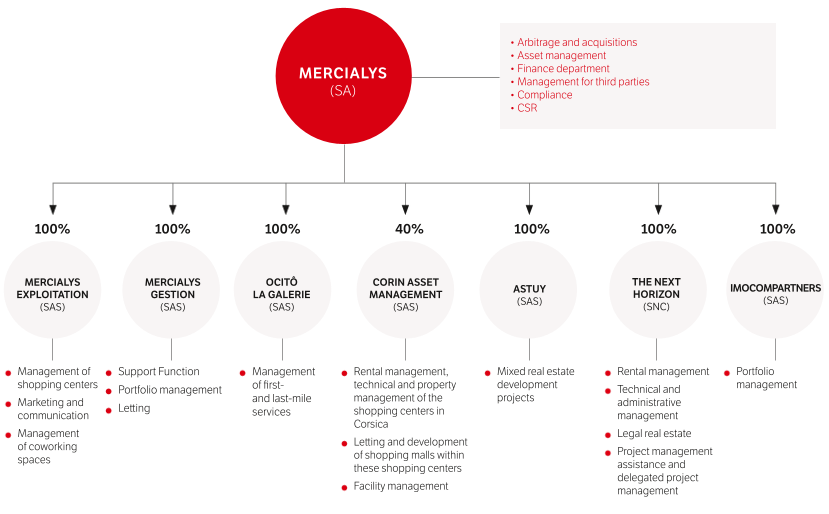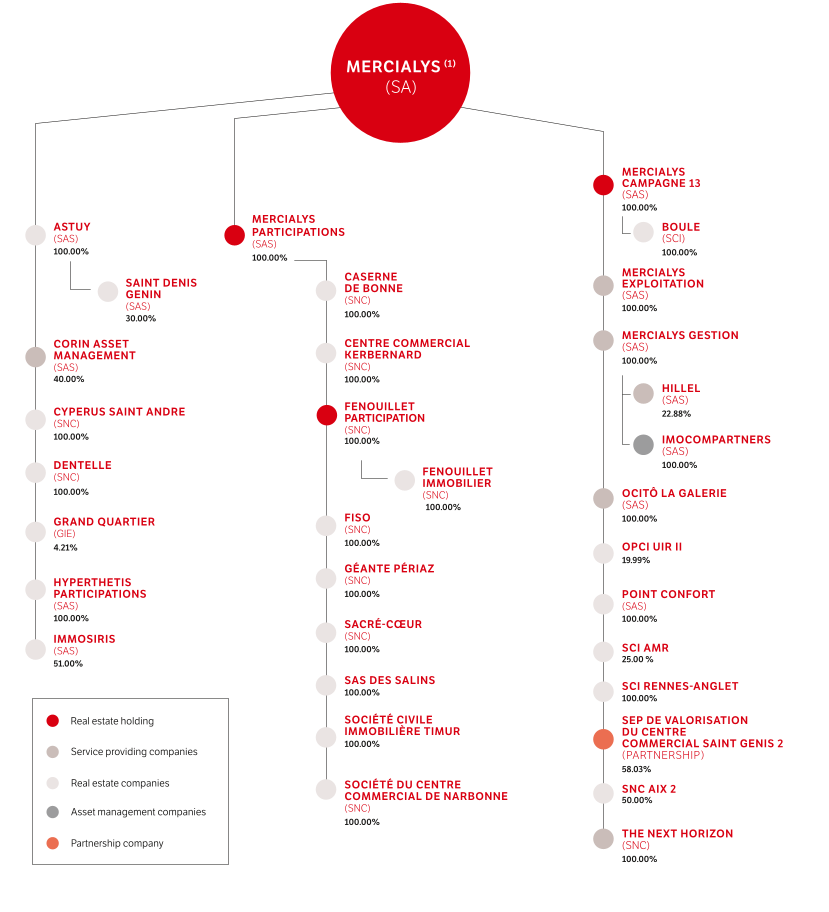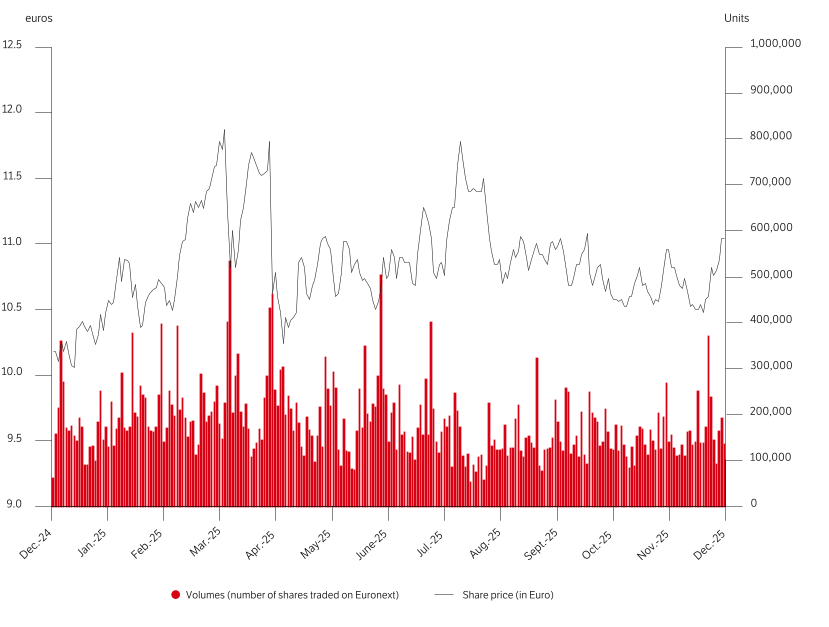
Mercialys_URD_2025 2025
-
-
1.1Activity report
French people’s appetite for consumption continued in 2025, but was even more polarized. Now repositioned in terms of its concept and refocused on leading assets in France’s most dynamic metropolitan areas, Mercialys’ portfolio has become a powerful performance accelerator.
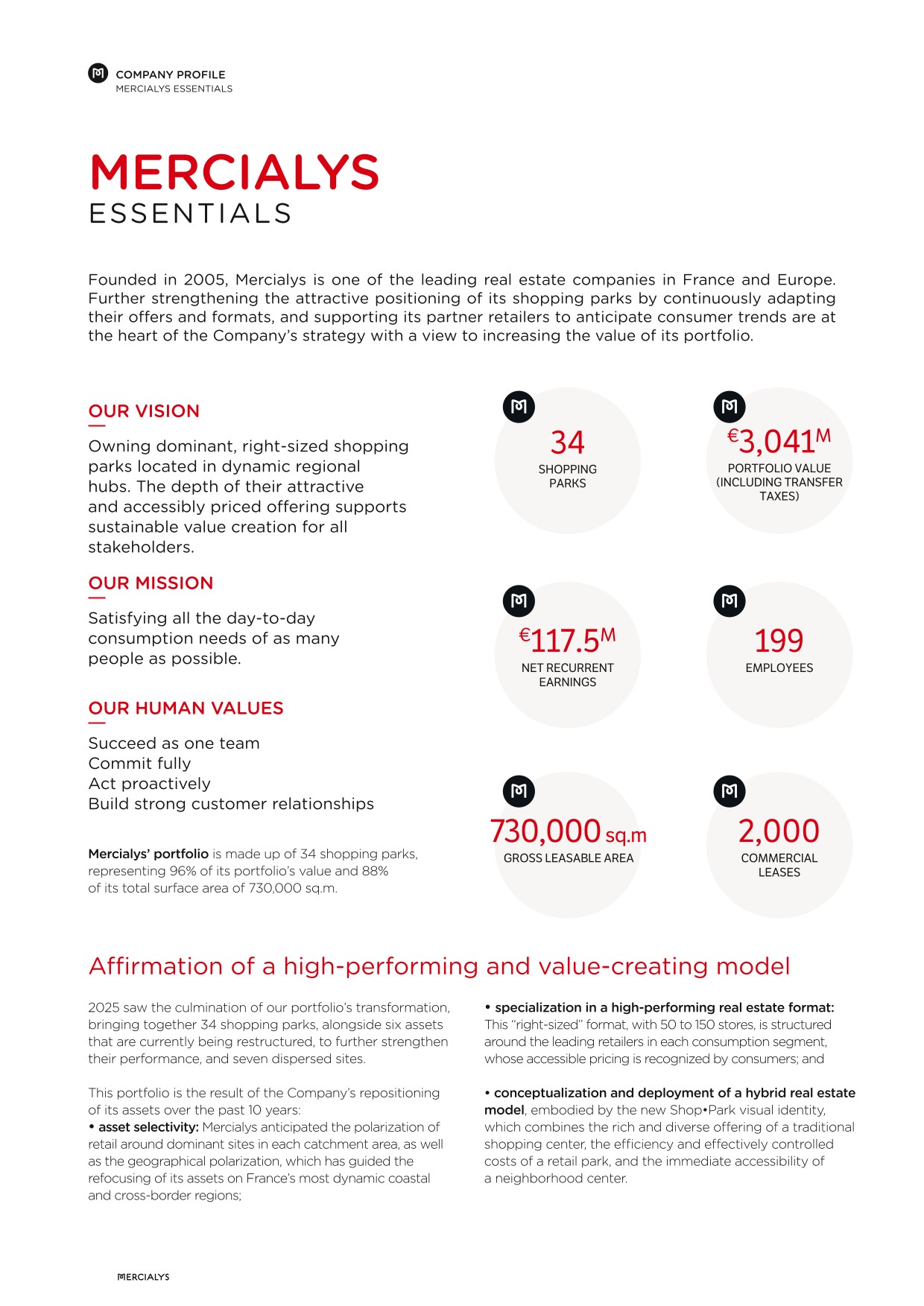
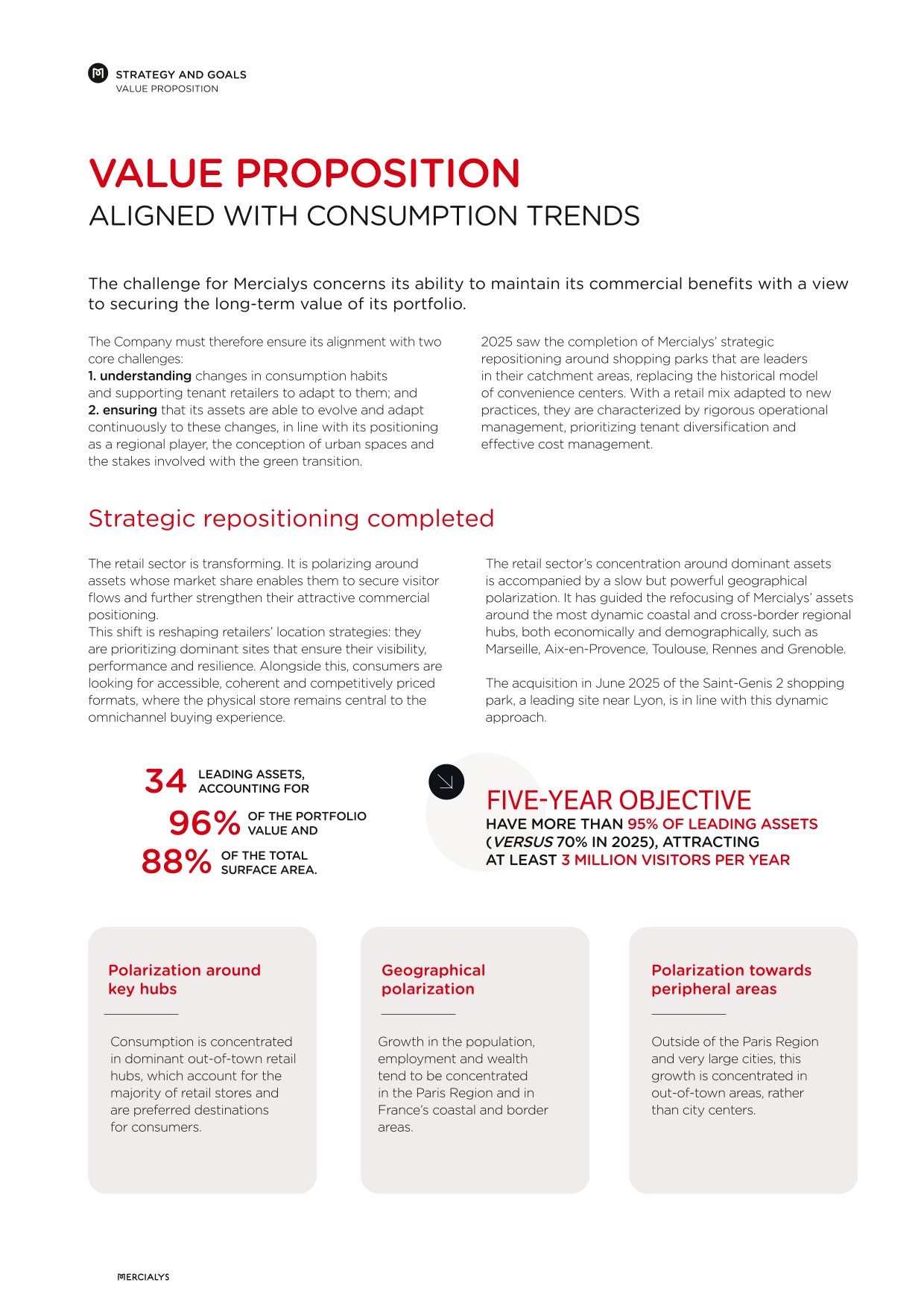
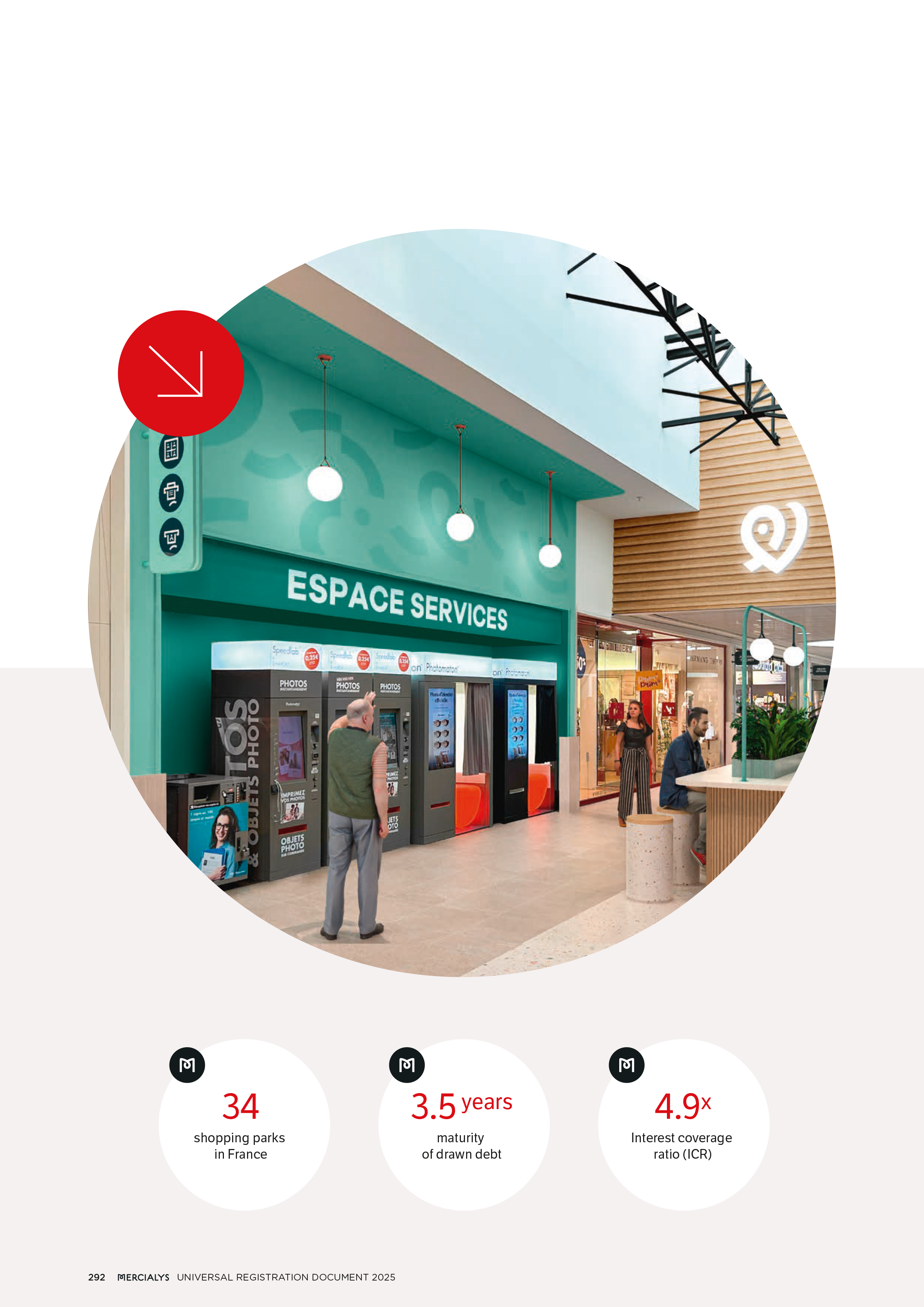
This repositioning was nearly completed in 2025, with a portfolio now comprised of 34 strategic sites that are leaders or co-leaders in their catchment areas, and which represent 96% of the total asset value and 88% of its total surface area.
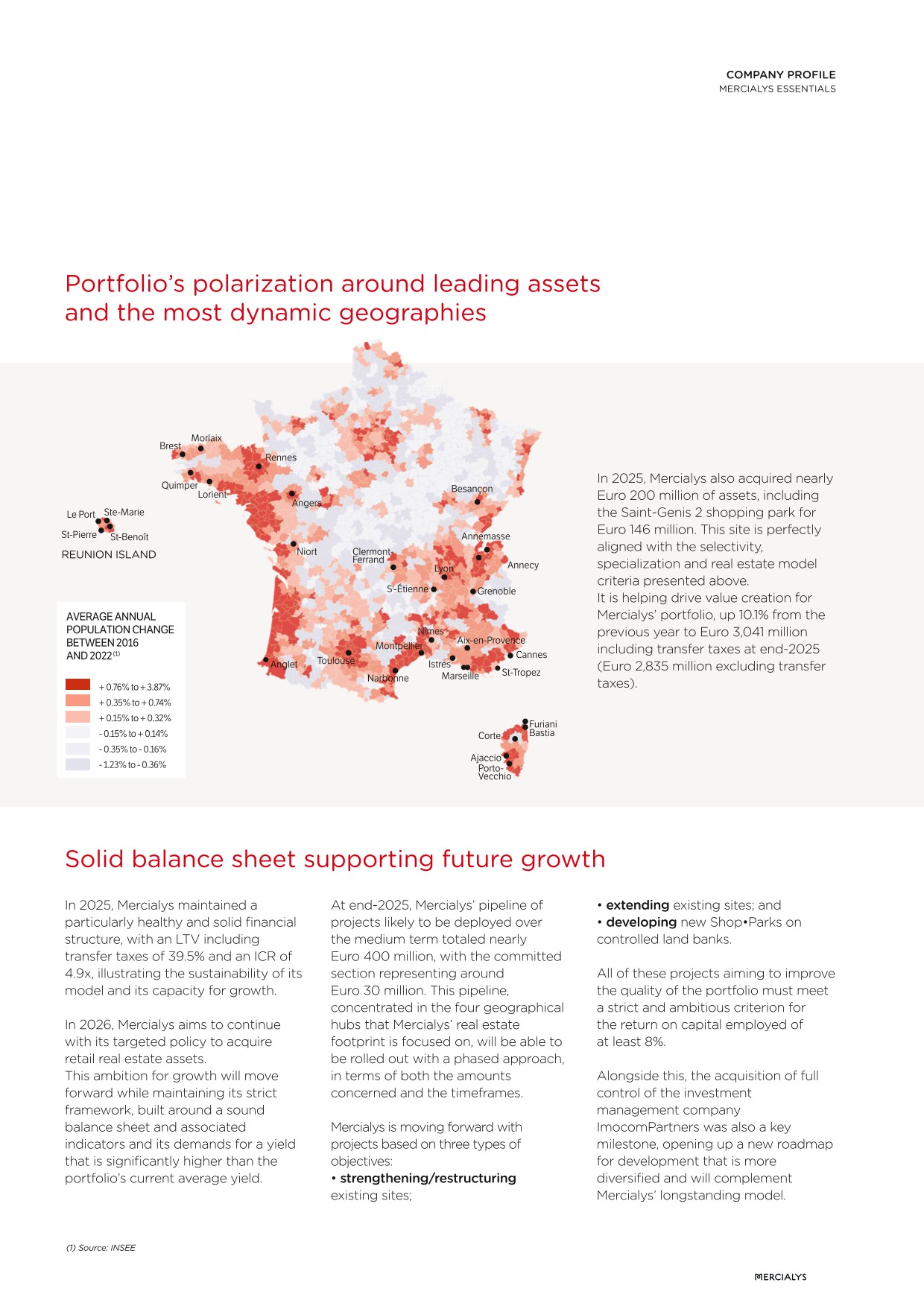
This polarization, which is also geographical, has guided the portfolio refocusing around coastal and cross-border regions in some of France’s most dynamic regional hubs, such as Marseille, Aix-en-Provence, Toulouse, Rennes and Grenoble.
The Group prioritizes assets with a “right-sized” format designed to capture a significant percentage of visitor flows. They include between 50 and 150 retailers, compared with an average of around 15 in traditional convenience centers. Their retail mix is designed around the leading banners in each segment.
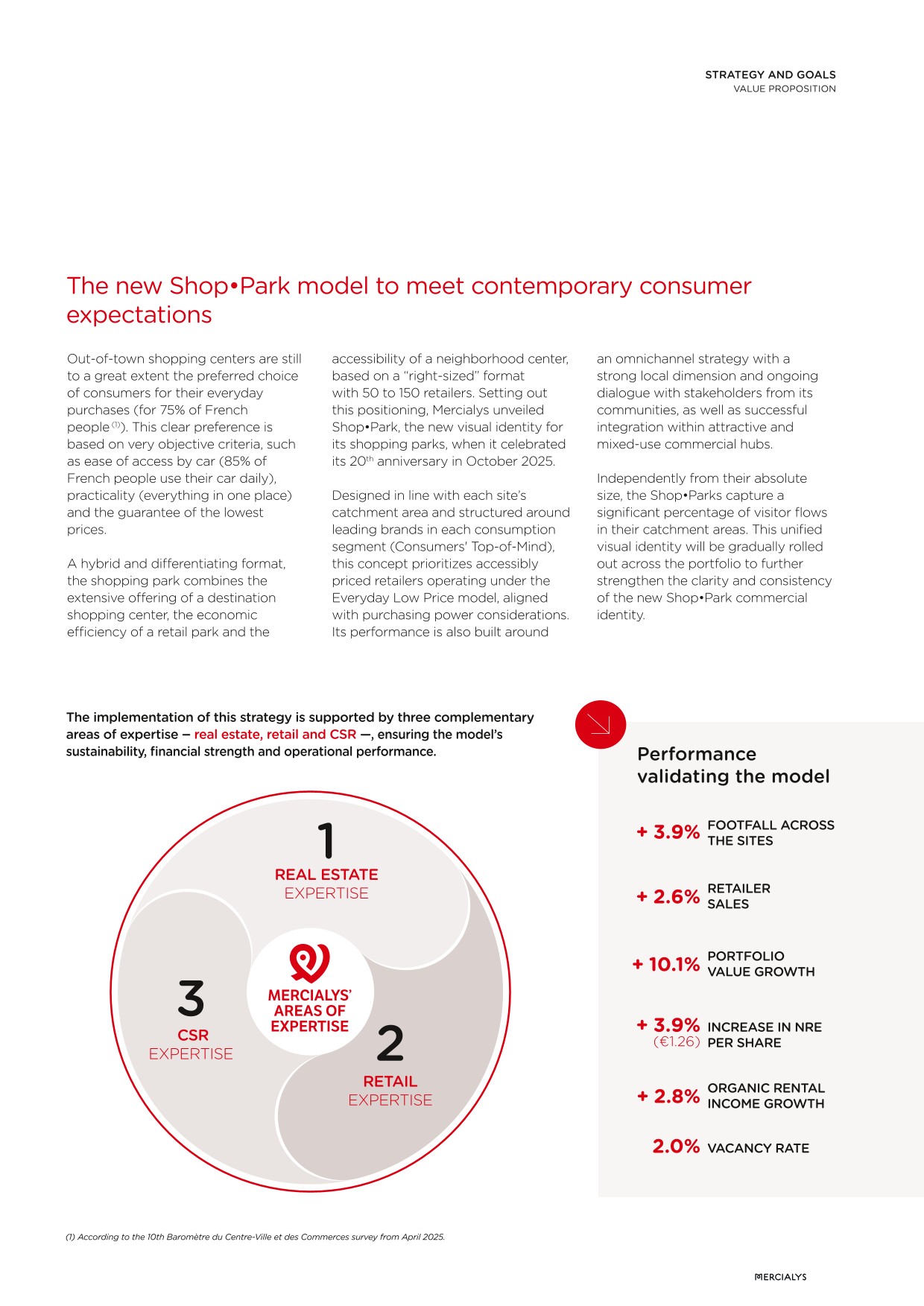
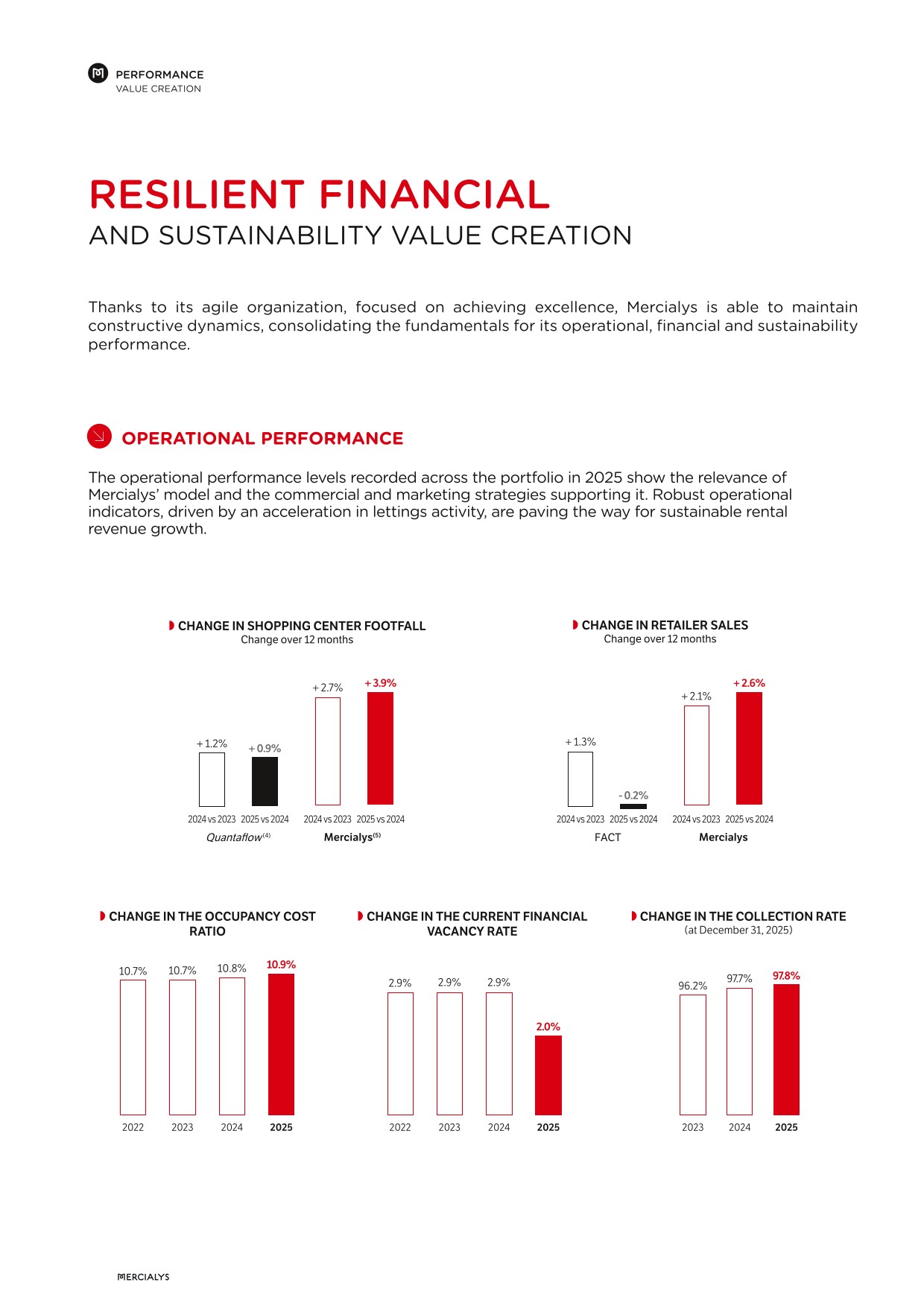
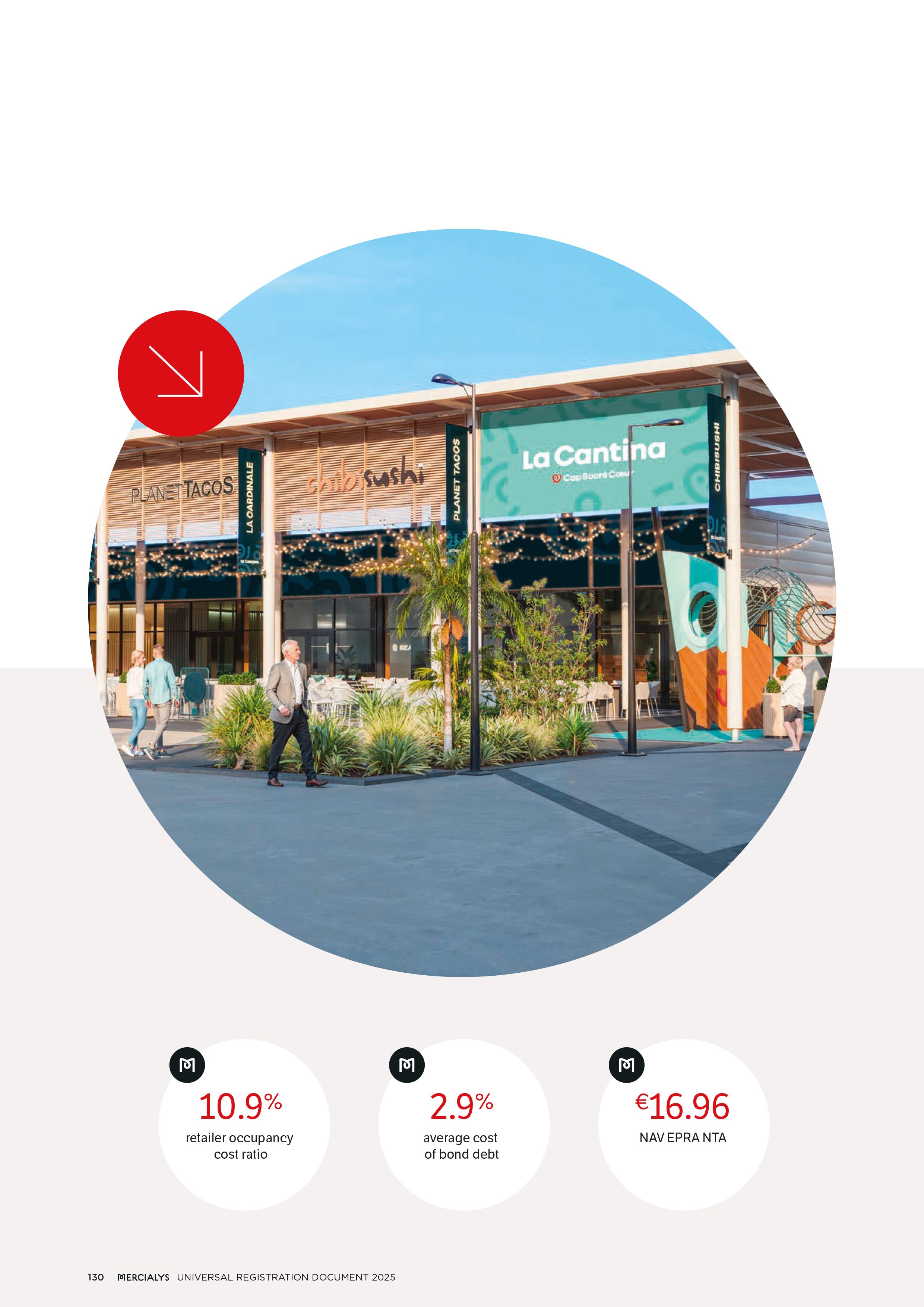
The operational performance levels recorded across the portfolio in 2025 show the relevance of our model and the commercial and marketing strategies supporting it. Footfall across the various sites increased by + 3.9% in 2025, while tenant retailers in our centers recorded sales growth of + 2.6%. These performances helped maintain a very attractive occupancy cost ratio of 10.9% over the year, stable compared with 2024.
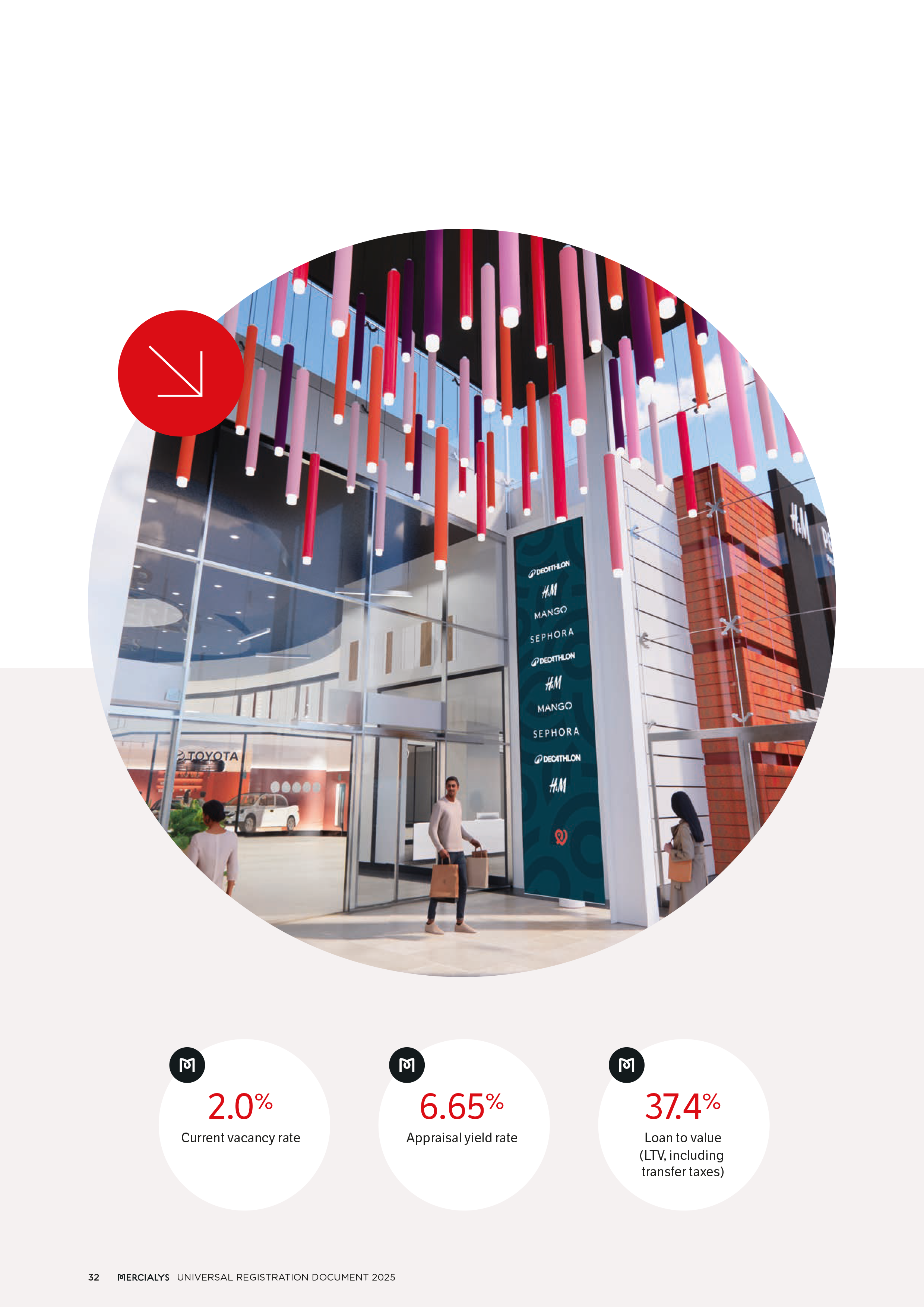
200 lease renewals or relettings were signed in 2025 (+ 10% vs 2024), with a reversion rate of + 2.2%, paving the way for sustainable rental revenue growth. The current financial vacancy rate (1) shows a historically low level of 2.0% at end-December 2025.
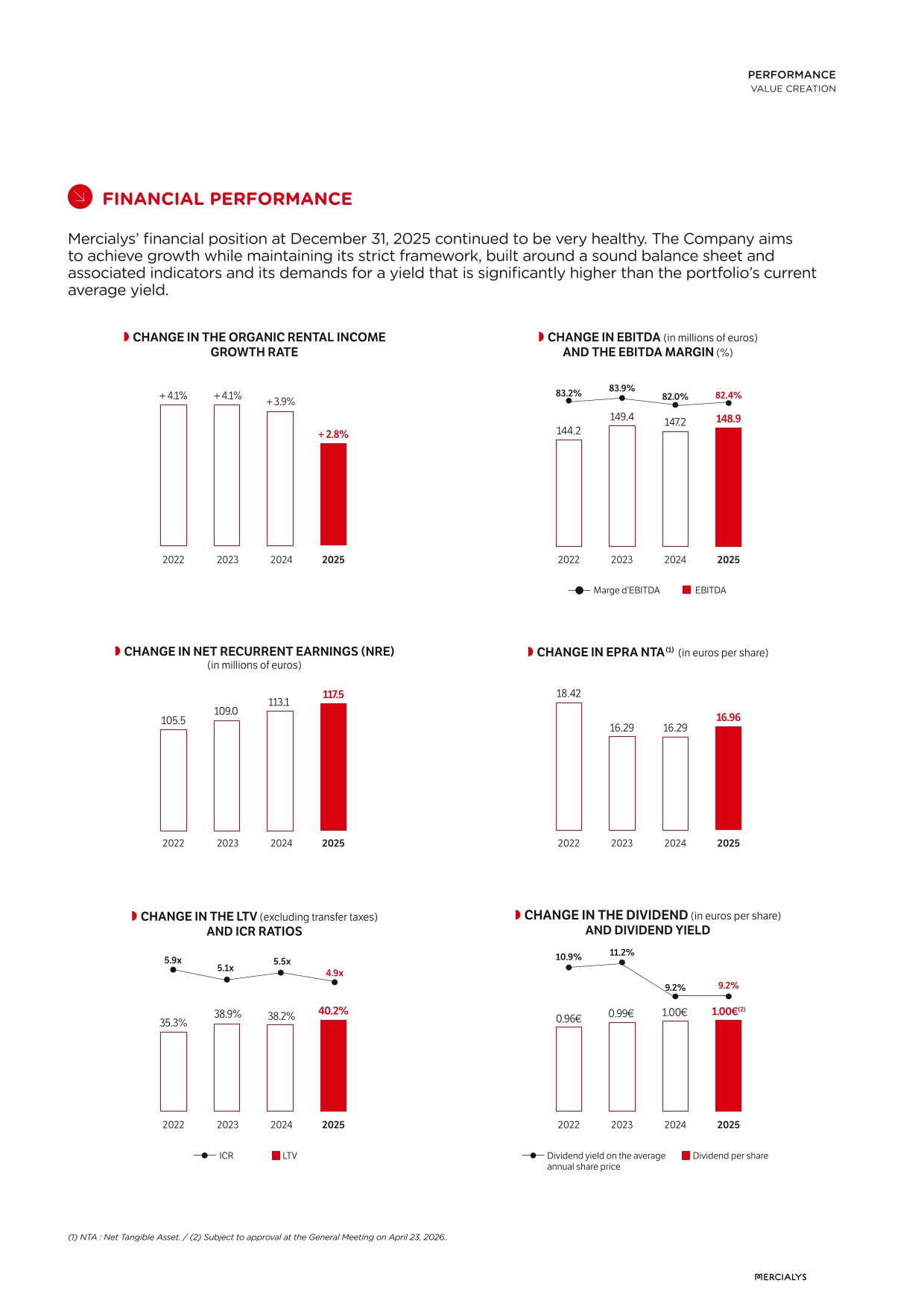
Invoiced rents increased by + 0.5% to Euro 180.1 million, benefiting from sustained organic growth of + 2.8%. Rental revenues climbed to Euro 180.6 million, up + 0.6%.
EBITDA came to Euro 148.9 million, up + 1.2% from 2024, factoring in the acquisition of the Saint-Genis 2 center in June 2025, offset by the disposals completed during the second half of 2024. The EBITDA margin remains high at 82.4% (+ 40bp vs 2024).
Net recurrent earnings (NRE) totaled Euro 117.5 million (+ 3.9% vs 2024). NRE is also up + 3.9% per share to Euro 1.26 (2), at the upper end of the revised guidance range, announced halfway through the year, for Euro 1.24 to Euro 1.27 per share.
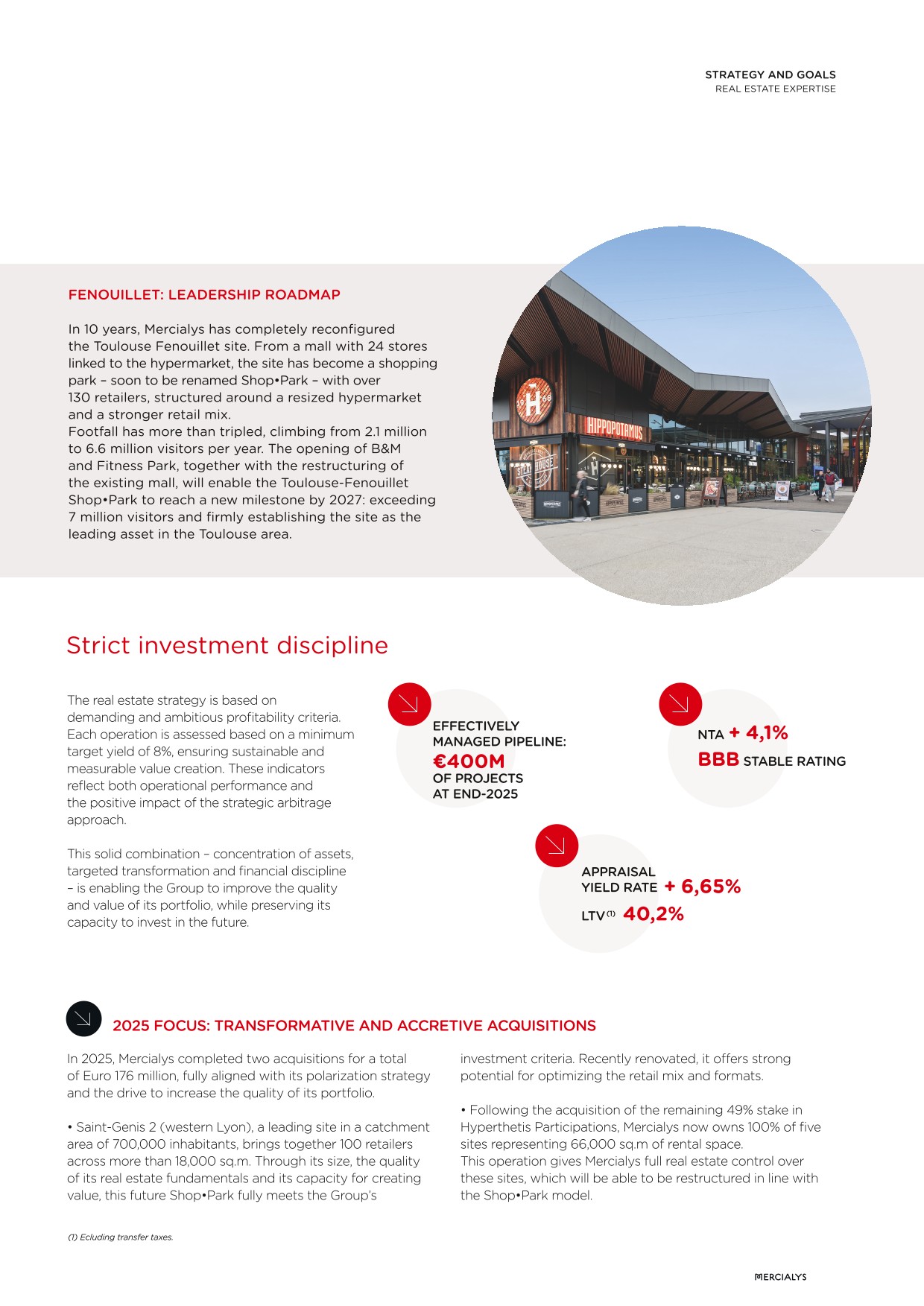
The asset acquisitions completed, as detailed below, for a net total of Euro 189 million, nevertheless enabled the Company to maintain its core balance sheet positions: the LTV ratio excluding transfer taxes (3) was 40.2% at December 31, 2025 (compared with 38.2% at December 31, 2024), well below the banking covenant level of 55% for the confirmed bank lines. The LTV ratio including transfer taxes was 37.5% (versus 35.7% at December 31, 2024). The ICR (4) was 4.9x at December 31, 2025, compared with 5.5x at December 31, 2024, significantly higher than the minimum level of at least 2x set by the bank covenants. On October 17, 2025, Standard & Poor’s confirmed its BBB/stable outlook rating for Mercialys. This solid balance sheet will enable the Company to replicate this investment strategy in 2026.
The portfolio value came to Euro 3,041.1 million including transfer taxes, up + 10.1% over 12 months on a current basis. The appraisal value including transfer taxes is up + 2.1% like-for-like, with the positive impact of rental income (+ 2.0%) offsetting the impact of a slight increase in rates.
The average appraisal yield rate was 6.65% at December 31, 2025, stable over 12 months. This change shows a positive yield spread of more than 300bp compared with the risk-free rate (10-year OAT) at end-December.
EPRA Net Tangible Assets (NTA) came to Euro 16.96 per share (5), up 8.5% over six months and 4.1% over 12 months.
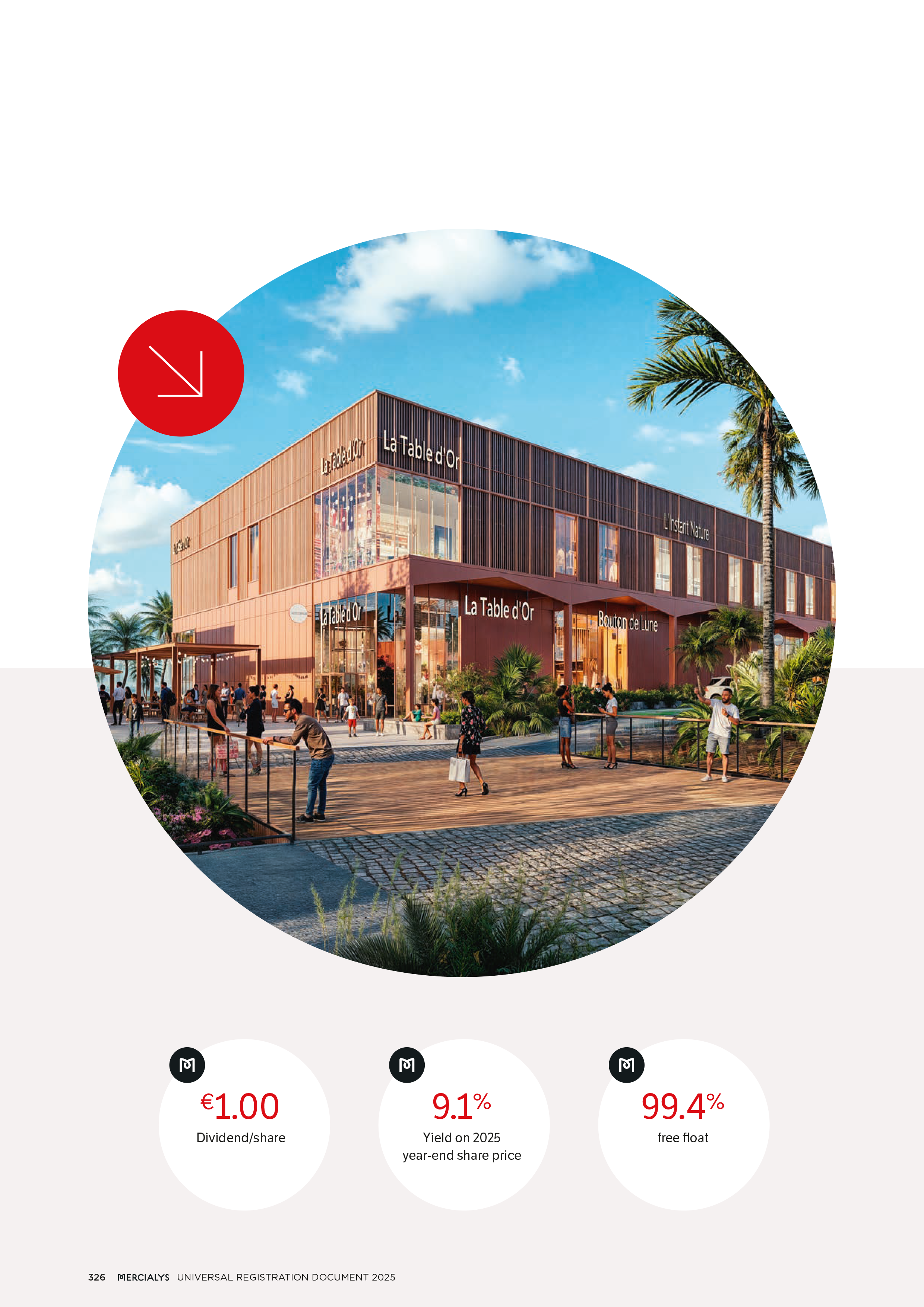
In view of all of these elements, Mercialys’ Board of Directors is submitting a proposal at the General meeting on April 23, 2026 for a dividend of Euro 1.00 per share for 2025, identical to the dividend paid out last year. The payout corresponds to 80% of 2025 NRE. The dividend offers a yield of 5.9% on the NTA of Euro 16.96 per share and 9.1% on the year’s closing price.
This proposed dividend is based on the distribution requirement with the SIIC tax status concerning exempt profits from:
- ●property rental or sub-letting operations (including dividends paid by the subsidiaries subject to the SIIC system), i.e. Euro 0.73 per share;
- ●the distribution of exempt income recorded on the Company’s balance sheet for Euro 0.27 per share.
1.1.1Affirmation of a high-performing model
Our transformation from convenience center to Shop•Park
Mercialys anticipated very early on the polarization of retail around leading sites in each catchment area and rolled out a deep transformation of its real estate model by successfully moving away from the convenience center segment.
The retail sector’s concentration around dominant assets is accompanied by a slow but powerful geographical polarization. It has guided the refocusing of Mercialys’ assets around the most dynamic coastal and cross-border regional hubs, such as Marseille, Aix-en-Provence, Toulouse, Rennes and Grenoble.
With 34 sites that are leaders or co-leaders in their catchment areas representing 96% of the portfolio value and 88% of its total surface area, Mercialys aims, within the next five years, to have more than 95% of its assets attracting at least 3 million visitors per year (versus 70% in 2025).
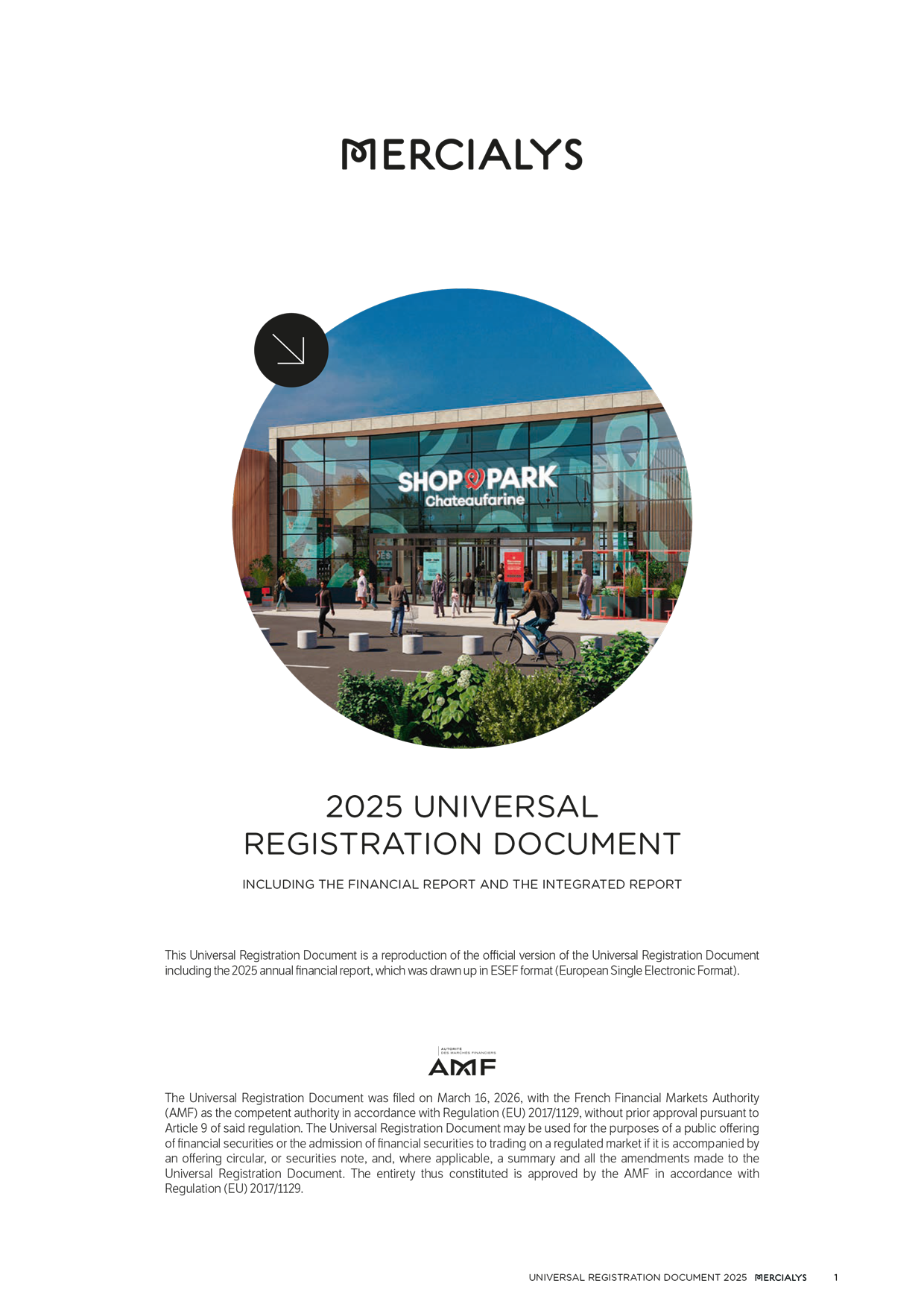
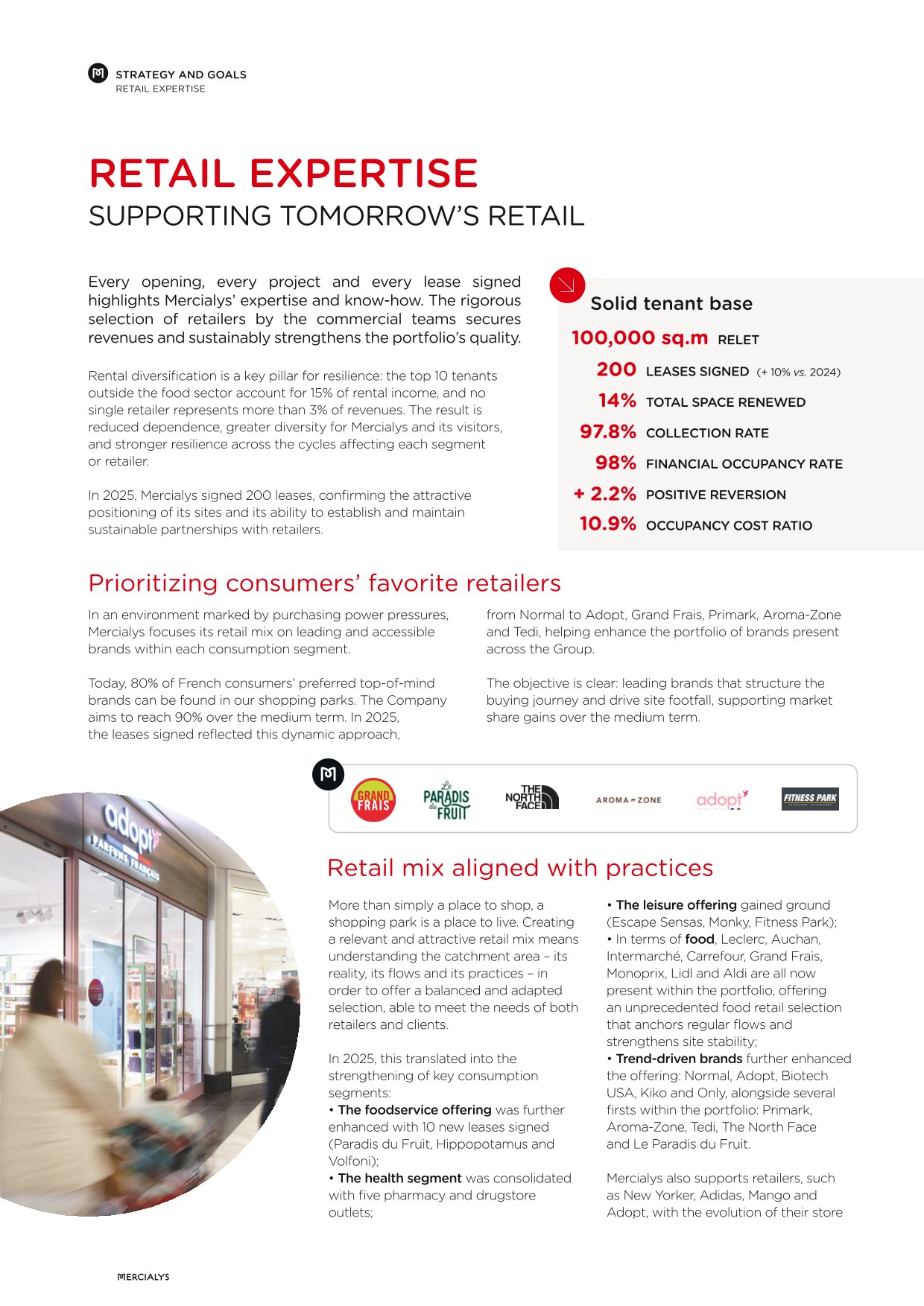
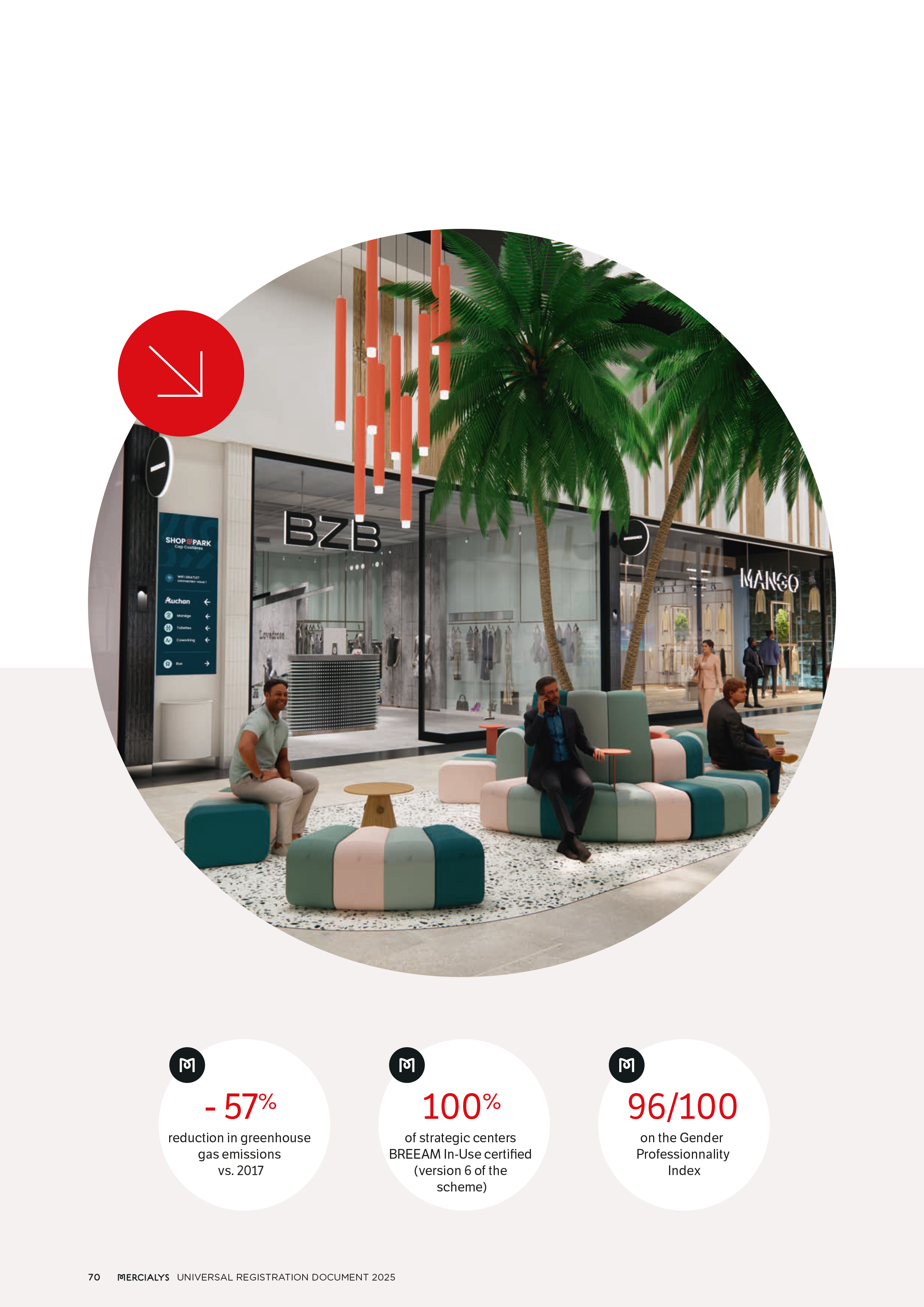
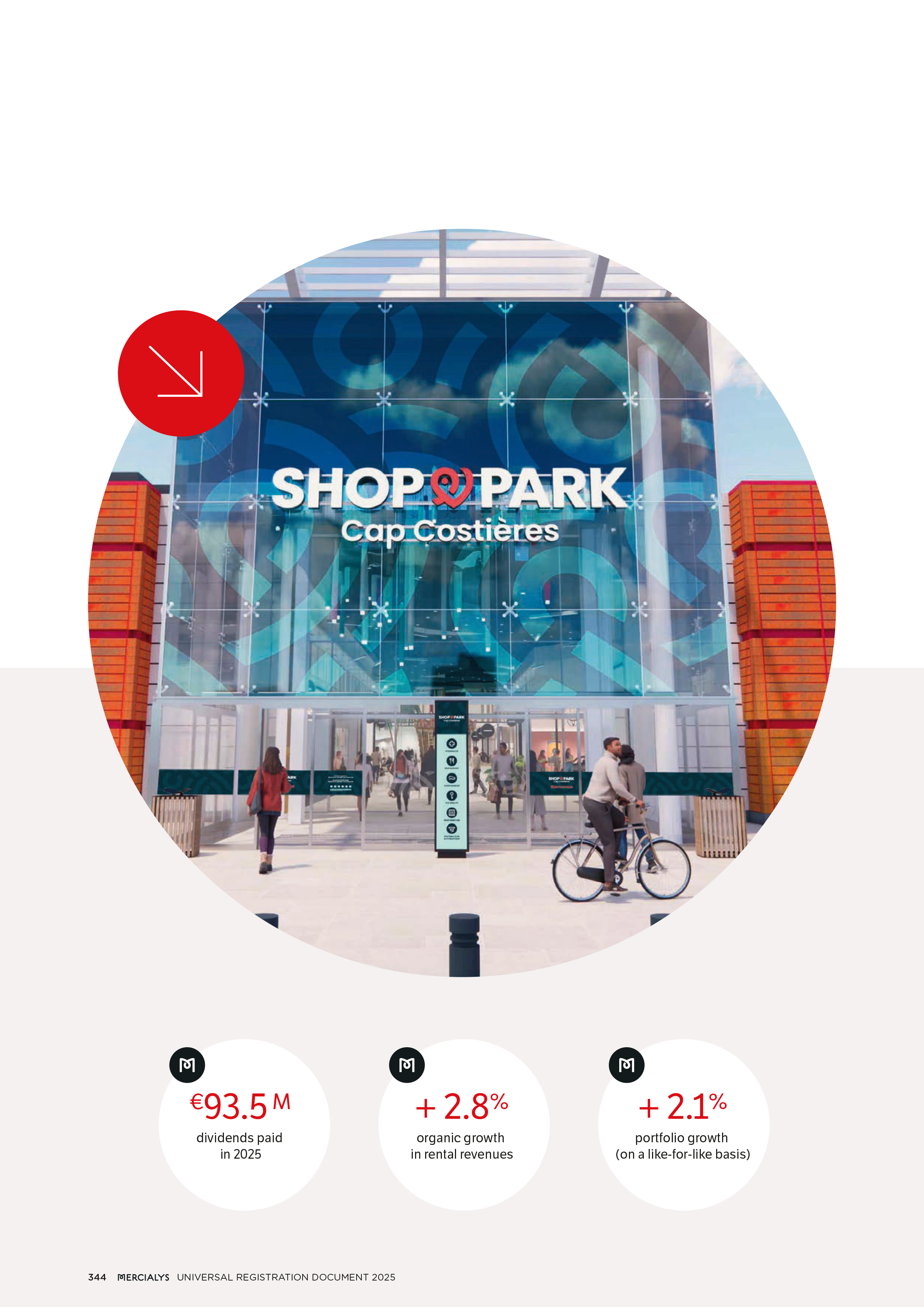
To support this retail and real estate evolution, Mercialys has developed a pioneering hybrid format, which it has rolled out across the French market. Its new Shop•Park visual identity was unveiled when it celebrated its 20th anniversary in October. The Shop•Park concept combines the extensive and diverse offering of a shopping mall, the economic efficiency and effectively controlled costs of a retail park, and the immediate accessibility of a neighborhood center.
The Group prioritizes assets that meet contemporary expectations: clarity of the offering, speed of the customer journey, protection of purchasing power, and strong local roots, with a “right-sized” format designed to attract consumers’ favorite brands to capture a significant percentage of visitor flows. Our Shop•Park include between 50 and 150 retailers, compared with an average of around 15 in traditional convenience centers, and their retail mix is designed around the leading banners in each segment.
The focus across the portfolio continues to be retailers that are renowned for their accessible pricing, a catalyst for purchases, and is built around a targeted commercial strategy in line with consumption habits and their evolution.
- ●renewing the foodservice offering, with more than 10 new leases signed: Paradis du Fruit (first in the portfolio), Hippopotamus (x2), Volfoni (first), Dreams Donuts, Miss Cookies and Club Café;
- ●diversifying the range of grocery retailers: Grand Frais, Leclerc and Lidl (x2). 2025 was marked by the finalization of the full rotation of the food operators anchoring Mercialys’ shopping parks;
- ●ramping up the healthcare offering: five pharmacy and drugstore outlets signed;
- ●developing a diverse leisure offering: Escape Sensas, Monky and Fitness Park across more than 10,000 sq.m;
- ●supporting current trends for discount fashion, beauty and pet retail: Primark (first in the portfolio), Aroma-Zone (first), Tedi (first), Only, The North Face (first), Normal (x4), Adopt (x3), Biotech USA and Kiko;
- ●supporting changes in formats among retailers: New Yorker, Adidas, Mango and Adopt.
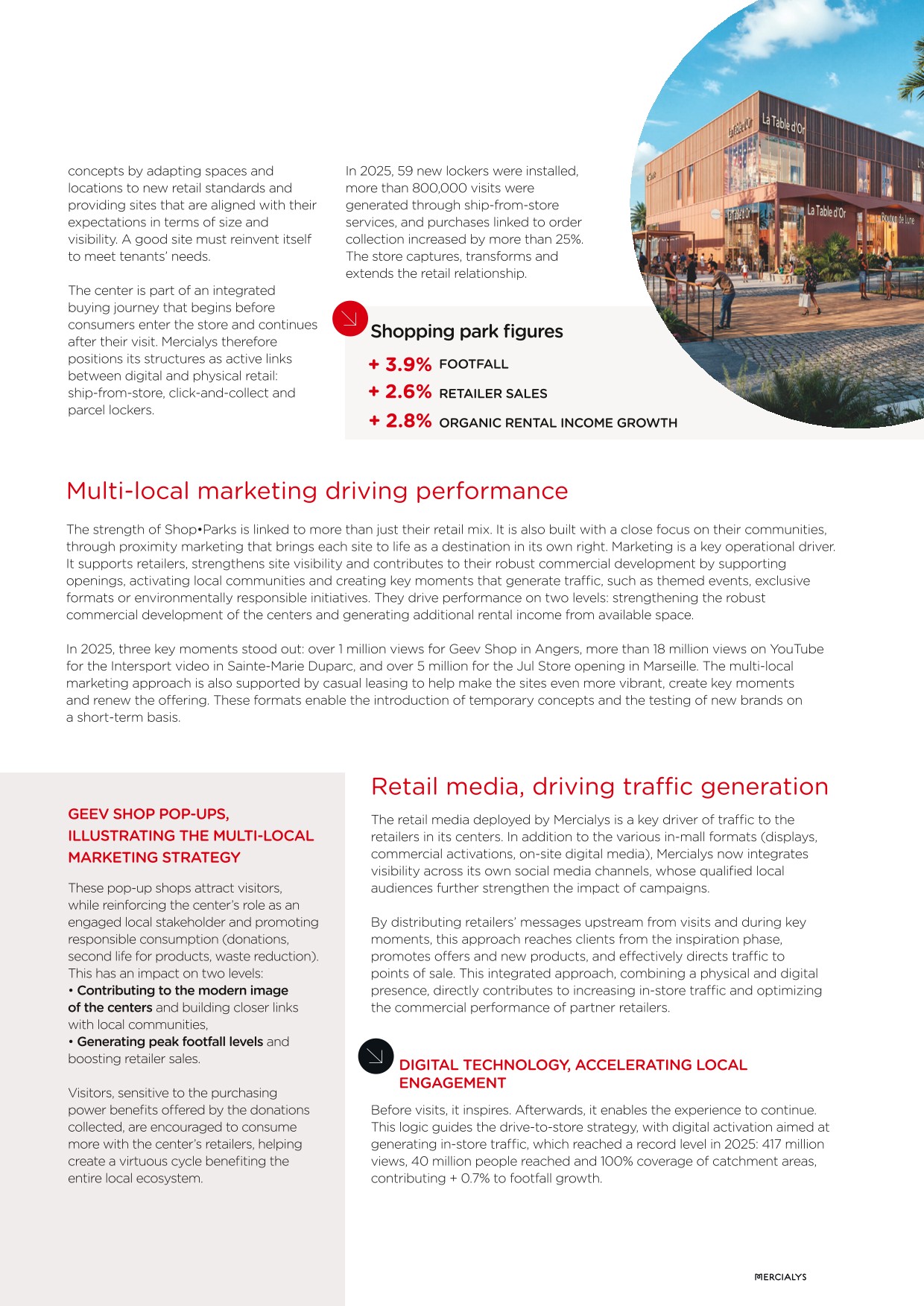
These commercial operations are benefiting from the support of a multi-local marketing approach on social media, which proved its effectiveness in 2025 by generating 417 million views, a record level of digital visibility for Mercialys. Illustrating this capacity to make an impact, the Geev Shop operation in Angers achieved more than one million views locally, with over 18 million views on YouTube for the Intersport store in Sainte Marie Duparc, and more than five million views for the Jul Store opening in Marseille.
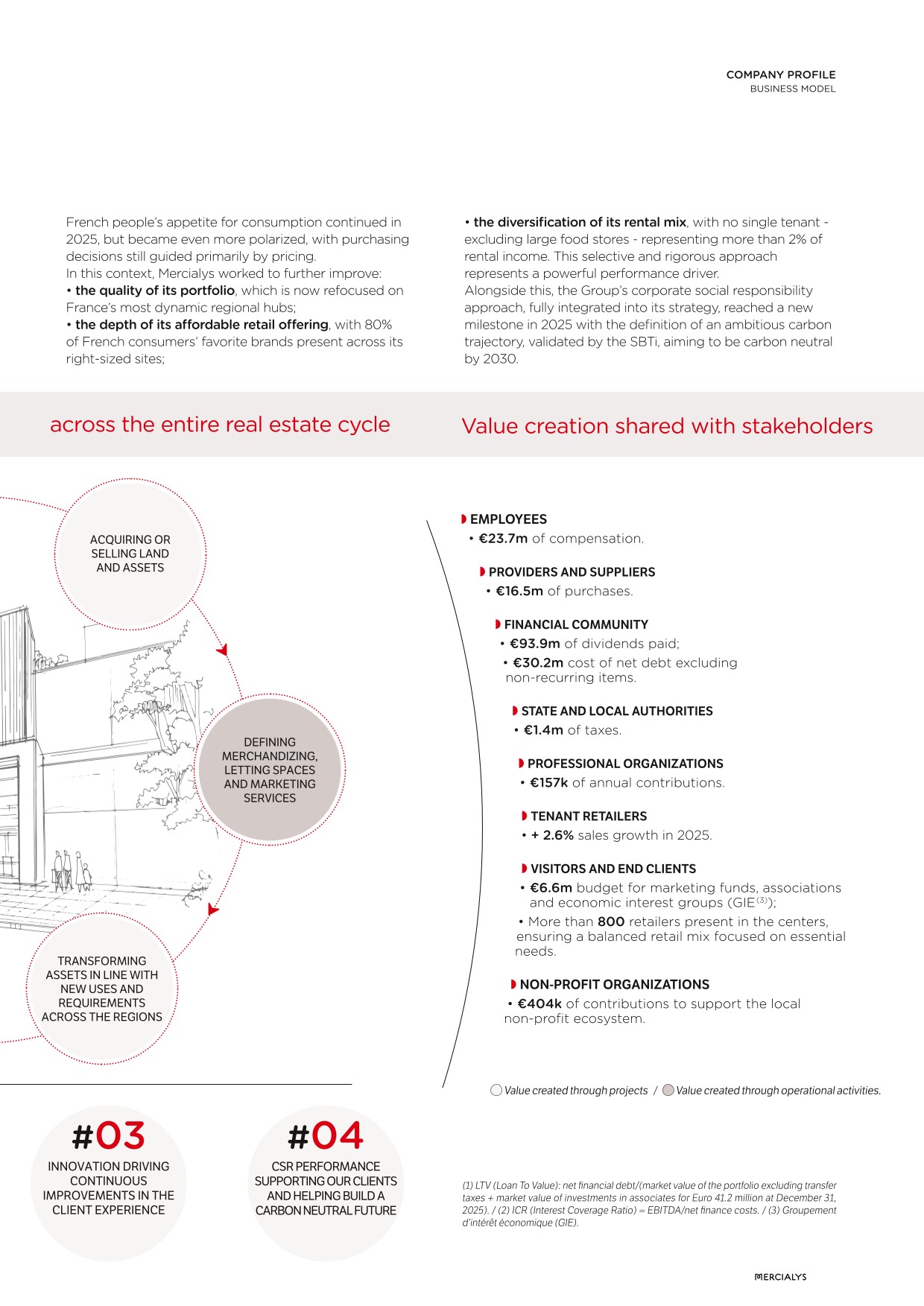
Our Shop•Park concept brings together the core pillars for sustainable outperformance
The operational performance levels recorded across the portfolio in 2025 show the relevance of our model and the commercial and marketing strategies supporting it:
- ●footfall at sites across our portfolio increased by + 3.9% over 12 months to end-December 2025, outperforming the change in the Quantaflow national panel (up + 0.9%) by + 300bp;
- ●Shop•Park retailer sales increased by + 2.6% over 12 months, significantly outperforming the FACT national index (down - 0.2%) by + 280bp;
- ●the occupancy cost ratio is stable at 10.9%;
- ●the diversification of the portfolio ensures structural resilience: the top 10 tenants (excluding food retail) account for 15% of rental income, and no single retailer is intended to represent more than 3% of rents.
Robust operational indicators, driven by an acceleration in lettings activity (+ 10% vs 2024), are paving the way for sustainable rental revenue growth:
- 1.organic growth in invoiced rents came to + 2.8% (6);
- 2.the 2025 reversion rate increased year-on-year to + 2.2% on the 200 leases signed during the year;
- 3.the current financial vacancy rate (7) shows a historically low level of 2.0% at end-December 2025.
- 4.the collection rate for rent and charges at end-December 2025 reached a record level of 97.8%.
Business model ensuring sustainable NRE growth
Invoiced rents increased by + 0.5% to Euro 180.1 million, benefiting from sustained organic growth, partially offset by the prorata impact of asset disposals completed in 2024. Rental revenues climbed to Euro 180.6 million, up + 0.6%.
EBITDA came to Euro 148.9 million, up + 1.2% from 2024, factoring in the acquisition of the Saint-Genis 2 shopping center in June 2025, offset by the disposals completed during the second half of 2024. The EBITDA margin remains high at 82.4% (+ 40bp vs 2024).
Net recurrent earnings (NRE) totaled Euro 117.5 million (+ 3.9% vs 2024). NRE is also up + 3.9% per share to Euro 1.26, at the upper end of the revised guidance range, announced halfway through the year, for Euro 1.24 to Euro 1.27 per share.
(In thousands of euros)
12/31/2024
12/31/2025
Change (%)
Invoiced rents
179,151
180,084
+ 0.5%
Rental revenues
179,534
180,591 (1)
+ 0.6%
Net rental income
172,314
170,498
- 1.1%
EBITDA
147,162
148,895
+ 1.2%
EBITDA margin (% of rental revenues)
82.0%
82.4%
Net recurrent earnings (2)
113,129
117,505
+ 3.9%
Net recurrent earnings per share (€)
1.21
1.26
+ 3.9%
- (1)Pro forma rental revenues in 2025 amounted to Euro 182.6 million, up 1.7% compared to 2024. Reported revenue for 2025 was negatively impacted by a temporary loss of rental income at the Brest and Niort sites, related to early lease terminations. This loss has been fully offset against compensation, which also covers the period of work carried out by the new lessees. This compensation is recognized in other operating items, in accordance with IFRS accounting rules. The new rental income on the re-let spaces will take effect in 2026 and 2027 after the units have been fitted out for the new stores.
- (2)Net recurrent earnings = net income attributable to owners of the parent before amortization, gains or losses on disposals net of associated fees, any asset impairment and other non-recurring effects.
-
1.2Financial report
Pursuant to regulation (EC) No. 1606/2002 of July 19, 2002, the Mercialys group’s consolidated financial statements were prepared in accordance with International Financial reporting Standards (IFRS) issued by the International Accounting Standards Board (IASB) as adopted by the European Union and applicable at December 31, 2025. These standards are available on the European Commission website at: https://finance.ec.europa.eu/capital-markets-union-and-financial-markets/company-reporting-and-auditing/company-reporting/financial-reporting_en.
The accounting policies set out below were applied consistently to all the periods presented in the consolidated financial statements, after taking into account, or with the exception of, the new standards and interpretations described below.
1.2.1Financial statements
1.2.1.1Consolidated income statement
(In thousands of euros)
12/31/2025
12/31/2024
Rental revenues
180,591
179,534
Service charges and property tax
(47,208)
(47,639)
Charges and taxes billed to tenants
40,734
41,631
Net property operating expenses
(3,620)
(1,212)
Net rental income
170,498
172,314
Management, administrative and other activities income
7,852
3,239
Other income
1
2
Other expenses
(5,784)
(7,867)
Personnel expenses
(23,672)
(20,526)
Depreciation and amortization
(38,775)
(37,828)
Reversals of/(Allowances for) provisions
5,027
(901)
Other operating income
7,413
154,721
Other operating expenses
(43,781)
(161,009)
Operating income
78,779
102,145
Income from cash and cash equivalents
9,528
6,727
Gross finance costs
(48,529)
(51,243)
(Expenses)/ Income from net financial debt
(39,002)
(44,516)
Other financial income
2,357
947
Other financial expenses
(5,044)
(3,472)
Net financial items
(41,688)
(47,041)
Tax expense
(1,128)
(793)
Share of net income from associates and joint ventures
916
2,432
Consolidated net income
36,879
56,742
Attributable to non-controlling interests
2,914
2,983
Attributable to owners of the parent
33,964
53,759
Earnings per share (1)
Net income attributable to owners of the parent (€)
0.36
0.58
Diluted net income attributable to owners of the parent (€)
0.36
0.58
- (1)Based on the weighted average number of shares over the period adjusted for treasury shares.
- Undiluted weighted average number of shares in 2025 = 93,447,418 shares.
- Fully diluted weighted average number of shares in 2025 = 93,447,418 shares.
1.2.1.2Consolidated statement of financial position
Assets
(In thousands of euros)
12/31/2025
12/31/2024
Goodwill
11,470
-
Intangibles
12,390
3,424
Property, plant and equipment other than investment property
9,082
7,445
Investment property
1,692,018
1,720,595
Right-of-use assets
143,493
14,784
Investments in associates
32,409
40,315
Other non-current assets
32,161
30,604
Deferred tax assets
1,326
1,700
Non-current assets
1,934,348
1,818,867
Trade receivables
27,853
30,766
Other current assets
27,879
27,048
Cash and cash equivalents
435,319
283,653
Investment property held for sale
7,721
-
Current assets
498,772
341,467
Total assets
2,433,120
2,160,334
Equity and liabilities
(In thousands of euros)
12/31/2025
12/31/2024
Share capital
93,887
93,887
Additional paid-in capital, treasury shares and other reserves
501,203
537,179
Equity attributable to owners of the parent
595,089
631,065
Non-controlling interests
71,435
130,957
Shareholders’ equity
666,524
762,022
Non-current provisions
1,453
1,390
Non-current financial liabilities
1,234,560
1,237,529
Deposits and guarantees
32,050
29,424
Non-current lease liabilities
74,570
13,991
Other non-current liabilities
3,462
4,675
Non-current liabilities
1,346,095
1,287,010
Trade payables
8,989
10,916
Current financial liabilities
360,042
50,765
Current lease liabilities
6,657
1,204
Current provisions
14,682
16,644
Other current liabilities
30,112
31,384
Current tax liabilities
17
390
Current liabilities
420,500
111,303
Total equity and liabilities
2,443,120
2,160,334
1.2.1.3Consolidated cash flow statement
(In thousands of euros)
12/31/2025
12/31/2024
Net income attributable to owners of the parent
33,964
53,759
Non-controlling interests
2,914
2,983
Consolidated net income
36,879
56,742
Depreciation, amortization (1) and provisions, net of reversals
71,472
31,049
Calculated expenses/(income) relating to stock options and similar
843
880
Other calculated expenses/(income) (2)
(1,207)
192
Share of net income from associates and joint ventures
(916)
(2,432)
Dividends received from associates and joint ventures
2,674
3,687
Income from asset disposals
1,748
13,410
Expenses/(income) from net financial debt
39,002
44,516
Net financial interest in respect of lease agreements
2,020
360
Tax expense (including deferred tax)
1,128
793
Cash flow
153,643
149,197
Taxes received/(paid)
(1,612)
(707)
Change in working capital requirement relating to operations, excluding deposits and guarantees (3)
2,379
8,555
Change in deposits and guarantees
2,616
4,489
Net cash flow from operating activities
157,027
161,535
Cash payments on acquisitions of:
- ●investment properties and other fixed assets
(101,752)
(28,780)
- ●non-current financial assets
(281)
(19)
Cash receipts on disposals of:
- ●investment properties and other fixed assets
-
131,202
- ●non-current financial assets
1,004
945
Investments in associates and joint ventures
-
(1,127)
Impact of changes in scope with change of control
(26,005)
-
Change in loans and advances granted
-
-
Net cash flow from investing activities
(127,035)
102,220
Dividends paid to shareholders of the parent company (final)
(93,462)
(92,643)
Dividends paid to shareholders of the parent company (interim)
-
-
Dividends paid to non-controlling interests
(15,054)
(60,897)
Capital increase and reduction
-
-
Other transactions with shareholders
(29,561)
-
Changes in treasury shares
1,469
(3,408)
Increase in borrowings and financial debt
506,468
518,707
Decrease in borrowings and financial debt
(210,000)
(422,000)
Repayment of lease liabilities
(3,942)
(1,356)
Interest received (4)
19,378
21,102
Interest paid
(53,622)
(57,762)
Net cash flow from financing activities
121,674
(98,257)
Change in cash position
151,666
165,498
Net cash at beginning of period
283,653
118,155
Net cash at end of period
435,319
283,653
- ●of which cash and cash equivalents
435,319
283,653
- ●of which bank overdrafts
-
-
(1) Depreciation and amortization exclude the impact of impairments on current assets
(2) Other calculated expenses and income mainly comprise:
● discounting adjustments to construction leases
(154)
(197)
● lease rights received from tenants and spread over the firm term of the lease
(206)
200
● deferred financial expenses
726
666
● interest on non-cash loans and other financial income and expenses
(1,758)
(758)
(3) The change in working capital requirement breaks down as follows:
● trade receivables
5,097
5,170
● trade payables
(2,088)
1,651
● other receivables and payables
(629)
1,734
Total working capital requirement
2,379
8,555
(4) Primarily comprising interest received on debt hedging instruments in accordance with IAS 7.16.
-
1.3Real estate portfolio
1.3.1Portfolio valued at Euro 3,041.1 million including transfer taxes at December 31, 2025
1.3.1.1Experts and methodology
The shopping parks owned by Mercialys are appraised by experts in accordance with the Royal Institution of chartered Surveyors (RICS) Code of Ethics, appraisal and valuation standards, using the fair value appraisal methods recommended by the 1998 Property Appraisal and Valuation Charter and the 2000 report published by the joint working group of the Commission des Opérations de Bourse (COB) and the Conseil National de la Comptabilité (CNC) on property asset valuations for listed companies.
Mercialys also complies with the Code of Ethics for French REITs (Sociétés d’Investissement Immobilier Cotées – SIIC) in terms of the rotation of appraisers. In accordance with the AMF recommendations concerning the rotation of real estate appraisers, Mercialys launched a call for tenders in 2024 covering 12% of the assets to be valued. This followed the call for tenders issued in 2022, covering 83% of the assets to be valued. This led to the appointment of new appraisers, which began working during the second half of 2024. The appraisers’ fees are determined based on the number and size of the assets to be valued when signing the three-year contract.
All of the assets in Mercialys’ portfolio have been valued, with those undergoing full appraisals subject to town planning surveys, market and competition studies, and site visits. In accordance with the 2000 COB/CNC report, two methods have been used to determine the fair value of each asset:
- ●first, the capitalization of income method, which involves taking the rental income generated by the asset and dividing it by a yield rate for similar assets, taking into account the actual rent level versus market levels;
- ●second, the discounted cash flow (DCF) method, which takes account of expected annual changes in rental incomes, vacancies, and other factors such as expected letting periods and the investment expenses covered by the lessor.
- ●a risk premium and a real estate market liquidity premium, as well as;
- ●potential risk premiums for obsolescence and rental risk.
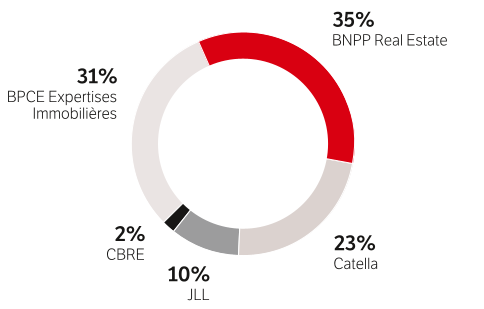
As of December 31, 2025, the appraisals were carried out by five independent appraisers: BNPP Real Estate Valuation, BPCE Expertises Immobilières, Catella Valuation, Jones Lang LaSalle Value & Risk Advisory, and CBRE Valuation. As of June 30, 2025, the appraisals were carried out by the same five appraisers as follows: BNPP Real Estate Valuation, BPCE Expertises Immobilières, Catella Valuation, Cushman & Wakefield Valuation and CBRE Valuation.
◗ Breakdown of valuations per appraiser
Mercialys’ portfolio value came to Euro 3,041.1 million including transfer taxes, up + 10.1% over 12 months and + 3.9% for the second half of the year.
Appraisal value at 12/31/2025
Current basis
Like-for-like (1)
Change over last 6 months
Change over last 12 months
Change over last 6 months
Change over last 12 months
Value excluding transfer taxes
2,834.6
+ 3.7%
+ 9.7%
+ 3.7%
+ 1.7%
Value including transfer taxes
3,041.1
+ 3.9%
+ 10.1%
+ 3.9%
+ 2.1%
- (1)Sites on a constant scope and a constant surface area basis.
On a like-for-like basis (19) including transfer taxes, it is up + 2.1% over 12 months and + 3.9% for the second half of the year.
The average appraisal yield rate was 6.65% at December 31, 2025, compared with 6.79% at June 30, 2025 and 6.65% at December 31, 2024.
Note that the valuation of Mercialys’ portfolio is determined on the basis of a “sum of the parts” approach. In other words, the total valuation is equal to the sum of the individual valuations of each asset, whether this is determined using the capitalization of income method or the DCF approach. The valuation of each asset presents its own underlying assumptions in terms of rental growth, investment, capitalization and discount rates.
This makes it difficult to reconstruct underlying average valuation assumptions at consolidated level. Matters are further complicated by the fact that appraisers do not always use strictly identical valuation methodologies, and the weighting criteria used when compiling the underlying assumptions for individual valuations may cause the results to vary significantly.
In the interests of transparency and accuracy, Mercialys approached its two main real estate experts, BNP Paribas Real Estate and BPCE Expertises Immobilières, for guidance on this point. These companies, which respectively appraise 35% and 31% of Mercialys’ assets by number, stated that they applied a compound annual growth rate (CAGR) of net rental income including indexation of + 3.3% for BNPP and + 3.5% for BPCE between 2026 and 2035.
1.3.1.2Real estate appraisal report prepared by Mercialys’ independent valuers
Introduction
- ●BNPP Real Estate Valuation;
- ●Catella Valuation;
- ●CB Richard Ellis Valuation;
- ●Jones Lang LaSalle Value & Risk Advisory;
- ●BPCE Expertises Immobilières,
At 12/31/2025
Number of assets
Potential rent
Fair value excluding transfer taxes
Fair value
including transfer taxesBNPP Real Estate Valuation
18
€121.4m
€1,855.9m
€1,990.0m
Jones Lang LaSalle Value & Risk Advisory
5
€6.7m
€79.1m
€85.0m
Catella Valuation
12
€16.1m
€154.1m
€165.6m
CB Richard Elis Valuation
1
€9.0m
€1,114.0m
€122.4m
BPCE Expertises Immobilières
16
€56.1m
€705.6m
€757.9m
of which undivided share
€7.1m
€74.2m
€79.7m
BPCE Expertises Immobilières
16
€49.0m
€631.4m
€678.2m
Total
53
€202.3m
€2,834.6m
€3,041.1m
General background to the appraisal
Background and instructions
In accordance with the instructions given by Mercialys (the “Company”), set out in the valuation contracts signed between Mercialys and the Appraisers, we have estimated the value of the assets owned by the Company reflecting the manner in which they are owned (full ownership, construction lease, etc.). This condensed report, which summarizes the conditions for our work, has been written in order to be included in the Company’s Registration Document. The appraisals were conducted locally by our expert teams and were reviewed by the pan-European teams of Appraisers. To determine the market value for each asset, we considered real estate transactions at European level, as well as domestic transactions. We confirm that our opinion of market value has been revised in light of other appraisals carried out in Europe, so as to ensure a consistent approach and to take into account all transactions and information available on the market. The valuations are based on the discounted cash flow method or the yield method, which are regularly used for assets of this kind.
Standards and general principles
We confirm that our valuations were conducted in accordance with the corresponding sections of the Code of Conduct from the 8th Edition of the RICS Valuation Standards (the “Red Book”). This is an internationally accepted basis of appraisal. Our valuations comply with IFRS accounting standards and the standards and recommendations published by the IVSC. The appraisals were also prepared in light of the AMF’s recommendations concerning the presentation of valuations of listed companies’ real estate portfolios, published on February 8, 2010. They also take into account the recommendations made in the Barthès de Ruyter report on the valuation of the real estate portfolios of listed companies, published in February 2000. We certify that we prepared our appraisal as independent external appraisers, as defined in the standards from the Red Book published by RICS.
Target value
Our valuations correspond to market values and were presented to the Company in terms of value excluding rights (after deducting transfer duties and costs) and including rights (market value before any deduction of transfer duties and costs).
Conditions
Information
We asked the Company’s management to confirm that the information provided to us relating to the assets and tenants is complete and accurate in all material respects. Consequently, we considered that all of the information known to the Company’s employees and which could affect the value, such as operating expenses, work undertaken, financial items including doubtful receivables, variable rents, current and signed lettings, rent-free periods, as well as the list of leases and vacant units was made available to us and is up to date in all material respects.
Surface area of assets
Environmental analyses and soil conditions
We were not asked to perform a study of soil conditions or an environmental analysis and we did not investigate past events to determine whether the soil or structures of the assets are, or have been, contaminated. Unless indicated otherwise, we assumed that assets are not, and should not be, affected by soil contamination and that the condition of the land does not affect their current or future use.
Urban planning
We did not study the building permits and assume that the properties have been built and are occupied and used in compliance with all necessary authorizations and are free of any legal recourse. We assumed that the assets comply with legal requirements and urban planning regulations, particularly as regards structural, fire, health and safety regulations. We also assumed that any extensions currently under construction comply with urban planning regulations and that all the necessary authorizations have been obtained.
Land titles and rental status
We have based our assessments on the rental position, summaries of additional revenues, non-recoverable charges, capital projects and the business plans provided to us. In addition to what is already mentioned in our reports for each asset, we assumed that ownership of the assets is not subject to any restrictions that would prevent or hinder their sale, and that they are free of any restrictions and encumbrances. We did not read the land titles for the assets and we accepted the rental and occupancy statements or any other relevant information communicated to us by the Company.
Condition of the assets
We noted the general condition of each asset during our visits. Our assignment does not include technical aspects concerning the structure of buildings. However, we indicated in our report any signs of poor maintenance observed during our visit, if applicable. The assets were appraised on the basis of information provided by the Company, according to which no hazardous materials have been used in their construction.
Taxation
Our valuations do not take account of any costs or taxes that may be incurred in the event of an asset being sold. The rental and market values provided do not include value added tax.
Confidentiality and publication
Lastly, in keeping with our usual practices, we confirm that our appraisal reports are confidential and intended solely for the Company. No liability is accepted in relation to third parties, and neither the appraisal reports as a whole nor extracts from these reports may be published in a document, declaration, circular or communication with third parties without our written agreement, covering both the form and content in which they may appear. In signing this Condensed report, each expert does so on their own behalf and exclusively for their own expert appraisal work.
-
Corporate Social Responsibility
Mercialys firmly believes that the consideration of environmental, societal and social issues is a major differentiating factor and creator of long-term value. It has made this an integral part of its corporate strategy. This is reflected in the day-to-day implementation of responsible and ethical management of all its owned and managed assets. This chapter sets out in detail its strategic Corporate Social Responsibility (CSR) projects, its policies and action plans implemented, as well as its results.
-
2.1Sustainability risks and opportunities covered by Mercialys’ CSR strategy
2.1.1CSR governance designed to effectively manage risks and opportunities and ensure the successful implementation of the strategy
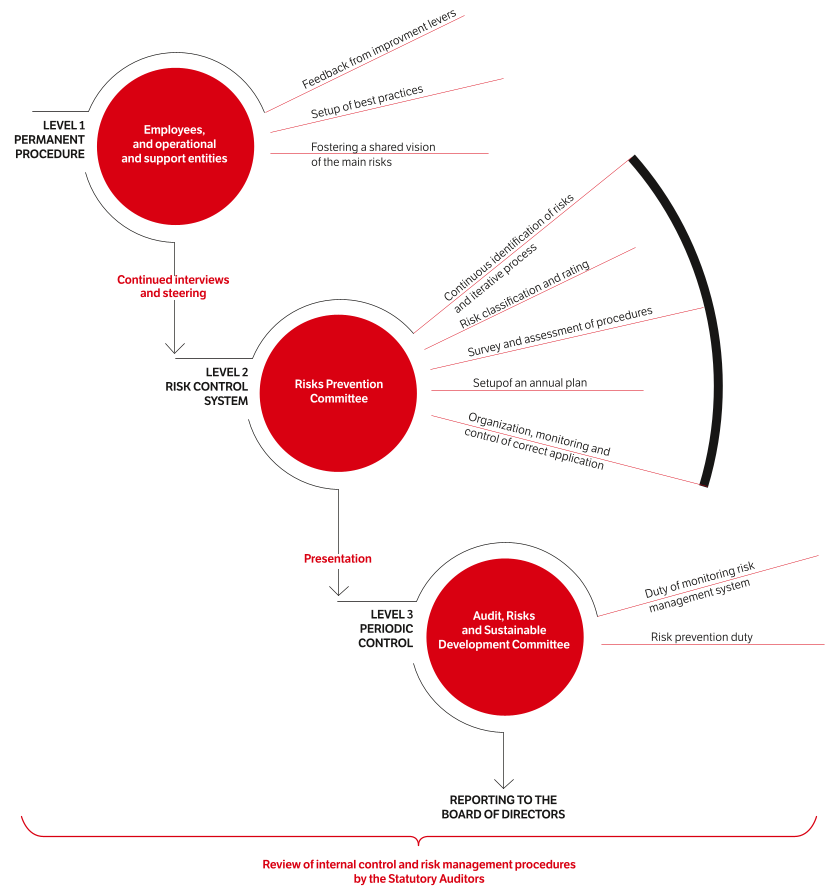
The management of CSR risks is an integral part of Mercialys’ risk management process. At the end of December 2025, the Risks Prevention Committee (RPC) was composed of the Deputy Managing Director, the Chief Financial Officer, the Director of Operations and External Relations, the Director of Human Resources, the Head of Internal Control, the CSR Director, the Ethics and Compliance and until December 31, 2025, the Deputy Chief Executive Officer. Having left her position with effect from December 31, 2025, the Deputy Chief Executive Officer has been replaced within the committee by the General Secretary. The composition of the committee is such that it benefits from the expertise of each member and can optimize its approach by having direct access to the various departments.
The Committee reports directly to the Executive Committee, which further strengthens the link between Mercialys’ strategy and risk management. It facilitated ongoing dialogue between the stakeholders involved in the risk management process, the Executive Committee and Senior Management, helping decisions to be taken quickly for actions at the sites and initiatives at the head office.
- 1.identifying the risks facing Mercialys;
- 2.identifying and assessing the procedures in place;
- 3.implementing a plan to supplement and optimize risk management;
- 4.organizing the oversight and proper application of procedures.
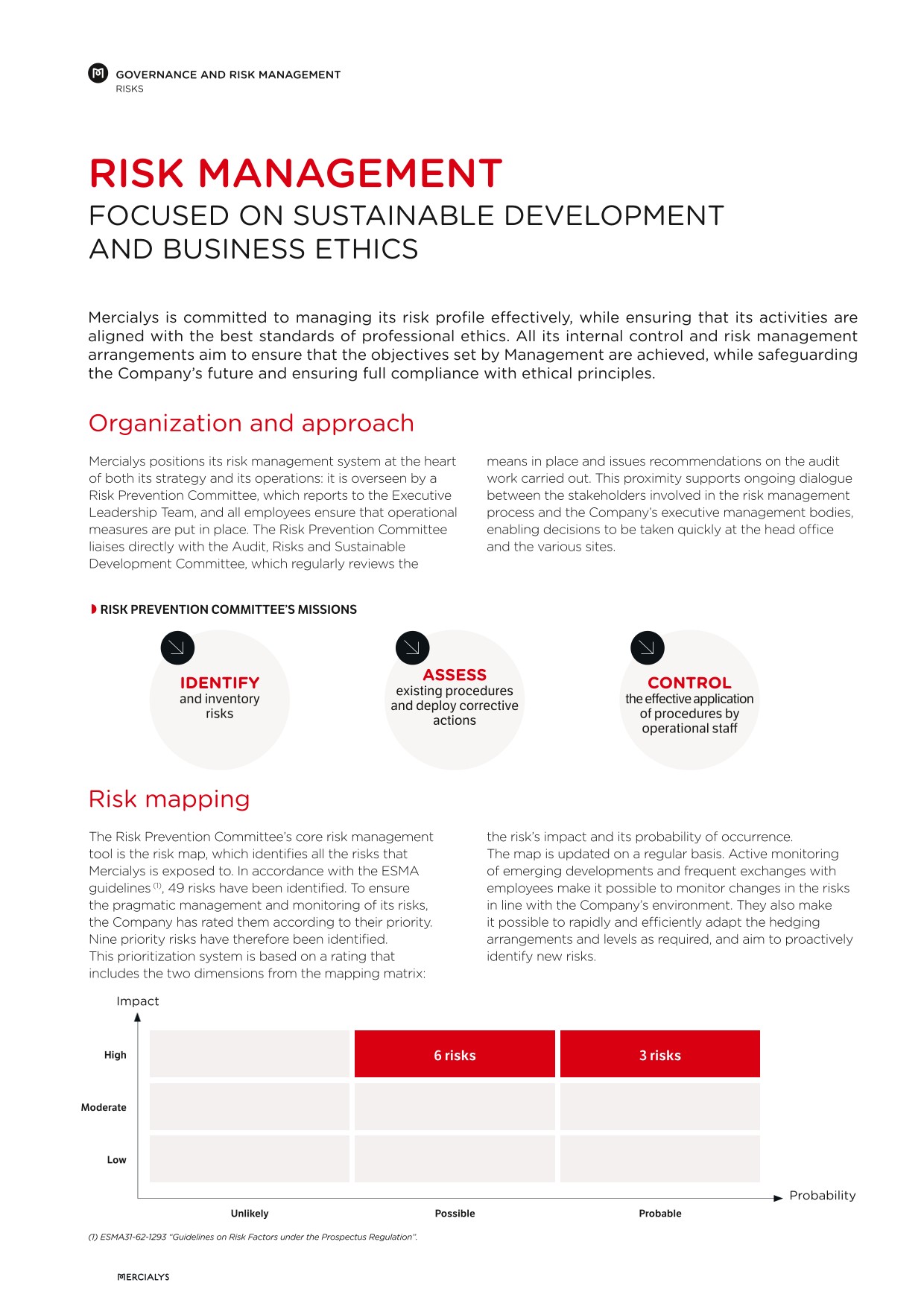
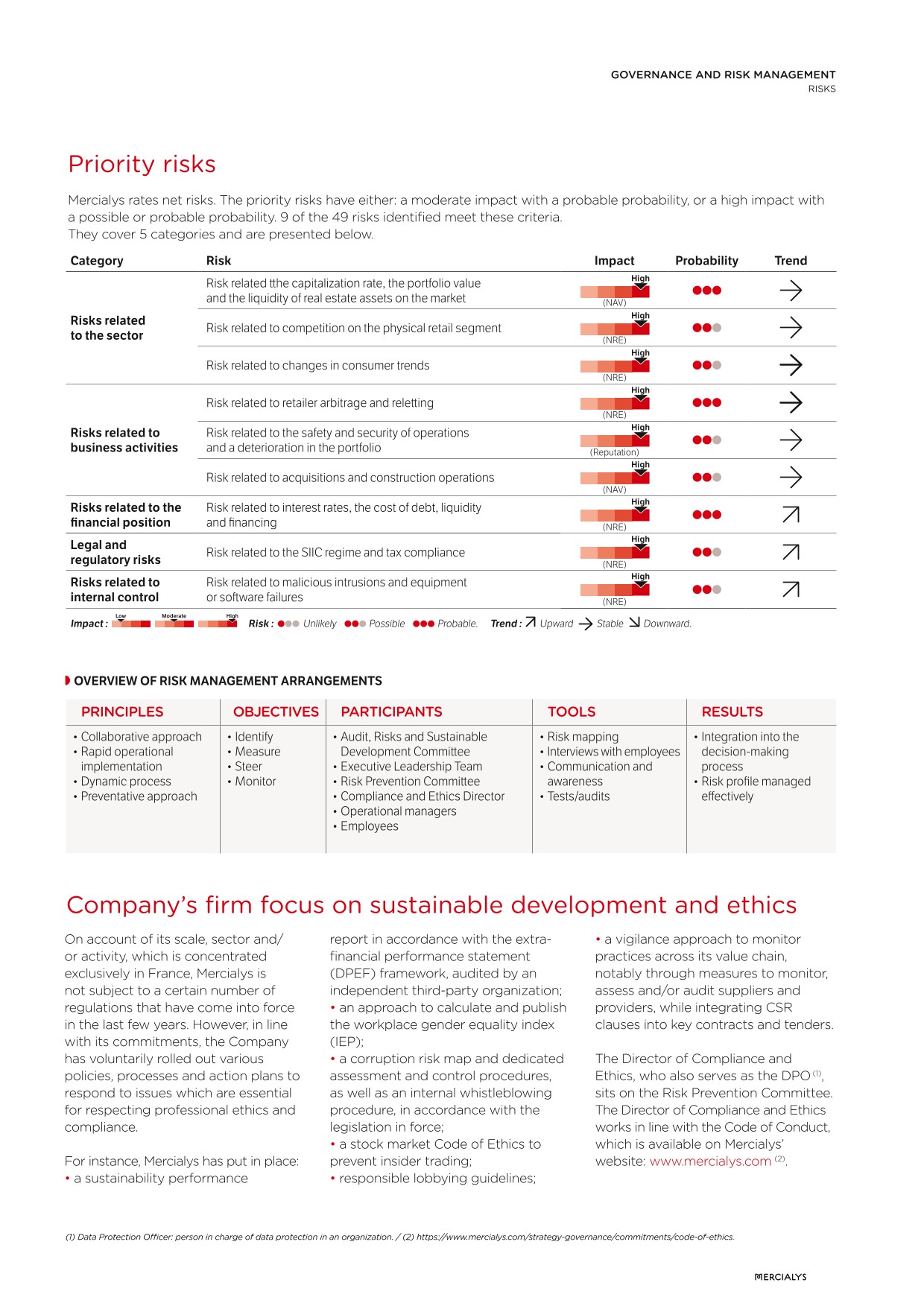
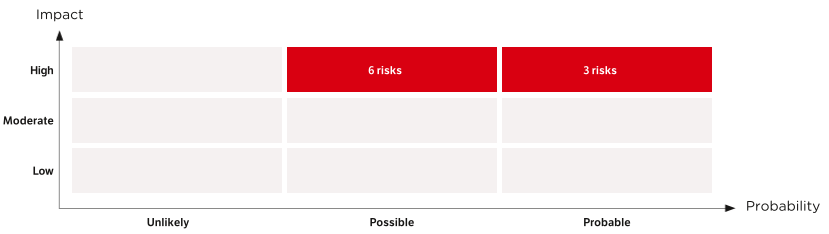
The 49 risks identified by the RPC are divided into 8 categories, one of which is dedicated to environmental, social and societal risks. All risks are then assessed annually according to their impact and probability of occurrence. Probability of occurrence assesses the possibility that a risk will materialize at least once, in the short, medium and/or long term. The impact quantifies consequences that may be:
- ●either financial (change in funds from operations (FFO) or net asset value);
- ●or obstacles to the continued deployment of the Company’s strategy and operations;
- ●or reputational (importance given by stakeholders or media impact).
CSR risks were assessed using this scale, based on the results of the stakeholder consultation conducted in 2020, prior to the definition of the CSR strategy.
Each year, the RPC reports on its work to the Company's Audit, Risks and Sustainable Development Committee.
The Board of Directors as a whole approves the key stages of the CSR strategy, as well as the associated objectives. It examines any changes, such as those that could impact the carbon roadmap. Directors have access to the expertise of Mercialys’ teams and sustainability rating agencies. They can also benefit from training and/or awareness-raising sessions on CSR issues. In 2025, the members of the Board of Directors benefited from a prospective presentation on the impact of the development of humanoid robots on business practices. In January 2026, a speaker from the French Institute of Directors (IFA) also provided the Directors with training on crisis management. For more details on the training provided to the Directors, please refer to Section 4.1.4, p. et seq.
To prevent, mitigate and reduce CSR risks while managing the objectives of its CSR strategy 4 Fair Impacts for 2030 presented in the table in § 2.1.2, the Company has set up a dedicated governance. It is cross-functional, in conjunction with the operational departments at Company level and broken down by asset.
Supervising cross-functional projects
The integration of CSR at Mercialys is based on solid governance involving the Executive Committee, the governance bodies and the operational teams.
The CSR team, whose mission is to implement the Company's CSR strategy, reported to the Deputy Chief Executive Officer until December 31, 2025. Since this date, the team has been reporting to the General Secretary, a member of the Executive Committee, proof of that CSR is at the heart of the Company's strategy. Human Resources development issues such as the implementation of Mercialys’ diversity and inclusion policy are the responsibility of the Human Resources Department.
Like the General Secretary, now in charge of CSR, the Director of Human Resources, responsible for social issues, is also a member of the Company’s Executive Committee, which is responsible for defining and monitoring the Company’s strategy.
The CSR strategy, risks and opportunities are regularly assessed, validated and reviewed by the Company’s various governance bodies.
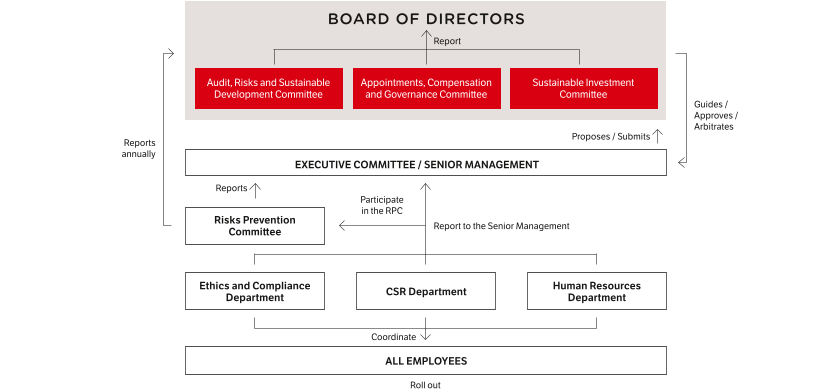
The Board of Directors is kept informed of the implementation of the CSR strategy and the achievement of the associated criteria at least annually and oversees the management of CSR issues by the Company through its three specialized committees:
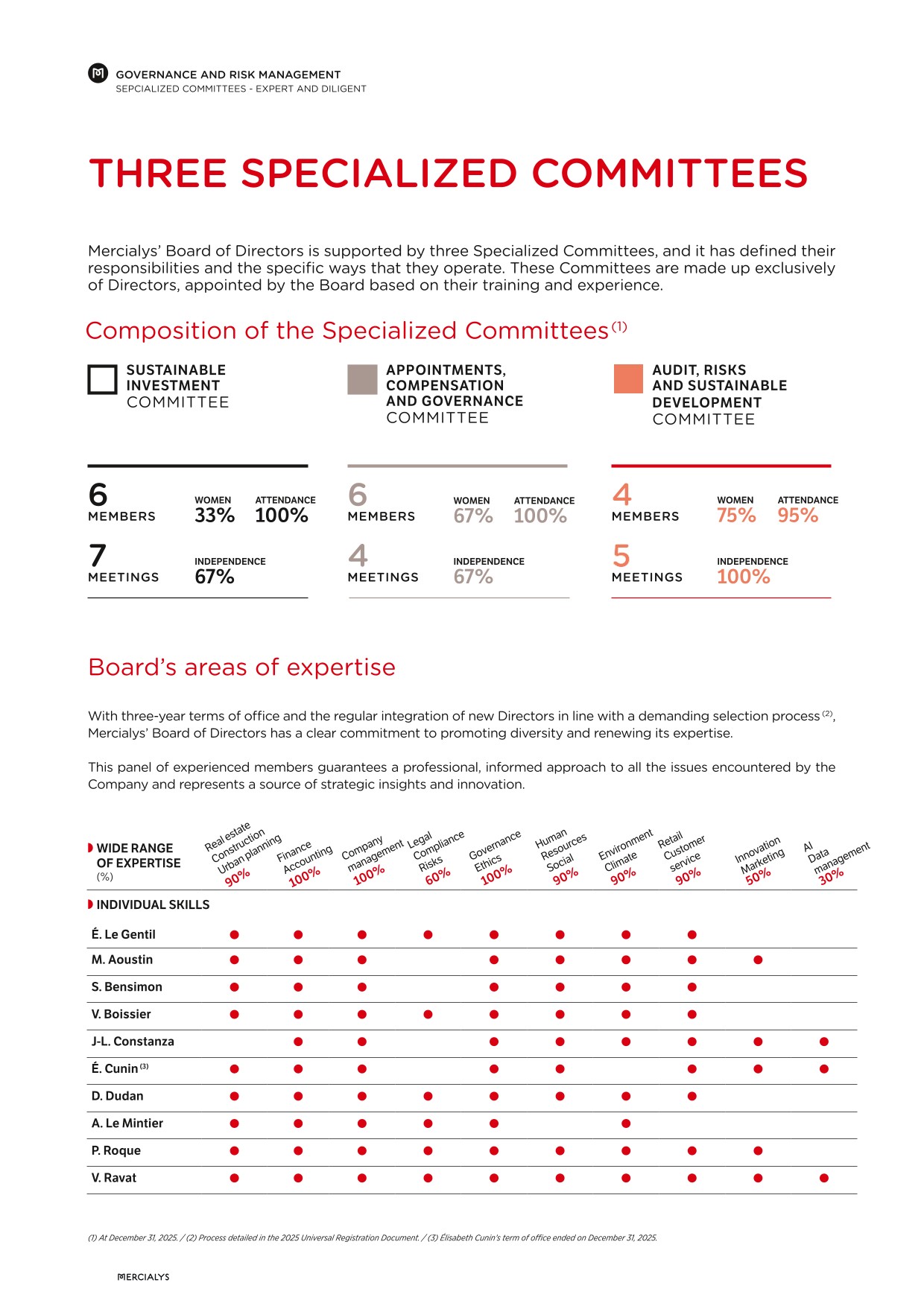
- ●the Audit, Risks and Sustainable Development Committee, which assesses CSR risks and opportunities, examines and validates the CSR strategy, checks on its progress once or twice a year, supervises the process for preparing sustainability information and notably reviews Chapter 2 of the Company’s Universal Registration Document;
- ●the Sustainable Investment Committee, which takes into account CSR aspects when reviewing strategic projects (disposals, acquisitions, growth strategy, etc.);
- ●the Appointments, Compensation and Governance Committee, which oversees the Company's workplace diversity, equality and equal pay policy, sets the ESG (environmental, social and governance) performance criteria related to senior management compensation, and considers CSR aspects in its recommendations for the appointment / reappointment of Directors.
Stéphanie Bensimon is the Director responsible for monitoring the CSR approach. In 2025, she reported on her duties to the Board of Directors, presenting her conclusions and potential ways to optimize the Company’s overall approach to CSR.
For more details on the roles of the various bodies and their interactions in terms of CSR, see § 4.1.6, p. 250 et seq. and the diagram below.
The integration of CSR at Mercialys is also based on the definition of quantified annual objectives, engaging both executives and employees, in order to measure the progress made in concrete terms.
Thus, the Company's Senior Management has 30% of its annual variable compensation indexed to the Company’s CSR performance. In addition, sustainability criteria also represent 30% of their long-term compensation. For 2025, the criteria used were linked to the progress made on 4 Fair Impacts for 2030, the Company’s carbon roadmap. For more information, see § 4.2.2, p. 259 et seq.
As all Mercialys employees are involved in the successful implementation of this strategy, they all also have an individual CSR objective in their annual variable compensation. This represents at least 10% of their compensation and is specific to their roles, quantitative for senior staff and qualitative for other categories of employees.
At the end of 2025, 100% of the Company’s bank credit lines included CSR performance objectives, for a cumulative amount of Euro 390 million. The margins of these credit lines are indexed to the performance in part 2 of the BREEAM In-Use environmental certification, to improvements in the waste recovery rate, and the achievement of the Company's greenhouse gas emissions reduction objectives, proving Mercialys' commitment to the fight against climate change. In 2025, several bank lines were negotiated and have been indexed to the Company's new Net Zero roadmap. Since 2021, the first year of implementation of this process, the Company has continuously benefited from a cumulative reduction in these margins thanks to the achievement of these objectives.
Acting at the asset level
In order to steer the CSR strategy at asset level, the Company’s 4 Fair Impacts for 2030 objectives have been broken down by asset, so as to reflect the operational reality. In order to plan the actions to be implemented to achieve these objectives, to phase them in over time, to forecast the budgets to be allocated and to monitor them, CSR roadmaps have been drawn up for each center. They were developed jointly by the Asset Management Department, the Center Management Department, the property manager, and the CSR team. They are adapted to the specificities of each site. In addition, during the annual reviews of the business plan by asset, the center directors and asset managers present the progress of the 4 Fair Impacts for 2030 CSR strategy to Senior Management and the Executive Committee.
To ensure their implementation and to detect any malfunctions as early as possible, a dedicated IT tool facilitates the monitoring, analysis and steering of key CSR performance indicators. It is accessible to all relevant departments as well as to external property managers. At operational level, the Mercialys employees responsible for shopping center management have access to key performance indicators for energy and water consumption and waste recovery at the centers. These KPIs make it possible to compare assets using different analysis criteria: in absolute value, in relative value compared to activity data, and between centers in the same geographical area, compared to the previous period. Some of the operating problems of the centers are thus identified, enabling them to be corrected quickly, while sharing the best practices already implemented.
◗ CSR governance
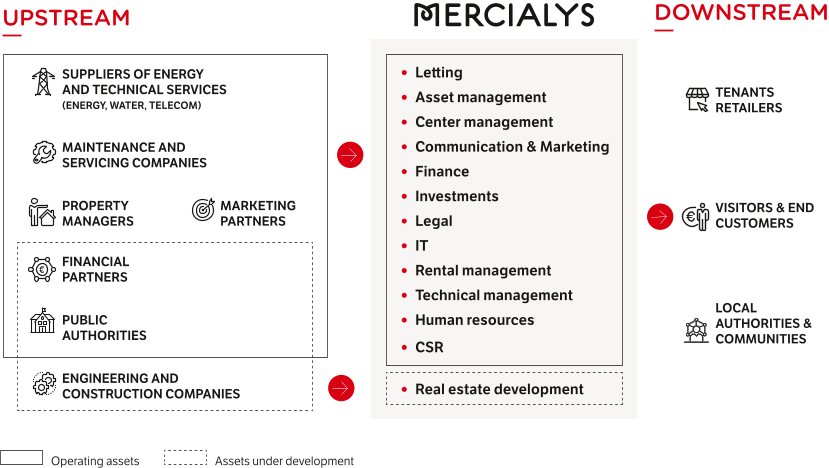
Mercialys relies on an integrated value chain, linking its upstream partners to its downstream stakeholders. All of the Company’s internal departments contribute to the creation of sustainable value. Real estate development is also a strategic lever to respond to the Company’s growth challenges and investor expectations, as illustrated in the diagram below.
◗ Company value chain
-
2.2For our environment
Because the construction sector generates 23% of French greenhouse gas emissions(2) and global warming represents physical and transition risks for Mercialys’ portfolio, the real estate company is committed to contributing to carbon neutrality through the following actions:
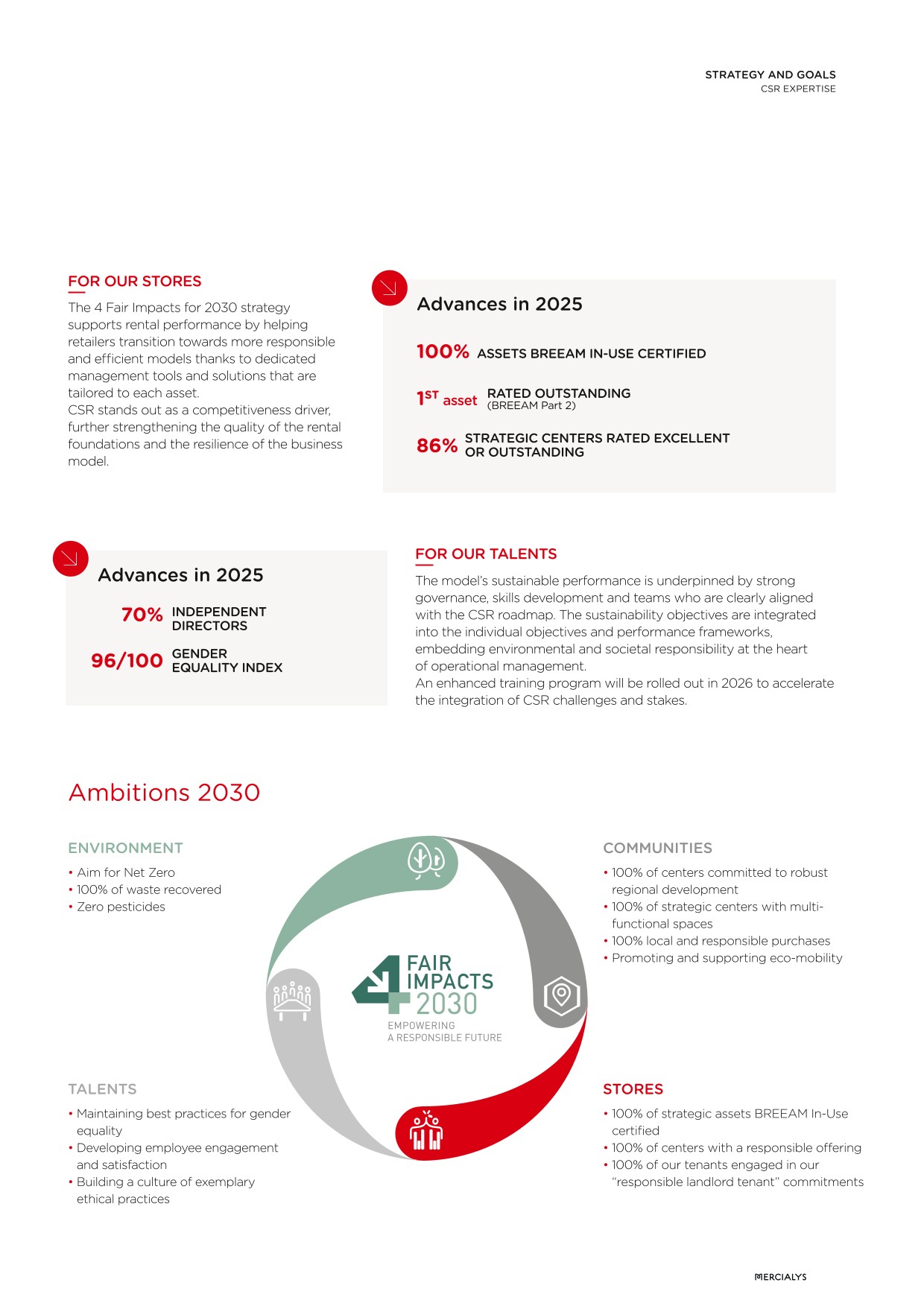
- ●By having its carbon roadmap certified by the Science Based Targets initiative (SBTi) since 2019 through an associated action plan, the Company has worked to limit the average rise in global temperatures to well below 2°C compared to pre-industrial level, in particular by fully exceeding the objectives set at the time of certification.
- ●Building on these results, Mercialys has defined a new and very ambitious greenhouse gas emissions reduction strategy, which has again been validated by the SBTi in accordance with their most recent "Buildings" sector standard. Mercialys' climate strategy is now based on four new objectives for 2030 and 2050. A new transition plan is currently being finalized and will ensure the achievement of these newly defined objectives.
- ●By reducing the pressure that the Company exerts on natural resources.
2.2.1Aim for Net Zero carbon emissions
The effects of climate change are also being observed in France, with 2025 being particularly affected by extreme weather events such as heat waves, fires, flooding, etc. Taking action to mitigate climate change and adapting its assets and their operation are key challenges for Mercialys. Mercialys’ Risks Prevention Committee (RPC) has identified and characterized the Company’s risks and opportunities associated with the effects of climate change. It is also transparent about its climate risks, in accordance with the 11 recommendations of the international working group Task Force on Climate-related Financial Disclosure (TCFD) (see p. 117 et seq.) and by responding publicly each year to the Carbon Disclosure Project (CDP) since 2017.
Adapting to the effects of climate change
In order to ensure the resilience of its portfolio, particularly regarding the physical consequences of climate change, Mercialys has identified the current climate risks most likely to affect its assets. Within the framework of its RPC, the Company has mapped the natural risks facing its assets: flooding, forest fires, risk of marine submersion, landslides, clay swelling, mining, seismic activity, and avalanches. 49% of assets in the current scope are affected by a Natural Risk Prevention Plan (NRPP), mainly related to the risk of flooding.
Taking things one step further and adopting a forward-looking perspective, Mercialys has commissioned detailed studies to assess the physical risks associated with climate change for each asset and to determine the asset’s vulnerability and resilience to these hazards. These studies comply with the criteria defined in Appendix A of Regulation (EU) 2020/852, known as the Taxonomy Regulation (see Appendix 1 p. 110). They help to identify the priority hazards for each asset and to determine the relevant climate change adaptation actions, to be included in multi-year work plans.
The Company has assessed 98% of its portfolio with regard to the following hazards: heat wave, drought, shrinkage and swelling of clays, forest fires, average rise in temperatures, flooding / rainfall, storms, marine submersion, coastal erosion, earthquakes and ground movement, cyclones, hurricanes and typhoons and cold waves. The studies analyzed the risks under the RCP 4.5 and RCP 8.5 scenarios of the Intergovernmental Panel on Climate Change (IPCC) and across two time horizons (30 and 50 years), so as to take into account the life span of a building. These scenarios correspond respectively to the implementation of measures to stabilize greenhouse gas emissions at around double pre-industrial levels, and to the Business As Usual scenario. For more information on the scenarios, see the table below.
The results show that Mercialys’ assets are mainly affected by heat waves, the average temperature rise and drought. The priority issues to be taken into account therefore relate to the insulation of buildings, the size and operation of heating and air conditioning systems and the monitoring of the building's structure.
In addition, Mercialys has also assessed the transition risks related to climate change for 35% of its portfolio. These detailed studies enable the identification of the potential impacts of regulatory, economic and technological changes related to the low-carbon transition, in order to anticipate challenges, adapt strategies and seize opportunities to ensure the resilience and sustainability of assets.
Contribute to planetary carbon neutrality
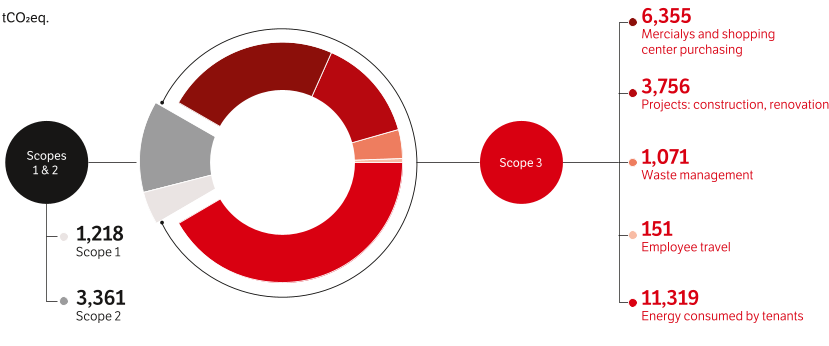
The graph below shows the breakdown of Mercialys’ greenhouse gas emissions according to the 15 categories of the GHG Protocol(3), offering a detailed overview of the Company’s carbon footprint and the main sources of emissions across its value chain.
◗ Carbon footprint - location-based
The Company uses this framework to measure and account for the greenhouse gas emissions from its activities. In order to reduce these, the Company has twice defined and certified its decarbonization roadmap using science-based standards.
As such, since 2019, the Company has contributed to the collective effort to limit the average rise in global temperatures to well below 2 °C compared with pre-industrial temperatures, having its carbon roadmap certified by the Science Based Targets initiative (SBTi) for the first time.
In order to define its objectives to fight climate change submitted to the SBTi, Mercialys studied three scenarios, over several time horizons between 2022 (5 years) and 2050:
- ●the Business As Usual (BAU) scenario, estimating the change in Mercialys’ emissions if its efforts remained at the level of the time;
- ●the Sectoral Decarbonization Approach (SDA) scenario of the real estate sector, making it possible to remain below a 2 °C increase (RCP 2.6 scenario of the IPCC Fifth Assessment Report);
- ●the scenario chosen by Mercialys, which led to measures to reduce the emissions identified by the Company and limited the increase in global temperatures to Well Below 2°C, the most ambitious category at that time(4).
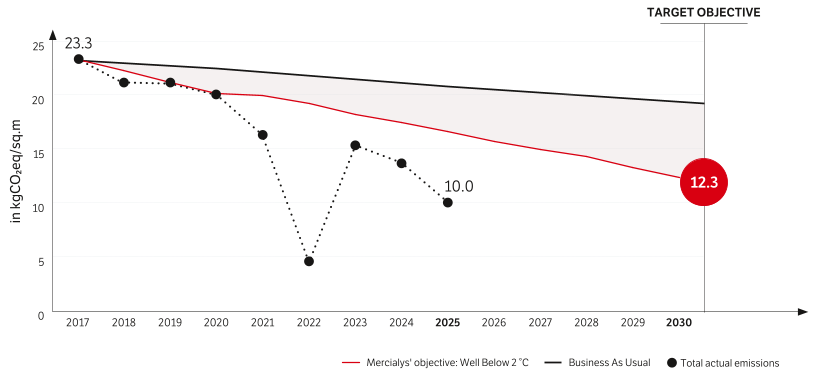
The various scenarios, the roadmap defined by Mercialys and the results obtained are shown in the graph below.
◗ Mercialys carbon roadmap approved by the SBTI in 2019
(in kgCO2eq./sq.m./year - current scope)Aware that the fight against climate change goes beyond its scope of direct responsibility, Mercialys has set itself targets both for the energy consumption of the parts of its assets under its direct management and for refrigerant leaks from its air conditioning systems (scopes 1 and 2), as well as its carbon footprint extended to third-party stakeholders (scope 3). As such, Mercialys’ climate strategy was based on four objectives covering the period between 2017 and 2030:
- ●reducing emissions related to energy consumption at its centers (scopes 1 and 2) by 47% per sq.m., using the market-based method(5);
- ●reducing emissions linked to tenants’ energy consumption by 46% per sq.m.;
- ●reducing emissions linked to employee business travel by 26%;
- ●reducing emissions related to the treatment of waste produced by the centers by 26% per metric ton of waste produced.
The Science Based Targets initiative approved these objectives in 2019, making Mercialys one of the first commercial real estate companies to have its objectives scientifically approved. In 2021, the Company had already achieved its decarbonization objectives previously set for scopes 1 and 2.
In 2025, almost all of these objectives had been achieved. With the exception of the objective relating to emissions linked to the energy consumption of its tenants, which can be indirectly managed by Mercialys within its strategy, all of the emissions reduction objectives defined in 2019 have been fully exceeded.
At the same time, the Science Based Targets initiative (SBTi) published its new "Buildings" sector standard. Mercialys has therefore made changes to its decarbonization roadmap to make it more ambitious and fully compatible with the carbon neutrality objective of the 4 Fair Impacts for 2030 strategy. In the first half of 2025, the Company submitted its new emission reduction targets, using this new sectoral approach, for scientific validation.
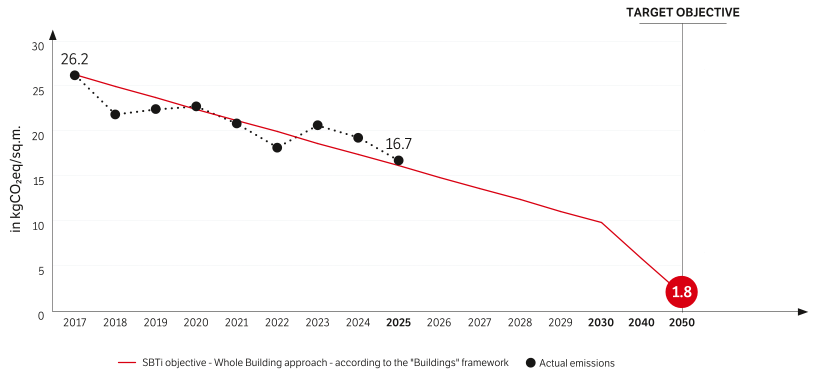
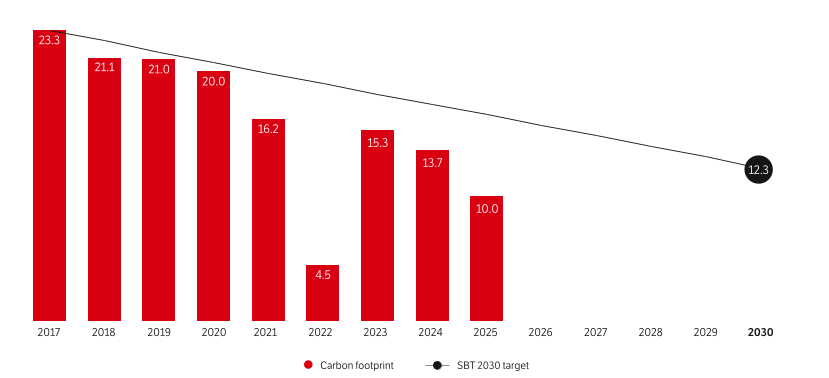
In August 2025, Mercialys obtained Net Zero certification from the SBTi. This validation confirms that the Company's new roadmap is aligned with the most ambitious short- and long-term climate scenarios. In other words, Mercialys is now committed to reducing its emissions using the Whole Building Approach. This means that its commitment covers both the energy consumption of the common areas of its centers and the energy consumption of its tenants, representing Mercialys’ desire to involve its main stakeholders in its work to combat climate change. In addition, Mercialys is committed to the objective of net zero emissions across its entire value chain by 2050.
◗ MERCIALYS NEW CARBON ROADMAP APPROVED BY THE SBTI in 2025
(in kgCO2eq./sq.m./year - current scope)This change also reflects the Company's desire to attach a decarbonization objective to all of its emission sources. With this in mind, two additional short- and long-term objectives have been set for the rest of scope 3. Mercialys' climate strategy is now based on these four new objectives:
- ●2017-2030 Near-Term objective: reducing emissions related to energy consumption at its centers (scopes 1, 2 and 3 category 13(6)) by 62.8% per sq.m., using the market-based method;
- ●2017-2030 Near-Term objective: reducing emissions related to construction and waste management (scope 3 categories 2, 4 and 5(7)) by 32.5% in absolute value;
- ●2017-2050 Net Zero objective: reducing emissions related to energy consumption at its centers (scopes 1, 2 and 3 category 13) by 93.2% per sq.m., using the market-based method;
- ●2017-2050 Net Zero objective: reducing scope 3 emissions related to all of Mercialys' activities (categories 1, 2, 3, 4, 5, 6, 7, 8, 9 and 15(8)) by 90% in absolute value.
Mercialys is in the process of reassessing its portfolio-wide transition plan designed to identify, quantify and organize the main strategies for achieving these short-term objectives. This collaborative work between the CSR Department, center management, the Technical Department and asset management will in the first half of 2026 lead to an adaptation of this transition plan at the level of each asset, taking into account local specificities as well as actions already undertaken or underway.
Continuing its actions on scopes 1 and 2
In order to achieve its new 2030 objectives for scopes 1 and 2, Mercialys’ strategy is based on four areas:
-
1.Reduce
the energy consumption of its centers by using the following levers:
- ●the modeling of shopping centers’ energy consumption, free from the impact of unexpected events (e.g. a breakdown) and external influencing factors (e.g. weather, occupancy), is used to identify optimization measures and the investment required to improve assets’ energy performance. All Mercialys assets, with the exception of the Saint-Genis 2 shopping center which was acquired in 2025, were analyzed as such;
- ●the implementation of remote meter reading at 89% of sites on the current scope. This system makes it possible to measure in real time the energy consumption of the sites by use and to analyze consumption by cross-referencing it with activity data such as shopping center opening hours or footfall. Alerts are automatically sent in the event of abnormal consumption so that certain management anomalies can be quickly corrected. This measurement and alert system also makes it possible to monitor water consumption and indoor air quality parameters (CO2, temperature, humidity, fine particles and VOCs(9));
- ●the steering and supervision of facilities through Building Management Systems (BMS) at 99% of Mercialys’ assets on the current scope, in particular to manage the operating time slots of the facilities and to regulate temperatures.
-
In
addition, the Company has continued to implement the sobriety plan put in place in 2022 to
contribute to the national effort to save energy. It is based on the following key measures:
- ●lowering heating and air conditioning temperatures to 17°C in winter and 26°C in summer,
- ●limiting heating at night to the bare minimum,
- ●switching off of general lighting and signs one hour after the last store closes,
- ●adjusting the air flow rates of ventilation systems,
- ●shutting down hot water tanks,
- ●reducing the light intensity of advertising screens and large display walls.
- ●improving the maintenance of certain equipment, in particular HVAC (heating, ventilation, air conditioning). Mercialys has installed a CMMS (Computerized Maintenance Management System) at 44% of its centers to ensure better monitoring of this maintenance and to identify sites that require work to be carried out.
- ●multi-year work plans for the installation of energy-efficient equipment, such as LED relamping for lighting;
- ●improving the insulation of its sites, in particular by taking advantage of the repaired waterproofing of its sites to improve the overall insulation performance of the building such as at the Chateaufarine shopping park, where insulation with a higher thermal resistance coefficient was selected.
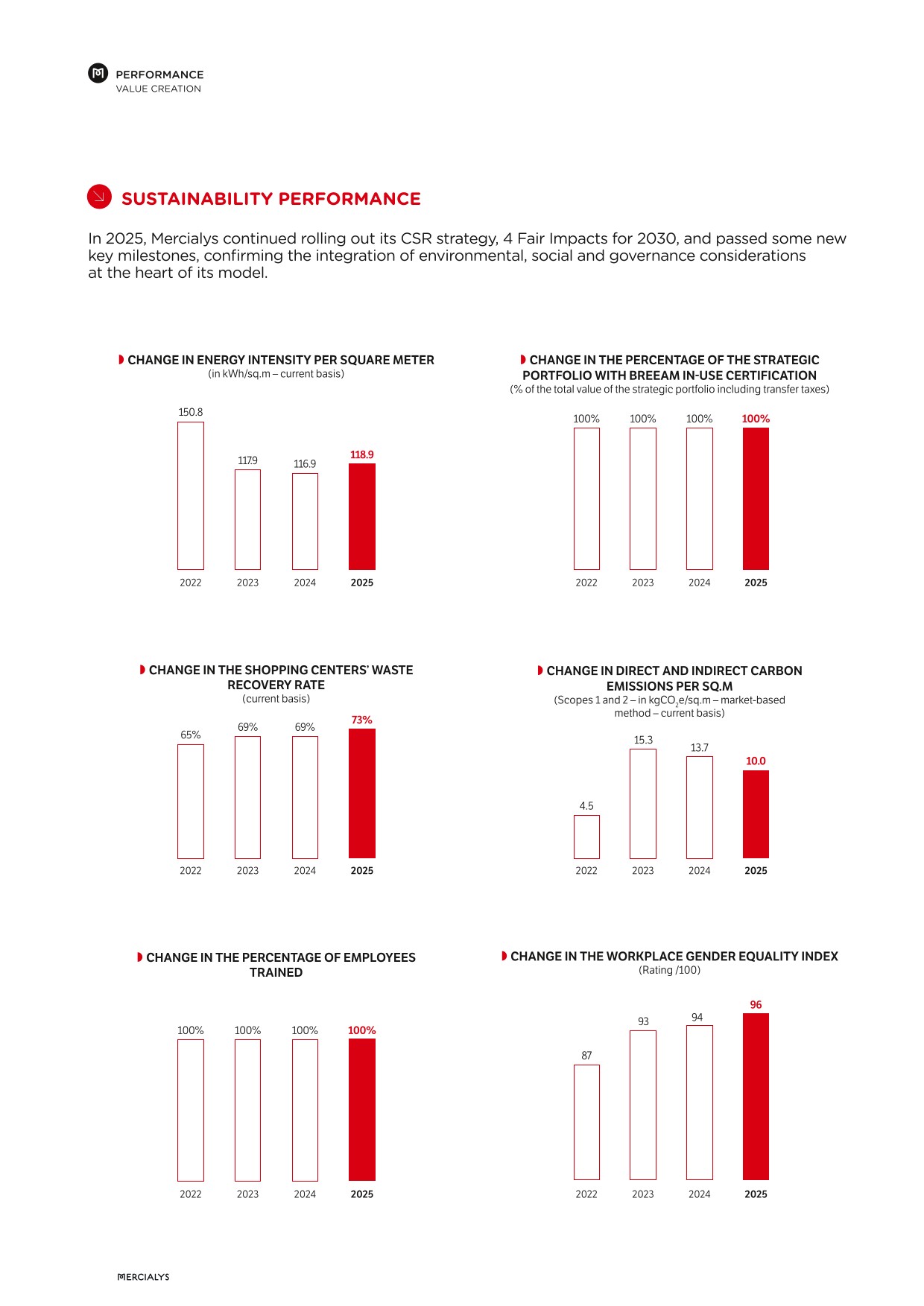
- All these actions have helped reduce the energy consumption per square meter of the Company’s shopping centers every year, achieving a reduction of 33% between 2017 and 2025, on the current scope.
- 2.Use less carbon-intensive energy to operate the shopping centers:
- The consumption of self-generated renewable energy has helped Mercialys to reduce its carbon footprint. For example, in 2025, the Cap Costières shopping park in Nîmes produced and consumed 320 MWh of electricity from photovoltaic units installed around the main building. This represents 33% of this center’s annual electricity consumption.
- In addition, when replacing HVAC equipment, the use of equipment that uses less carbon-intensive energy is preferred. For example, the heating and air conditioning equipment at the Albertville shopping park that used gas has been replaced by equipment powered by electricity, with a much lower carbon impact.
- At the end of 2025, 45% of the energy consumption of Mercialys centers came from renewable sources, and 53% of the electricity consumed by Mercialys centers in mainland France was from renewable sources.
- 3.Replace leak-prone air conditioning systems with new units that run on refrigerants with a lower global warming potential (GWP, i.e. the level of contribution to the greenhouse effect). Mercialys checks its facilities regularly and monitors refrigerant leaks on a monthly basis. Its overall leak rate in 2025 was 1.2%, well below the national average, which is 9% according to ADEME(10). At the same time, Mercialys is exploring less-polluting alternatives to conventional refrigerants. All of these factors are an integral part of Mercialys' refrigerant replacement strategy, which was updated in 2025 due to regulatory changes. For example, La Caserne de Bonne in Grenoble has replaced its facilities and now uses R1234ze with a low Global Warming Potential (GWP).
- 4.As a last resort, Mercialys may have to offset its incompressible residual emissions. It has not yet resorted to this option.
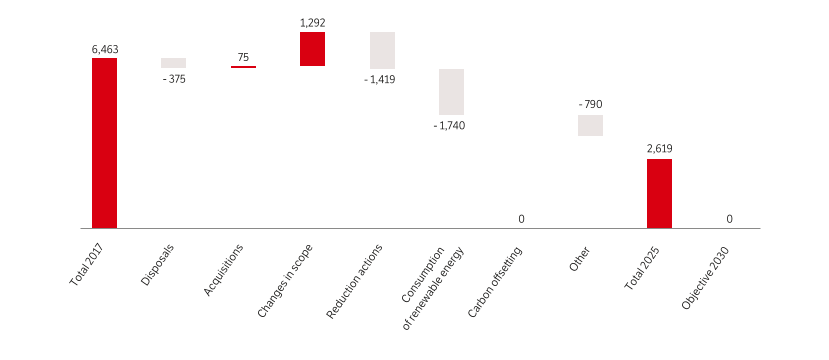
Mercialys has assessed the impact of the measures it has implemented, as well as external factors, to analyze the factors used to reduce its carbon emissions (see graph below).
◗ Change in scope 1 and 2 carbon emissions
As such, the reduction in greenhouse gas emissions since 2017 is linked to action taken by Mercialys, whether in day-to-day management or investments. Thanks to these actions carried out over many years, Mercialys is ahead of its Well Below 2°C carbon roadmap for scopes 1 and 2, as shown in the graph below.
◗ Carbon intensity scopes 1 and 2 per sq.m.
Enhance the approach by integrating scope 3
Meeting reduction commitments for scope 3 items involves the cooperation of all Mercialys’ stakeholders. Its main levers for involving the shopping centers’ tenants, employees and service providers are:
- ●working with retailers to reduce their energy consumption. Details of their consumption are recorded and incorporated into the Company's action plans so as to provide them with comparative information that is useful for their operations (average energy consumption per square meter by type of activity, for instance, see p. 88). This work should also be amplified as part of the Tertiary Eco Energy System (DEET), which provides for cooperation between the lessor and the lessee to improve the overall energy efficiency of the building;
- ●advising tenants on their low-carbon electricity purchases;
- ●raising employees’ awareness of their business travel’s carbon impact. All employees are equipped with videoconferencing tools, widely used and the preferred option since 2020. The practice of teleworking, in place at Mercialys since 2017, is widespread (see p. 103 et seq.). In addition, the Company car leasing policy has been reviewed and now favors hybrid vehicles;
- ●working on the end-of-life treatment of the waste produced by the shopping centers. In conjunction with the waste collection services, Mercialys is seeking to optimize waste sorting and select the most energy-efficient outfalls in terms of carbon impact. These aspects were the subject of particular attention during the latest call for tenders (see p. 85).
SBT
2017-2030 objective2025
2024
2023
2022
2021
2017
Change 2017-2025
SBTi 2025
WBAScopes 1, 2 and 3 (category 13)
Energy for common areas and general services and tenants' energy consumption
(in kgCO2eq./sq.m.)
- 62.8%
16.7
19.2
20.6
18.1
20.8
26.2
- 36.2%
Scope 3
(other
categories)Works, operational waste and upstream emissions
- 32.5%
4,827
8,953
2,834
2,485
3,348
15,151
- 68.1%
SBTi 2019
Scopes 1 and 2
Energy for common areas and general services
(in kgCO2eq./sq.m.)
- 47%
10.0
13.7
15.3
4.5
16.2
23.3
- 57.1%
Scope 3
Tenant energy consumption
(in kgCO2eq./sq.m.)
- 46%
18.6
19.8
23.3
23.3
23.7
23.4
- 20.5%
Employee travel
(in tCO2eq.)
- 26%
150.5
129.6
157.7
248.4
206.9
289.0
- 47.9%
Waste management
(in tCO2eq./metric ton)
- 26%
0.166
0.165
0.167
0.170
0.172
0.280
- 40.7%
-
2.3For our stores
Because retail is undergoing major changes, notably driven by a need for proximity and meaning, Mercialys is committed to promoting more responsible retail by:
- ●offering its customers a range of more sustainable and ethical products and services in its certified centers;
- ●committing to its tenant retailers through a “responsible landlord tenant” pact.
2.3.1100% of strategic assets BREEAM In-Use certified
Mercialys uses the international environmental certification BREEAM In-Use as a simple, readable and scalable management tool for the assessment of its assets. This tool is used to support teams in the environmental management of sites. It provides a framework for comparing the assets of a portfolio, identifying best practices and highlighting the teams’ work on a daily basis. Furthermore, certification helps the Company to implement the work necessary to guarantee the resilience of its portfolio, in both environmental and societal terms, by taking into account emerging CSR issues. On the other hand, certified, energy-efficient and resilient shopping centers represent differentiating added value likely to make the centers more attractive to visitors, tenants and investors. Lastly, certification also addresses the issues that need to be considered from the point of view of financial stakeholders, as evidenced by the Euro 390 million cumulative credit lines signed since 2021 that notably include this indicator (see p. 73).
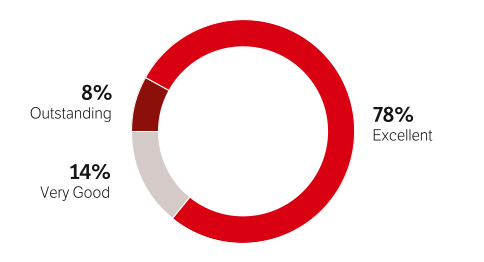
All assets are certified using v6, the most demanding version of the standard, which notably has a stronger focus on environmental resilience. All the strategic centers assessed according to this new version were deemed Very Good for the asset management component, and 78% were deemed Excellent and 8% Outstanding. These results demonstrate the daily commitment of the teams to maintaining the Company’s assets in line with the highest environmental standards.
◗ Certification level: asset management
All strategic assets, representing 92% of the portfolio's value, were thus certified at the end of 2025, with an average score of 74% in section 2 (asset management). These excellent results testify to Mercialys’ maturity and its teams’ commitment to continually improving operational performance.
Mercialys has rolled out this certification beyond its strategic portfolio and currently covers 95% of its portfolio, as well as assets held in partnership with investors, who thus benefit from this expertise.
-
2.4For our communities
Because Mercialys is deeply rooted in local communities, it is committed to being a major partner to sustainable development, by:
- ●forging special links that create mutual value with local players;
- ●developing mixed-use spaces that generate solid and diversified activities;
- ●supporting local employment through local recruitment and subcontracting and initiatives led by local teams.
2.4.1100% of centers committed to regional development
Shopping centers are places where people meet and foster community cohesion. They thus play an active role in the cities where they are located, creating new forms of centrality. Aware of this responsibility, Mercialys places its centers right at the heart of their local ecosystem. They contribute to the economic development of the regions in which they are located, by generating, among other things, local employment.
Supporting jobs in the centers
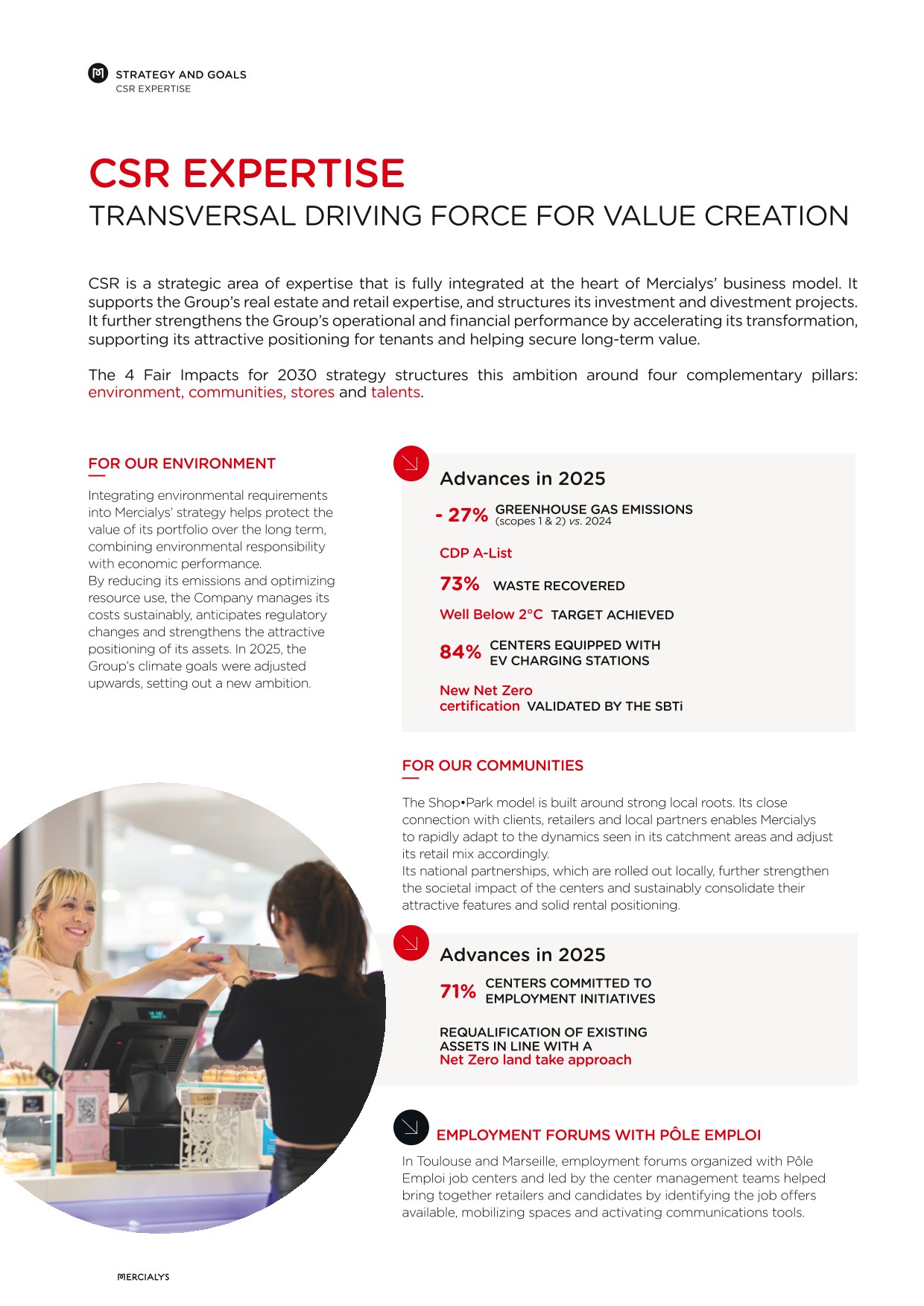
Mercialys centers host over 16,500 long-term jobs that cannot be relocated, generated by site retailers. Indeed, 95% of shopping center workers in France are on permanent contracts, higher than the national average of 85%(17). Mercialys also advertises these jobs by publishing retailer vacancies on each center’s website and social media. The Company increased the visibility of 65 job opportunities with its tenant retailers in 2025.
Furthermore, the centers’ day-to-day management requires the involvement of numerous service providers (security, cleaning, etc.). In 2025, more than 230 jobs were associated with on-site services.
Promoting jobs around shopping centers
The Company is also proactive in its support of employment in its economic regions. Every year, employment initiatives, such as job fairs or job datings are organized at the centers in partnership with local or national brands and recruitment agencies. The shopping centers provide these businesses with spaces to more widely advertise their job vacancies. They may be tenants of the shopping center looking to recruit, or companies outside the center, present in the local region. For example, the local association MIFE (Maison de l’Information sur la Formation et l’Emploi) in Loire Sud was hosted at the Espace Monthieu shopping park, to help promote local recruitment through the Entrepreneurship Bus in particular.
Another example is the Espaces Fenouillet shopping park, which has a job information unit (Relais Information Emploi). This is a service offered by the Fenouillet town council, the Pôle emploi jobs center and the Comité de Bassin d’Emploi Nord Haute-Garonne (CBE). The units hosts workshops as well as providing information for jobseekers, employees and students as well as for companies looking for employees. Individual support is offered, as are collective workshops and local job offers with follow-up and networking.
Boosting regions
In order to revitalize the regions and their stores, Mercialys has been partnership to the Initiative France network since 2021. This is the leading non-profit network for financing and supporting entrepreneurs in France. This partnership is implemented locally with each regional branch of the Company’s centers. At the end of 2025, 63% of strategic centers, in terms of value, had committed to local Initiative France associations.
First of all, Mercialys brings its expertise by encouraging its center directors to participate in commissions and panels to award financing to local entrepreneurs. As trade experts, they can support and advise them on their projects by analyzing the business plans presented to obtain financing, for example.
-
2.5For our talents
Mercialys firmly believes that strong ethics, combined with strategic, inclusive and dynamic talent management, are sources of wealth and performance for itself and for its stakeholders.
It should be noted that the information presented in § 2.5 concerns the scope of consolidated companies for the entire fiscal year, with the exception of ImocomPartners, a subsidiary wholly owned by Mercialys since March 2025 (see Appendix 5, Methodological note p. 123).
The Company, as a responsible employer, has been committed for several years to an approach based on four pillars:
- ●maintaining a very high level of ethics;
- ●promoting diversity and benefiting from inclusion;
- ●developing skills and enhancing individual potential;
- ●retaining talent and boosting employee engagement.
2.5.1An employer committed to maintaining a very high level of ethics
Clearly-defined business ethics commitments and procedures
Mercialys' commitment to this approach is reflected in its employees' strong involvement in ethics and regulatory compliance. This approach is overseen by the Ethics and Compliance Director, who is also the Company’s Ethics Officer. She reported directly to the Deputy Chief Executive Officer. The latter having left her position on December 31, 2025, the Ethics and Compliance Director has since this date reported to the General Secretary, a member of the Executive Committee.
In terms of ethics and compliance, the Company’s objective is to reduce its exposure to the risks associated with non-compliance with regulations and thereby contribute to strengthening its reputation and ability to attract and retain employees.
In terms of compliance, Mercialys has structured operational and financial control processes to ensure that all laws and regulations relating to its business are complied with. They apply to the various decision-making chains giving rise to the Company’s engagement with its various internal and external stakeholders. This approach contributes to the mitigation of the Company’s risks, as described in chapter 5 of this Universal Registration Document. In addition to the control procedures, the compliance approach at Mercialys is deeply linked to the concept of ethics, and is regularly explained and reminded to all employees.
Mercialys has introduced a Code of Ethics, which includes the Anti-Corruption Code of Conduct. It reiterates the need to respect international fundamental principles, legislation and the environment. This document also formalizes the commitments made and the resulting rules of behavior in all of the Company’s business lines and for all employees.
This charter reiterates that the Company operates exclusively in mainland France and Reunion Island, and that all of its employees work in France, a country that has ratified the eight fundamental conventions of the International Labor Organization (ILO). These regulations therefore apply in particular to the fight against discrimination at work, freedom of association and the recognition of the right to collective bargaining, the elimination of all forms of forced or compulsory labor, and the abolition of child labor.
Mercialys strives to scrupulously comply with these conventions and all ethical regulations applicable to the business world.
Moreover, Mercialys has been a signatory to the UN Global Compact since 2018. This commitment demonstrates its will to respect the ten universal principles relating to human rights, international labor standards, environmental protection and the fight against corruption, and to ensure that its suppliers and subcontractors do likewise.
Mercialys employees undertake to respect and uphold the Code of Ethics in the performance of their duties, for the smooth running of the business.
- ●respect for the environment and the measures implemented to reduce the Company’s environmental footprint;
- ●prevention of conflicts of interests;
- ●fight against money laundering and financing of terrorism;
- ●fight against corruption;
- ●the duty of care;
- ●the oversight of lobbying practices, which is set out in charter dedicated to responsible lobbying;
- ●inside information and prevention of insider trading;
- ●non-financing of political life;
- ●protection of employees’ health and safety;
- ●prevention of discriminatory actions and the right to union representation;
- ●the whistleblowing procedure.
This charter is given to all new employees joining the Company. It is also available on Mercialys’ intranet and website(20), in French and English.
Although Mercialys is not subject to certain provisions of the “Sapin II” Law(21), the Company is committed to controlling the risks governed by this law. Mercialys deals with the risk of corruption in terms of not only compliance with the ethical rules that the Company wants all employees to respect, but also as an operational and financial hazard. As such, the Company conducts continuous checks and dialogue with its various departments.
The challenge is not only to deal with significant financial risks, but to identify behavior to be avoided. The scope of controls carried out by Mercialys to prevent corruption concerns the activities managed on its own behalf, subcontracted activities, as well as the activities managed on behalf of its partners. The aspects of passive and active corruption are addressed by the control procedures put in place.
Specific approaches and procedures to ensure all aspects of the Company’s compliance policy are applied
As Mercialys is a listed company, compliance with stock market regulations is an important issue for all employees. In this respect, a regularly updated Stock Market Code of Ethics is published on the Company’s website and intranet. It outlines the regulations applicable to executives, directors, members of the Management Committees, persons closely related to them, insiders and more generally any other person concerned.
A procedure for the protection of whistleblowers is also in place. Employees are regularly reminded of this procedure, which is also clearly displayed in Mercialys’ head offices, including the measures to improve this protection put in place by the Law of March 21, 2022. It guarantees confidentiality, as required by law, and allows whistleblowers to contact the Ethics Officer directly by telephone or email. The whistleblower is informed in writing of the receipt of their report within seven days. No reports were made via this system in 2025. Employees are also free to ask the Ethics Officer about any issues that they may wish to raise.
Furthermore, with a view to maintaining ethical, well-balanced business relations with retailers, Mercialys has signed the NEGO4GOOD Charter. This charter contains the four fundamental principles of ethical and responsible negotiation.
Responsible lobbying guidelines were also drawn up in 2020. The Director of Operations and External Relations is responsible for lobbying activities and ensures that the influencing strategy does not generate conflicts of interests. In 2024, Mercialys updated this charter to align it with its climate commitments (for more information, see Chapter 5, § 5.1.2, p. 305).
At December 31, 2025, Mercialys declared two interest representatives to the HATVP(22). A register of external persons met and the reason for the meetings has been put in place and is regularly updated. The procedure in place takes into consideration the extension of the regulations to actions carried out at local level, applicable since July 1, 2022.
In order to ensure that the Company’s ethics policy is properly understood, Mercialys regularly provides training to its employees on this subject. In 2025, the Company decided to take a further step by providing them with three ethics training courses, notably via e-learning:
- ●the first was dedicated to preventing the risk of corruption,
- ●the second to the GDPR (General Data Protection Regulation), and
- ●the third was to verify employees' knowledge of the content of Mercialys' Code of Ethics by means of a quiz.
Each training course included a test of employees' knowledge at the end of the sessions. The average score obtained in the quizzes was 28.3/30.
Since 2022, employees sign an annual declaration on the existence or absence of conflicts of interest, in addition to the declaration signed when they join the Company.
Continuation of solidarity actions and partnerships
The Company’s ethical commitments are not limited to its policies and processes: they also extend to numerous solidarity initiatives. Solidarity, and the partnerships arising therefrom, are an essential pillar of Mercialys’ culture.
In 2025, Mercialys strengthened its non-profit partnership with the Article 1 association to promote the professional integration of young people and equal opportunities. This association offers young students personalized educational support from a professional mentor, in order to help them through their integration and professional success, and in particular to find their first job. New initiatives were organized with Article 1, notably including participation in careers evenings for students and the introduction of mentoring provided by the Company's employees In 2025, Mercialys also distributed a share of the apprenticeship tax to:
- ●Article 1; and
- ●Telemaque, a non-profit association that works to promote equal opportunities in education by supporting young people from low-income backgrounds from middle school onwards.
In 2025, Mercialys supported the École Henri IV endowment fund, which aims to promote the inclusion of students from low-income backgrounds through the financing of scholarships, English lessons, cultural activities and digital media.
Mercialys also supports the commitment of its employees to charity work, confident that this type of initiative is likely to promote employee involvement in civil society. This commitment is reflected in its participation in charitable community and sporting events, which the Company supports, such as the “Course de la Jonquille contre le Cancer” charity run held in March 2025. 51 employees took part in the challenge to raise money for the Institut Curie.
In the same spirit, Mercialys employees have the opportunity to show solidarity by donating days of leave to colleagues with a relative (ascendant or descendant) whose health condition requires them to be available for significant periods of time. They can also donate some of the meal vouchers provided by the Company to support work to combat malnutrition and/or help students in difficulty.
-
Appendices
1.European Taxonomy Regulation
The European Taxonomy Regulation (EU) 2020/852 of June 18, 2020 on “the establishment of a framework to facilitate sustainable investment”, known as the EU Taxonomy, aims to define a common framework for the classification of environmentally sustainable activities. Its purpose is to drive investments towards activities contributing to the environmental transition to achieve the objectives defined in the European Green Deal.
Due to its size, Mercialys is not subject to the regulation, but nevertheless assesses its share of turnover, operating expenses and eligible investments aligned with sustainable activities according to the six objectives of the EU Taxonomy.
Mercialys’ activities correspond to the activity eligible under section 7.7 of the Taxonomy “Acquisition and ownership of buildings”. Indeed, the acquisition, transformation and operation of real estate assets, predominantly shopping centers, constitutes Mercialys’ business as presented in the Company’s business model (see p. 8 et seq.). Some of the Company's capital expenditure (CAPEX) is used to transform its assets into aligned assets, and thus make a substantial contribution in respect of Activity 7.3 “Installation, maintenance and repair of energy efficiency equipment”.
The data presented corresponds to that in the financial statements, as published in Chapter 1 of this Universal Registration Document for the entire consolidated scope of the Company, as required by the Directive.
The operating expenses (OPEX) to be considered for the purposes of the taxonomy are restrictive and include only: non-capitalized R&D costs, renovation costs for non-capitalized buildings, short-term leases, maintenance and repair and other direct expenses related to the routine maintenance of property, plant and equipment necessary for their proper functioning. Mercialys’ analysis showed that OPEX as defined by the European taxonomy represent less than 5% of the Company’s total OPEX. They are therefore immaterial and are not presented.
Once the Company’s eligible activities have been identified, to be “sustainable” they must make a substantial contribution to at least one of the following objectives while not causing significant harm to others and respecting minimum social standards:
- ●CCM: climate change mitigation: helping to stabilize greenhouse gas emissions in line with the Paris Climate Agreement;
- ●CCA: climate change adaptation: helping to prevent or reduce negative impacts related to the current and future climate;
- ●WTR: the sustainable use and protection of water and marine resources: ensuring the good condition of bodies of water and preventing the deterioration of bodies of water in good condition;
- ●CE: the transition to a circular economy;
- ●PPC: pollution prevention and control;
- ●BIO: the protection and restoration of biodiversity and ecosystems.
Objective
Substantial contribution criterion (Activity 7.7)
Do no significant harm criterion (Activity 7.7)
Analysis of Mercialys’ alignment
Climate change mitigation
For buildings constructed before December 31, 2020
EPC A rating or among the top 15% of assets at national or regional level in terms of energy performance
and
With an energy performance measurement and management system
Climate-related physical risks were identified through an assessment
and
Measures are taken (or within 5 years) when risks are identified- ●Assessment of centers in the top 15% in terms of energy efficiency per sq.m. according to the benchmark defined by Deepki(23) and/or with an EPC (Energy Performance Certificate) A rating
- ●Use of an energy consumption measurement and analysis tool at all of the Company’s sites
- ●In-depth studies of the resilience of each site to climate change
Climate change adaptation
Climate-related physical risks were identified through an assessment
and
Adaptation solutions were put in place
For buildings constructed before December 31, 2020
EPC rating A, B or C
or among the top 30% of assets at national or regional level in terms of energy performance
- ●In-depth studies of the resilience of each site to climate change, with an appropriate action plan in the event of a major risk
- ●Assessment of centers in the top 30% in terms of energy efficiency per sq.m. according to the benchmark defined by Deepki (1) and/or with an EPC rating of C or higher
Objective
Substantial contribution criterion (Activity 7.3)
Do no significant harm criterion (Activity 7.3)
Analysis of Mercialys’ alignment
Climate change mitigation
Individual measurement(24) from among:
- ●addition of insulation to existing building envelope components
- ●replacement of windows or doors
- ●installation and replacement of energy-efficient light sources
- ●installation, replacement, maintenance and repair of heating, ventilation and air-conditioning systems
- ●installation of low water consumption kitchen and sanitary water fittings
Compliance with established criteria for construction materials and components related to pollution and the presence of chemicals
and
Assessment of the materiality of the risk for the individual measures implemented in assets identified as being the most vulnerable to climate change
-
●Identification
of CAPEX that falls into one of these categories. The following were carried out
in 2025:
- ●Switch to LED lighting in compliance with Directive 2011/65/EU of the European Parliament and of the Council of June 8, 2011 on the restriction of the use of certain hazardous substances in electrical and electronic equipment (OJ L 174, 07/01/2011, p. 88)
- ●Replacement of rooftop systems that contain certain refrigerants in compliance with Annexes I and II of Regulation (EC) No. 1005/2009 of the European Parliament and of the Council
At the same time, the Company must guarantee minimum social standards. It must operate within the framework of the OECD Guidelines for Multinational Enterprises and the United Nations Guiding Principles on Business and Human Rights (including the ILO Fundamental Conventions). As a signatory of the United Nations Global Compact since 2018, Mercialys is committed to respecting and ensuring that its suppliers and subcontractors respect the ten universal principles relating to human rights, international labor standards, protecting the environment and the fight against corruption. The Company has also formalized its commitments in its Code of Ethics and Code of Conduct, signed by all new employees. This charter reiterates that the Company operates exclusively in mainland France, Corsica and Reunion Island, and that all of its employees work in France, a country that has ratified the eight fundamental conventions of the International Labour Organization (ILO). These regulations therefore apply in particular to the fight against discrimination at work, freedom of association and the recognition of the right to collective bargaining, the elimination of all forms of forced or compulsory labor, and the abolition of child labor (see p. 92 et seq.).
-
3.1Consolidated financial statements
3.1.1Financial statements
3.1.1.1Consolidated income statement
(in thousands of euros)
Notes
12/2025
12/2024
Rental revenues
180,591
179,534
Service charges and property taxes
(47,208)
(47,639)
Charges and taxes billed to tenants
40,734
41,631
Net property operating charges
(3,620)
(1,212)
Net rental income
6.1
170,498
172,314
Management, administrative and other activities income
6.2
7,852
3,239
Other income
6.3
1
2
Other expenses
6.4
(5,784)
(7,867)
Personnel expenses
6.5
(23,672)
(20,526)
Depreciation and amortization
6.6
(38,775)
(37,828)
Reversals of/(Allowances for) provisions
5,027
(901)
Other operating income
6.7
7,413
154,721
Other operating expenses
6.7
(43,781)
(161,009)
Operating income
78,779
102,145
Income from cash and cash equivalents
9,528
6,727
Gross finance costs
(48,529)
(51,243)
(Expenses)/Income from net financial debt
14.1.1
(39,002)
(44,516)
Other financial income
14.1.2
2,357
947
Other financial expenses
14.1.2
(5,044)
(3,472)
Net financial expense
(41,688)
(47,041)
Tax expense
7.1
(1,128)
(793)
Share of net income from equity associates and joint ventures
3.5
916
2,432
CONSOLIDATED NET INCOME
36,879
56,742
Attributable to non-controlling interests
2,914
2,983
Attributable to owners of the parent
33,964
53,759
Earnings per share (1)
20.3
Net income attributable to owners of the parent (in euros)
0.36
0.58
Diluted net income attributable to owners of the parent (in euros)
0.36
0.58
- (1)Based on the weighted average number of shares over the period adjusted for treasury shares.
- Undiluted weighted average number of shares in 2025 = 93,447,418 shares.
- Fully diluted weighted average number of shares in 2025 = 93,447,418 shares.
3.1.1.2Statement of consolidated comprehensive income
(in thousands of euros)
Notes
12/2025
12/2024
Consolidated net income
36,879
56,742
Items that may be recycled as income
3,273
(4,863)
Cash flow hedges
18
3,412
(4,994)
Tax effects
7.2
(139)
131
Items that may not be recycled as income
115
117
Change in fair value of financial assets measured at fair value through the other items of comprehensive income
18
(7)
(15)
Actuarial gains or losses
22.1
164
177
Tax effects
7.2
(42)
(46)
Other comprehensive income for the period, net of tax
3,388
(4,746)
Consolidated comprehensive income
40,266
51,996
Attributable to non-controlling interests
2,914
2,983
Attributable to owners of the parent
37,352
49,013
3.1.1.3Consolidated statement of financial position
Assets
(in thousands of euros)
Notes
12/2025
12/2024
Goodwill
3.1
11,470
-
Intangible assets
3.1/8.1
12,390
3,424
Property, plant and equipment
8.1
9,082
7,445
Investment properties
8.1
1,692,018
1,720,595
Right-of-use assets
9
143,493
14,784
Investments in associates
3.5
32,409
40,315
Other non-current assets
10
32,161
30,604
Deferred tax assets
7.2
1,326
1,700
Non-current assets
1,934,348
1,818,867
Trade receivables
12
27,853
30,766
Other current assets
13
27,879
27,048
Cash and cash equivalents
14
435,319
283,653
Investment properties held for sale
8.2
7,721
-
Current assets
498,772
341,467
TOTAL ASSETS
2,433,120
2,160,334
Equity and liabilities
(in thousands of euros)
Notes
12/2025
12/2024
Share capital
20
93,887
93,887
Additional paid-in capital, treasury shares and other reserves
501,203
537,179
Equity, attributable to owners of the parent
595,089
631,065
Non-controlling interests
20.5
71,435
130,957
Equity
666,524
762,022
Non-current provisions
22
1,453
1,390
Non-current financial liabilities
14
1,234,560
1,237,529
Deposits and guarantees
32,050
29,424
Non-current lease liabilities
9
74,570
13,991
Other non-current liabilities
17.2
3,462
4,675
Non-current liabilities
1,346,095
1,287,010
Trade payables
15
8,989
10,916
Current financial liabilities
14
360,042
50,765
Current lease liabilities
9
6,657
1,204
Current provisions
22
14,682
16,644
Other current liabilities
16
30,112
31,384
Current tax liabilities
16
17
390
Current liabilities
420,500
111,303
Total equity and liabilities
2,433,120
2,160,334
3.1.1.4Consolidated cash flow statement
(in thousands of euros)
Notes
12/2025
12/2024
Net income attributable to owners of the parent
33,964
53,759
Non-controlling interests
2,914
2,983
Consolidated net income
36,879
56,742
Depreciation, amortization (1) and provisions, net of reversals
6.6
71,472
31,049
Expenses/(income) relating to stock options and similar
843
880
Other calculated expenses/(income) (2)
(1,207)
192
Share of net income from equity associates and joint ventures
3.5
(916)
(2,432)
Dividends received from associates and joint ventures
3.5
2,674
3,687
Income from asset disposals
4.3/6.7
1,748
13,410
Expenses/(Income) from net financial debt
39,002
44,516
Net financial interest in respect of lease agreements
9
2,020
360
Tax expense (including deferred tax)
7
1,128
793
Cash flow
153,643
149,197
Taxes received/(paid)
(1,612)
(707)
Change in working capital requirement relating to operations, excluding deposits and guarantees (3)
2,379
8,555
Change in deposits and guarantees
2,616
4,489
Net cash flows from operating activities
157,027
161,535
Cash outflows on acquisitions of:
- ●investment properties and other fixed assets
4.2/8.1.2.3
(101,752)
(28,780)
- ●non-current financial assets
(281)
(19)
Cash inflows on disposals of:
- ●investment properties and other fixed assets
4.3
-
131,202
- ●non-current financial assets
1,004
945
Investments in associates and joint ventures
4.5
-
(1,127)
Impact of changes in scope with change of control
4.5
(26,005)
-
Change in loans and advances granted
-
-
Net cash flow from investing activities
(127,035)
102,220
Dividends paid to shareholders of the parent company (final)
21
(93,462)
(92,643)
Dividends paid to shareholders of the parent company (interim)
21
-
-
Dividends paid to non-controlling interests
20.5
(15,054)
(60,897)
Increase or decrease in share capital
-
-
Other transactions with shareholders
4.5
(29,561)
-
Changes in treasury shares
1,469
(3,408)
Increase in borrowings and financial liabilities
4.1
506,468
518,707
Decrease in borrowings and financial liabilities
4.1
(210,000)
(422,000)
Repayment of lease liabilities
9
(3,942)
(1,356)
Interest received (4)
4.4
19,378
21,102
Interest paid
4.4
(53,622)
(57,762)
Net cash flow from financing activities
121,674
(98,257)
Change in cash position
151,666
165,498
Net cash at beginning of year
14
283,653
118,155
Net cash at end of year:
14
435,319
283,653
- ●of which cash and cash equivalents
435,319
283,653
- ●of which bank overdrafts
-
-
(1) Depreciation and amortization exclude the impact of impairment on current assets.
(2) Other calculated expenses and income mainly comprise:
● discounting adjustments to construction leases (Note 10, p. 161);
(154)
(197)
● lease rights received from tenants and spread out over the fixed term of the lease;
(206)
200
● financial expenses spread out;
726
666
● interest on non-cash loans and other financial income and expenses.
(1,758)
(758)
(3) The change in working capital requirement breaks down as follows:
● trade receivables;
5,097
5,170
● trade payables;
(2,088)
1,651
● other receivables and payables.
(629)
1,734
Total working capital requirement
2,379
8,555
(4) Primarily comprising interest received on instruments classified as debt hedging instruments under IAS 7.16.
3.1.1.5Change in consolidated equity
(in thousands of euros)
Share capital
Capital reserves (1)
Treasury shares
Consolidated reserves and retained earnings
Actuarial gains or losses
Change in financial assets through other comprehen-
sive incomeEquity attributable to owners of the parent (2)
Non-
controlling interestsTotal equity
At January 1, 2024
93,887
498,102
(5,323)
97,962
(257)
(7,147)
677,224
188,871
866,095
Other comprehensive income for the period
-
-
-
(4,863)
132
(15)
(4,746)
-
(4,746)
Net income for the fiscal year
-
-
-
53,759
-
-
53,759
2,983
56,742
Consolidated comprehensive income for the period
-
-
-
48,896
132
(15)
49,013
2,983
51,996
Treasury share transactions (Note 20 p. 174)
-
-
(2,652)
(757)
-
-
(3,408)
-
(3,408)
Dividends paid in respect of 2023
-
-
-
(92,643)
-
-
(92,643)
(60,897)
(153,540)
Share-based payments
-
-
-
880
-
-
880
-
880
At December 31, 2024
93,887
498,102
(7,974)
54,338
(125)
(7,161)
631,065
130,957
762,022
Other comprehensive income for the period
-
-
-
3,273
121
(7)
3,388
-
3,388
Net income for the fiscal year
-
-
-
33,964
-
-
33,964
2,914
36,879
Consolidated comprehensive income for the period
-
-
-
37,238
121
(7)
37,352
2,914
40,266
Treasury share transactions (Note 20 p. 174)
-
-
2,470
(1,001)
-
-
1,469
-
1,469
Dividends paid in respect of 2024
-
-
-
(93,462)
-
-
(93,462)
(15,054)
(108,516)
Share-based payments
-
-
-
843
-
-
843
-
843
Other changes in shareholdings without gain/loss of control of subsidiaries (3)
-
-
-
17,821
-
-
17,821
(47,382)
(29,561)
AT DECEMBER 31, 2025
93,887
498,102
(5,504)
15,776
(4)
(7,168)
595,089
71,435
666,524
- (1)Capital reserves correspond to premiums on shares issued for cash or assets, merger premiums and statutory reserves.
- (2)Attributable to Mercialys SA shareholders.
- (3)On July 11, 2025, Mercialys acquired 49 % of the shares in Hyperthétis Participations for Euro 28.1 million. Expenses related to this transaction amounted to Euro 1.4 million.
-
3.2Separate financial statements
3.2.1Financial statements
3.2.1.1Income statement
(in thousands of euros)
Notes
12/2025
12/2024
Rental revenues
132,813
126,123
Non-recovered property taxes
(1,746)
(1,649)
Non-recovered service charges
(2,325)
(2,488)
Net property operating charges
(11,130)
(5,052)
Net rental income
3
117,612
116,933
Management, administrative and other activities income
4
224
2,009
Depreciation
(23,022)
(22,765)
Provisions
5
(12,324)
1,050
Personnel expenses
6
(2,308)
(3,940)
Other expenses
7
(19,350)
(18,286)
Operating income
60,831
75,001
Net financial expense
8
6,881
(28,166)
Net exceptional items
9
(142)
(2,094)
Employee profit-sharing
10
(13)
(6)
Corporate tax
11
-
-
Net income
67,557
44,734
3.2.1.2Balance sheet
Assets
(in thousands of euros)
Notes
12/2025
12/2024
Gross
Depreciation and impairment
Net
Net
Intangible assets
63,796
(3,034)
60,762
3,152
Concessions, patents and similar
3,607
(2,296)
1,311
981
Goodwill
58,252
(738)
57,514
794
Other intangible assets
1,937
-
1,937
1,377
Property, plant and equipment
1,455,116
(346,197)
1,108,919
1,114,949
Land
748,218
(43,612)
704,606
710,214
Buildings
661,236
(293,953)
367,283
382,105
Industrial plants, machinery and equipment
6,659
(3,156)
3,503
791
Other property, plant and equipment
7,140
(5,476)
1,663
1,553
Fixed assets in progress
31,864
-
31,864
20,286
Investments
791,728
(211,323)
580,404
550,833
Participating interests
655,143
(211,323)
443,819
417,003
Loans
136,270
-
136,270
133,534
Other investments
314
-
314
296
Total non-current assets
12
2,310,640
(560,555)
1,750,086
1,668,934
Receivables
13
307,790
(21,613)
286,178
253,091
Trade accounts and other receivables
37,022
(15,296)
21,726
23,403
Other operating receivables
248,537
(6,317)
242,221
205,212
Prepaid expenses
22,231
-
22,231
24,476
Marketable securities
14
421,961
-
421,961
259,719
Treasury shares
5,504
-
5,504
7,974
Other securities
101
-
101
90
Cash
416,356
-
416,356
251,654
Total current assets
729,751
(21,613)
708,138
512,809
Expenses to be spread over several fiscal years
3,831
-
3,831
3,311
Bond redemption premiums
4,812
-
4,812
3,653
Total assets
3,049,034
(582,167)
2,466,866
2,188,706
Liabilities
(in thousands of euros)
Notes
12/2025
12/2024
Share capital and additional paid-in capital
561,944
561,944
Reserves
9,389
9,389
Revaluation adjustment
15,635
15,635
Retained earnings
90,061
138,789
Earnings
67,557
44,734
Interim dividend
-
-
Statutory provisions
1,116
940
Equity
15
745,703
771,432
Provisions
16
18,404
20,970
Borrowings and financial liabilities
17
1,644,624
1,334,395
Trade payables and related accounts
18
10,891
14,685
Tax and social security liabilities
18
9,061
9,171
Amounts payable on fixed assets and related accounts
18
904
1,085
Other liabilities
18
36,643
36,151
Prepaid income
636
817
Current liabilities
1,702,759
1,396,305
Total liabilities
2,466,866
2,188,706
3.2.1.3Cash flow statement
(in thousands of euros)
Notes
12/2025
12/2024
Net income
67,557
44,734
Depreciation, amortization, and impairment allowances net of reversals
35,056
109,874
Income from asset disposals
457
(1,618)
Other calculated expenses/(income)
5,797
3,688
Cash flow
108,866
156,678
Change in working capital requirement (1)
(34,004)
(18,331)
Net cash flow from operating activities
74,862
138,347
Acquisitions of investment assets
(119,776)
(24,878)
Disposals of fixed assets
(155)
23,639
Change in loans and advances granted (2)
1,004
17,520
Net cash flow from investing activities
(118,927)
16,281
Dividends and interim dividends paid
15
(93,462)
(92,643)
Increase or decrease in share capital
-
-
Increase in borrowings (3)
508,691
521,410
Decrease in borrowings (3)
(210,000)
(422,000)
Net cash flow from financing activities
205,228
6,767
Change in net cash position
161,163
161,395
Net cash at beginning of year
257,891
96,496
Net cash at end of year
419,057
257,891
Cash on balance sheet
421,961
259,719
Bank overdrafts
(2,904)
(1,827)
- (1)The change in working capital requirement breaks down as follows:
● Trade receivables
1,342
4,536
● Trade payables
(4,135)
(3,204)
● Other receivables
(37,241)
(11,974)
● Other payables
1,797
(10,233)
● Adjustment accounts
4,234
2,543
Change
(34,004)
(18,331)
- (2)In 2024, mainly corresponds to the offsetting of Fenouillet Immobilier receivables for Euro 16,575,000.
- (3)In 2025, increases in borrowings and financial liabilities corresponded mainly to a bond issue of Euro 300 million and commercial paper issues for Euro 210 million. The decrease in borrowings and financial liabilities corresponded to commercial paper repayments for Euro 210 million
- In 2024, increases in borrowings and financial liabilities corresponded to a bond issue of Euro 300 million and commercial paper issues for Euro 222 million. Decreases in borrowings and financial liabilities corresponded to the redemption of the bond maturing in 2027 for Euro 200 million and commercial paper repayments for Euro 222 million.
-
4.1Management and control of the Company
The Company refers to the Corporate Governance Code for listed companies published by the French Association of Private Companies (Association Française des Entreprises Privées – AFEP), and the Organization of French companies (Mouvement des Entreprises de France – MEDEF) (the AFEP-MEDEF Code). The AFEP-MEDEF Code can be consulted on the AFEP website at the following address: www.afep.com. In accordance with the AFEP-MEDEF Code, and pursuant to Article L. 225-37 of the French Commercial Code, it is hereby stated that the Company complies with all the recommendations of the AFEP-MEDEF Code.
The Company is incorporated as a société anonyme (limited liability company). Since February 13, 2019, to further improve the quality of the Company’s governance with respect to best market practices, the functions of Chairman of the Board of Directors and Chief Executive Officer have been separated. Éric Le Gentil serves as Chairman of the Board of Directors and Vincent Ravat as Chief Executive Officer. On the same date, Elizabeth Blaise was appointed Deputy Chief Executive Officer, a position until then held by Vincent Ravat.
- ●the Board, which performs strategic and control functions; and
- ●Senior Management, which is in charge of operational functions and the execution of the strategy.
The Board of Directors renewed the directorships of Éric Le Gentil, Vincent Ravat and Elizabeth Blaise on April 29, 2025. Elizabeth Blaise stepped down from her position as Deputy Chief Executive Officer with effect from December 31, 2025.
4.1.1Board of Directors
4.1.1.1General principles governing the composition of the Board
The Board’s operating procedures are established by law, the Company’s articles of association and the Board’s Rules of Procedure. The latter is detailed in § 9.1.5, p. 370 et seq.
- ●directorships run for 3 years. The Board is partly renewed each year, in accordance with Article 16 of the Company’s articles of association and the AFEP-MEDEF Code. This allows for business continuity, promotes the smooth renewal of directorships and gives shareholders the opportunity to vote on these directorships with sufficient frequency;
- ●the articles of association stipulate no age limit for Directors other than the statutory limit according to which no more than one third of the active Directors may be over the age of 70;
- ●the Board of Directors consists of a minimum of 3 and a maximum of 18 members, appointed by the Ordinary General Meeting of Shareholders (see Article 14 of the articles of association, or p. 365);
- ●under Article 23 of the articles of association, one or more non-voting Directors may be selected from the shareholders and appointed by the Ordinary General Meeting or, between two Ordinary General Meetings, by the Board of Directors subject to approval at the next General Meeting. Non-voting Directors, appointed for a 3-year term, attend Board of Directors’ Meetings. In this context, they provide comments and opinions and take part in discussions in an advisory capacity. There may not be more than 5 non-voting directors. The age limit for serving as a non-voting Director is set at 80 years. However, to this day the Company has no non-voting Directors;
- ●each Director must own at least 100 registered shares (see Article 15 of the articles of association, or p. 365 et seq.). The Rules of Procedure recommend that this shareholding be increased to the equivalent of one year of compensation in respect of their directorships (see Article 20 of the Rules of Procedure, or p. 377).
The Board of Directors attaches particular importance to its composition and that of its Committees in order to promote diversity. It relies, in particular, on the work and proposals of the Appointments, Compensation and Governance Committee, which regularly conducts reviews and makes proposals, as often as circumstances require, regarding positive changes in the composition of the Board of Directors and its Committees, in line with the Group’s strategy. To this end, when the Board of Directors is looking for a new independent member, the Committee puts forward various candidates whose skills, knowledge and experience have been assessed and supplement or reinforce those skills already accessible to the other members of the Board of Directors.
4.1.1.2Composition of the Board of Directors
A.Composition of the Board of Directors at December 31, 2025
Members of the Board of Directors
Personal information
Experience
Position on the Board
of DirectorsMembership of Specialized Committees
2025 attendance rate
Gender
Age (1)
Number of Mercialys shares owned (1)
Offices held in listed companies (excluding Mercialys)
Date of 1st appointment
Expiry of directorship
2025 attendance rate
ARSDC
ACGC
SIC
Non-independent members
Éric Le Gentil
Non-executive corporate officer
M
65
28,698
0
02/13/2013
GM 2028
100%
○
100%
○
100%
Vincent Ravat
Executive corporate officer
M
51
197,814
0
06/15/2022
GM 2027
100%
○
100%
Élisabeth Cunin
F
65
3,132
0
06/06/2012
12/31/2025 (2)
100%
○
100%
Independent members
Maël Aoustin
M
45
4,000
0
04/27/2023
GM 04/23/2026
100%
○ P
100%
○
100%
Stéphanie Bensimon
F
49
4,600
0
06/07/2018
GM 2028
100%
○
100%
○ P
100%
Victoire Boissier
F
58
5,000
0
04/20/2016
GM 04/23/2026
100%
○
80%
○ P
100%
Jean-Louis Constanza
M
64
3,400
0
10/20/2022
GM 2027
88%
○
100%
Dominique Dudan
F
71
5,000
2
04/26/2018
GM 2027
100%
○
100%
○
100%
Arnaud Le Mintier
M
62
100
0
04/29/2025
GM 2028
100%
○
100%
Pascale Roque
F
64
5,000
0
10/24/2017
GM 04/23/2026
100%
○
100%
○
100%
Number of meetings in 2025
8
5
4
7
2025 attendance rate
99%
95%
100%
100%
- (1)As at December 31, 2025.
- (2)Resigned.
ARSDC: Audit, Risks and Sustainable Development Committee
ACGC: Appointments, Compensation and Governance Committee
SIC: Sustainable Investment Committee.
○: Member of the Committee - P: Chairman/woman of the Committee
Given the geographical exposure of the Company, all the Directors are of French nationality. One of them is also Swiss.
Most of the time, meetings of the Board of Directors and the Specialized Committees are held in person. However, the possibility is offered to participate by telephone or videoconference, in accordance with the regulations and the Rules of Procedure. Details of the means of attendance at each meeting held in 2025 are presented in § 4.1.4 and 4.1.5, p. 370 et seq.
Due to an increasing number of professional commitments, Élisabeth Cunin, a Director of the Company since 2012, advised Mercialys' Board of Directors of her decision to step down. Her resignation took effect on December 31, 2025.
Diversity policy
The Board of Directors pays particular attention to the balance of its composition and that of its Specialized Committees. It aims to guarantee governance that complies with best practices, the law and the recommendations of the AFEP-MEDEF Code. Its purpose is to ensure the independence and objectivity of its members and to guarantee the effective performance of their duties. A summary table of the diversity policy applicable to the members of the Board of Directors is presented below:
Criteria
Policy and objectives
Implementation and results
Board size
Pursuant to Article 14 of the articles of association, the Board is composed of at least 3 and no more than 18 members.
At December 31, 2025, the Board was composed of 10 Directors.
Élisabeth Cunin resigned from her directorship with effect from December 31, 2025. The decision was made not to replace her. The Board now has 9 Directors.
Age and seniority of members
Under the terms of Article 16 II of the articles of association, no more than one third of the Board of Directors’ members may be over the age of 70.
The Board also seeks a balanced distribution in terms of seniority among its members, in order to benefit both from their in-depth knowledge of the Company and from the newer perspective of others.
At December 31, 2025:
- ●the Directors were all aged between 45 and 71 and the average age was 59,
- ●their length of service ranged between less than one year and 13 years.
Gender equality
Articles L. 225-18-1 and L. 22-10-3 of the French Commercial Code impose a requirement for each gender to be represented by at least 40% of the Directors.
The Board is committed to maintaining a balanced gender representation.
The number of women and men on the Board of Directors is balanced, with:
- ●at December 31, 2025, 5 women and 5 men, i.e. 50% women,
- ●from January 1, 2026, 4 women and 5 men, i.e. 44% women.
Two of the tree Committees, namely the Appointments, Compensation and Governance Committee and the Sustainable Investment Committee, are chaired by women. In addition, the Audit, Risks and Sustainable Development Committee and the Appointments, Compensation and Governance Committee include a majority of women.
At December 31, 2025, the proportion of women on the Committees was as follows:
- ●75% for the Audit, Risks and Sustainable Development Committee,
- ●67% for the Appointments, Compensation and Governance Committee (60% since January 1, 2026), and
- ●33% for the Sustainable Investment Committee.
Qualifications and professional experience
The Board ensures that it maintains diversity and complementarity in terms of technical skills and experience, which must be in line with the Company’s activities.
Its long-term goals are, through recruitment or training, to have:
- ●Directors who are all competent in CSR, whether in terms of social and governance aspects or environmental and climate aspects,
- ●50% of Directors competent in each skill category identified in the skills matrix below.
The Board of Directors benefits from a panel of experienced members responding to the Mercialys group’s challenges, namely in the areas of:
- ●real estate,
- ●finance,
- ●company management,
- ●legal, compliance and risks,
- ●human resources, social and governance,
- ●the environment and climate,
- ●retail and customer service,
- ●innovation and marketing,
- ●AI and data management.
In the event of future recruitment, the Board considers that the following areas of expertise could be strengthened:
- ●priority expertise: retail,
- ●complementary expertise: urban planning and international experience.
Independence of members
The Board of Directors is committed to maintaining a proportion of independent Directors at least equal to the threshold of 50% recommended by the AFEP-MEDEF Code for companies that are widely-held and without controlling shareholders.
It also ensures that the Specialized Committees are organized in such a way as to guarantee a high level of independence in the performance of their work.
The Company goes beyond the recommendations of the AFEP-MEDEF Code, since as at December 31, 2025, 7 of the 10 Mercialys Directors were independent, i.e. 70% (78% since January 1, 2026). This percentage is in line with the highest international standards.
All Specialized Committees are chaired by independent members.
Diverse, cross-functional and complementary skills
The Board of Directors reinforces the diversity of its skills with a panel of experienced members. They have developed expertise in areas deemed key by the Company.
The skills mapping was drawn up on the basis of the annual declarations made by the members of the Board of Directors. These declarations were made in accordance with the skills validation criteria below. It was reviewed by the Appointments, Compensation and Governance Committee and by the Board of Directors.
Description of skills / areas of expertise
Skills / Areas of expertise
Contribution to the Board
Number of Directors
Percentage of Directors
Real estate, construction, urban planning
Experience in real estate, construction or urban planning so as to understand the Group’s challenges and support its development.
Ability to analyze changes in the property market and inform investment decisions.
9/10
90%
Finance, accounting
Expertise in the field of corporate finance and accounting for the financial sector, investments or as an executive with responsibilities in financial and accounting management.
Contribution of in-depth financial expertise contributing to help ensure the quality of financial governance, the reliability and transparency of information, and assess the soundness of the business model.
10/10
100%
Company management
Experience in a senior management position or as a member of the Executive or Management Committee or a senior executive.
Contribution to governance that supports management in the implementation of the strategy and the assessment of performance.
10/10
100%
Legal, compliance, risks
Experience in law, compliance, insurance or risk management.
Analysis of the management of legal and compliance risks, the reliability of internal control and the security of the decision-making process.
6/10
60%
Governance, ethics
Understanding of governance or ethics issues acquired through operational experience or training, in particular membership of the IFA.
Promotes exemplary Board functioning, the quality of deliberations, transparency and stakeholder confidence.
10/10
100%
Human Resources, social
Experience in the management of human resources and social issues, solid knowledge of corporate governance.
Consideration of the human aspect of governance and human capital issues, as well as monitoring succession plans for executives and holders of key positions.
9/10
90%
Environment, climate
Understanding of environmental and climate-related issues acquired through operational experience or training, promotion of sustainable development issues.
Integration of sustainability, energy transition and non-financial performance objectives into the Group's strategy, and assessment of the consistency of environmental and climate commitments.
9/10
90%
Retail, customer service
Technical or managerial experience in retail or customer service.
An understanding of the retailer-related challenges and customer expectations.
10/10
100%
Innovation, marketing
Technical or managerial experience in innovation and marketing.
Contribution to the development and assessment of innovation and brand strategies, in line with the Group's positioning.
5/10
50%
AI, data management
Exposure to topics related to artificial intelligence, data management and cybersecurity, acquired through professional experience and/or training.
Assessment of the strategic implications and risks associated with artificial intelligence, data management and cybersecurity.
3/10
30%
Diversity of skills of each Director
- (1)Stéphanie Bensimon was appointed responsible for monitoring the CSR approach on April 20, 2021.
- (2)Term of office expired on December 31, 2025.
The main key skills of the members of the Board of Directors are described in their individual biographies presented in § 4.1.1.2, B, p. 228 et seq.
A Board composed mainly of independent Directors
The Appointments, Compensation and Governance Committee is tasked with monitoring the position of each of the Directors in terms of any relationships they might have with the Company or Group companies to ensure that there is nothing that might compromise their freedom of judgment or might lead to possible conflicts of interest with the Company. In this capacity, the Appointments, Compensation and Governance Committee conducts an annual review of the composition of the Board of Directors. This review focuses in particular on the independence of the Directors with regard to the criteria set out in the AFEP-MEDEF Code:
Criterion 1 - Employee corporate officer within the past 5 years
Not to be and not to have been within the previous 5 years an employee or executive corporate officer of the Company, nor an employee, executive corporate officer or Director of a consolidated company, nor of the Company’s parent company or a company consolidated within this parent company.
Criterion 2 - Cross-directorships
Not to be an executive corporate officer of a company in which the Company directly or indirectly holds a directorship or in which an employee appointed as such or an executive corporate officer of the Company (currently or in the previous five years) holds a directorship.
Criterion 3 - Significant business relationships
Not to be (or directly or indirectly linked to) a customer, supplier, commercial banker, investment banker, or consultant that is significant to the Company or its Group, or for which the Company or its Group represents a significant portion of its activity.
Criterion 4 - Family ties
Not to be related by close family ties to a corporate officer.
Criterion 5 - Statutory Auditors
Not to have been a Statutory Auditor of the Company within the previous 5 years.
Criterion 6 - Directorship exceeding 12 years
Not to have been a Director of the Company for more than 12 years.
Criterion 7 - Status of non-executive corporate officer
A non-executive corporate officer cannot be considered as independent if he or she receives variable compensation in cash or shares or any compensation linked to the performance of the Company or the Group.
Criterion 8 - Status of the major shareholder
Directors representing major shareholders of the Company or its parent company may be considered independent if these shareholders do not take part in the control of the Company. Nevertheless, beyond a 10% threshold in capital or voting rights, the Board, upon a report from the Appointments, Compensation and Governance Committee, should systematically review the qualification of a Director as independent in the light of the composition of the Company’s share capital and the existence of a potential conflict of interest.
Significant business relationships
Every year, the Board pays particular attention to the significant business relationships criterion. When business flows or relationships have been identified between the Company or Group and the companies in which Directors qualified as independent hold positions or offices, or have an interest, qualitative and/or quantitative factors are generally taken into consideration by the Board to confirm the independence of the Directors concerned. In particular, the Board assesses from the point of view of each party the significance of the business flow, in terms of volume of business, economic dependence and strategic nature. The Board also takes into account the prior existence of the business relationship in relation to the appointment of the Director. The Board relies on the work of the Appointments, Compensation and Governance Committee to determine whether these relationships are likely to affect the independence of the Directors. No criterion is assessed in isolation and the Board carries out an overall analysis on a case-by-case basis.
With regard to Élisabeth Cunin, who has been a Director since 2012, the Board of Directors carries out an annual review of the nature and extent of the existing business relationship between Mercialys and the Kiabi group. Following her taking up of new positions in 2025, it will also be necessary to examine the relationships between Mercialys and the Auchan and Gifi groups.
The business flows identified relate exclusively to rental relationships, under which these groups operate retail spaces at sites owned by Mercialys. These relationships were entered into under standard market conditions, without preferential conditions, and do not give rise to any involvement by Élisabeth Cunin in their negotiation, finalization or follow-up. The Board of Directors does not intervene in commercial relations with tenants. It has no direct or indirect decision-making power in the establishment or maintenance of these business flows.
The table below presents the main factors used by the Board to assess whether or not business flows were material, given the proportion of rental income and the lack of dependency of the groups concerned, as at December 31, 2025:
Group - Position held
Branches
in France
Affiliates in France
Stores located in Mercialys shopping centers or retail parks
Dependence of the partner with regard to its network of stores
Share of total rental income received by Mercialys
Assessment of business flows with regard to the proportion of rental income
Kiabi - Chairwoman
231
122
2
Not specified
0.39%
Not significant
Auchan - Director
435
53
17
Not specified
5.37%
Significant
Gifi - Member of the Supervisory Board
540
9
1
Not specified
0.16%
Not significant
Following the analysis of these factors, the Board of Directors considered that Élisabeth Cunin no longer met the third independence criterion as of May 5, 2025.
- ●Élisabeth Cunin lost her status as an independent Director on June 6, 2024 due to her length of service on the Board of Directors;
- ●she resigned from her directorship with effect from December 31, 2025.
Conclusion
At December 31, 2025, 7 Directors fully met the independence criteria: Stéphanie Bensimon, Victoire Boissier, Dominique Dudan, Pascale Roque, Maël Aoustin, Jean-Louis Constanza and Arnaud Le Mintier.
The table below provides a summary analysis of the position of each of the Directors in respect of the independence criteria set out in the AFEP-MEDEF Code, as at December 31, 2025:
Rigorous selection process
New Directors are recruited according to the needs of the Board of Directors, particularly in terms of skills and experience. The comments made when the Board’s operations are assessed by the Directors already in post are taken into account.
Independent external firms specializing in the recruitment of executives and corporate officers are charged with finding applicants.
A selection of varied profiles is presented to the Appointments, Compensation and Governance Committee. It then selects certain candidates. The Chairwoman of the Committee and the Chairman of the Board of Directors conduct interviews with the shortlisted candidates who have confirmed their interest. They report on the content of these meetings to the Committee. The Committee then issues an opinion to the Board of Directors. The latter decides on the proposed profile(s).
Implementation in 2025
In 2024, the Board of Directors decided to launch the process of recruiting a new Director. To this end, it appointed an independent specialized firm.
On the recommendation of the Appointments, Compensation and Governance Committee, the Board of Directors decided on February 12, 2025 to submit to the shareholders the candidacy of Arnaud Le Mintier. The General Meeting of April 29, 2025 approved his appointment as Director:
- ●Arnaud Le Mintier is classed as an independent Director, as verified by the Board of Directors.
- ●Through his entrepreneurial experience and within institutional asset management companies, he has comprehensive knowledge of the real estate, urban planning and construction segments, perfectly aligned with Mercialys' strategic challenges. In addition, his expertise in the structuring of development and fundraising operations enabled him to become a member of the Sustainable Investment Committee.
Definition of needs
Selection
Appointment
Independent
DirectorsDefinition of needs by the Board of Directors
Identification of potential candidates by a recruitment firm
Shortlist drawn up by the Appointments, Compensation and Governance Committee followed by interviews between the chosen candidates, the Chairwoman of the Committee and the Chairman of the Board of Directors
Formulation of an opinion by the Appointments, Compensation and Governance Committee
Co-option by the Board of Directors and proposal for ratification by the General Meeting
OR
Proposal for appointment by the General Meeting
Directors who are executive corporate officers
Definition of needs by the Board of Directors
Proposal from the Appointments, Compensation and Governance Committee
Co-option by the Board of Directors and proposal for ratification by the General Meeting
OR
Proposal for appointment by the General Meeting
Reappointment
Reappointments of Directors are proposed with a view to maintaining the required balance and ensuring the availability of a set of skills commensurate with the Company’s activities, strategic priorities and the duties entrusted to the Board Committees. Account is also taken of:
- ●their desire to be involved in the Company’s development;
- ●their contribution to the work of the Board;
- ●their sensitivity to CSR commitments; and
- ●their availability given the frequency of Board and Committee meetings.
The Appointments, Compensation and Governance Committee submits its recommendations to the Board of Directors, which decides whether or not to propose the renewal of directorships to the General Meeting.
The General Meeting of April 23, 2026 will be asked to vote on the reappointment of the following: Victoire Boissier, Pascale Roque and Maël Aoustin.
B.Offices and positions held by members of the Board of Directors and Senior Management as at December 31, 2025
EXPERTISE AND EXPERIENCE
Éric Le Gentil is a graduate of the École Polytechnique, of the Institut d’Études Politiques de Paris and of the Institut des Actuaires français. He began his career in 1985 in insurance auditing. From 1986 to 1992, he held various positions within the French Ministry of Finance including that of advisor on insurance matters to Pierre Bérégovoy’s cabinet. From 1992 to 1999, he held various roles at Athéna Assurances and AGF Assurances. He joined the Generali France group in 1999 as Chief Executive Officer of Generali Assurances Vie & Iard. In December 2004, he was appointed Chief Executive Officer of Generali France Assurances. From July 17, 2013 until February 13, 2019, Éric Le Gentil was Chairman and Chief Executive Officer of Mercialys. Since February 13, 2019, he has been Chairman of the Board of Directors of the Company.
Main position
Chairman of the Board of Directors of Mercialys*
Offices and positions held within Mercialys* at December 31, 2025
Date of appointment (1)
Date when term will expire
- ●Director
February 13, 2013
OGM 2028
- ●Chairman of the Board of Directors
February 13, 2013
Board meeting to be held after the OGM in 2028
- ●Member of the Appointments, Compensation and Governance Committee
January 20, 2021
OGM 2028
- ●Member of the Sustainable Investment Committee
February 14, 2024
OGM 2028
Other offices and positions held in 2025
Within and outside of the Mercialys group
- ●None
Offices and positions ended during the past 5 years
- ●Member of the Mercialys* Strategy and Transformation Committee
- ●Member of the Mercialys* Investment Committee and of the Appointments and Compensation Committee
- ●Chairman of Ergera
- ●Senior Advisor at Datafolio
- (1)Éric Le Gentil was the permanent representative of Generali Vie, a Director of Mercialys, from January 1, 2009 to February 13, 2013.
-
*Listed
company.
Key areas of expertise
Real estate, construction, urban planning
In-depth knowledge of real estate and asset management: in charge of asset management and real estate at Generali France from 2002 to 2013, former Chairman and Chief Executive Officer of Mercialys and Chairman of the Board of Directors of the Company since February 2019.
Finance, accounting
Chief Financial Officer of PFA Athena Assurances from 1993 to 1996; in charge of the steering functions of Generali France (Finance, Accounting, Risks and Audit Department) from 2002 to 2013; experience as a company executive.
Company management
Over 25 years of management and senior management experience in the insurance and real estate sectors.
Legal, compliance, risks
Proven experience in compliance and risks: 27 years in the insurance industry and 6 years as Chairman and Chief Executive Officer of a listed company.
Governance, ethics
Chairman of the Board of Directors of a listed company for more than 10 years; outside Mercialys, Director of numerous listed and unlisted companies and member of advisory committees for nearly 15 years, including companies outside France; IFA member.
Human Resources, social
Management of teams of 100 to 3,000 people for more than 25 years.
Environment, climate
Expertise developed as part of the Mercialys management team and through involvement in the establishment of the CSR strategy; member of the Chapter Zero France association; Carbone 4 training.
Retail, customer service
In charge of the distribution network for general agents from 1996 to 1999 at PFA Athena Assurances and then at AGF Assurances; former Chairman and Chief Executive Officer of Mercialys.
EXPERTISE AND EXPERIENCE
Since February 2019, Vincent Ravat has served as Chief Executive Officer of Mercialys. He has also been a Director of the Company since June 15, 2022. Vincent Ravat served as Deputy Chief Executive Officer from August 2016 to February 2019. He joined Mercialys in January 2014 as Deputy Managing Director. Previously, he served from 2011 as Director of Operations France for Hammerson, a real estate investment, development and management group, listed on the London Stock Exchange. From 2000 to 2010, he held various positions in Asia, Switzerland, Spain and France with the Ludendo and Distritoys groups, of which he was a member of the Executive Committee. He is a graduate of Neoma Business School and a member of the Royal Institution of Chartered Surveyors (MRICS) since November 2015.
Main position
Chief Executive Officer of Mercialys*
Offices and positions held within Mercialys* at December 31, 2025
Date appointed
Date when term will expire
- ●Chief Executive Officer
February 13, 2019
Board meeting to be held after the OGM in 2028
- ●Director
June 15, 2022
OGM 2027
- ●Member of the Sustainable Investment Committee
February 14, 2024
OGM 2027
Other offices and positions held in 2025
Within the Mercialys group
- ●Member of the Strategic Committee of SCI Rennes-Anglet
Outside the Mercialys group
- ●Director of Initiative France
- ●Director of the Institut pour la Ville & le Commerce
- ●Director of the Fédération des Entreprises Immobilières
- ●Executive Vice-Chairman and member of the Board of Directors of the Fédération des Acteurs du Commerce dans les Territoires
- ●Member of the Strategic Committee of Colbr
Offices and positions ended during the past 5 years
- ●Member of the Mercialys* Strategy and Transformation Committee
- ●Manager of Cyperus Saint André
- ●Manager of Etablissements S Gaymard
Key areas of expertise
Real estate, construction, urban planning
High level of expertise in the real estate sector and asset management acquired in various management positions within the companies Hammerson and Mercialys.
Finance, accounting
Graduate of ESC Rouen, now known as Neoma Business School, with a major in “Corporate Finance”; various management functions held within companies leading to involvement in numerous financing transactions and in the accounting and analytical management of these same companies.
Company management
Manager of various specialized retail companies, including one in Spain, one in Switzerland, one in Hong Kong and one in China; Deputy Chief Executive Officer, then Chief Executive Officer and Director of Mercialys; member of the Strategic Committee of a French start-up, providing advice on the management of its activity and growth.
Legal, compliance, risks
Permanent member of the Mercialys Risks Prevention Committee since its creation in September 2016; highly experienced in the prevention of health and safety issues in companies and establishments open to the public.
Governance, ethics
Holds various directorships, granting him a wealth of experience in governance; member of the IFA; as a member of RICS since November 2015, he fully adheres to its Code of Conduct by applying and promoting the highest ethical standards in development, land management, real estate, building and works; membership of the Institution also requires the continuous development of professional skills, expertise and behavior, notably through mandatory ongoing education, which is also necessary for the renewal of the "carte professionnelle" in France.
Human Resources, social
Significant experience in social and human resources issues developed by managing various companies, in particular in France, but also in Spain, including during the difficult economic and social crisis of 2008, in Switzerland and in China with in each case more than a hundred employees.
Environment, climate
Heavily involved in the development of Mercialys’ various strategic CSR plans with a particular focus on energy sobriety and the energy transition with a view to decarbonizing the Company’s real estate portfolio and activities; member of the Chapter Zero France association; Carbone 4 training.
Retail, customer service
10 years of experience in retail groups in France and abroad with responsibilities covering all specialized retail and distribution functions.
Innovation, marketing
Responsible for the marketing and innovation divisions of several companies operating in both real estate and retail, in France and abroad.
AI, data management
Has completed several basic training courses (in particular from Stanford University) on the topics of machine understanding of human language, the mathematical foundations of AI, neural networks and learning models allowing an understanding of the potential areas of use of AI in business, their implications and the associated project management and implementation issues.
EXPERTISE AND EXPERIENCE
Maël Aoustin has an engineering degree from INSA Lyon, a Master of Science from Brunel University of London and a Master’s degree from HEC Paris. He has been Chairman of the Management Board of Uxco Group since March 2022, an integrated investment, development and operations group specializing in residential, student and hotel real estate, majority owned by Brookfield Asset Management. Maël Aoustin has nearly 20 years of experience in real estate, including 12 years at Unibail-Rodamco where he held various management positions in France and abroad in investment, asset management and operations. He then served as Chief Executive Officer of commercial real estate company Galimmo from 2016 to 2022. He was also in charge of mergers and acquisitions and real estate for the Louis Delhaize retail group.
Main position
Chairman of the Management Board of Uxco Group
Offices and positions held within Mercialys* at December 31, 2025
Date appointed
Date when term will expire
- ●Director
April 27, 2023
OGM of April 23, 2026
- ●Member of the Audit, Risks and Sustainable Development Committee
April 27, 2023
OGM of April 23, 2026
- ●Chairman of the Audit, Risks and Sustainable Development Committee
February 14, 2024
OGM of April 23, 2026
- ●Member of the Sustainable Investment Committee
February 14, 2024
OGM of April 23, 2026
Other offices and positions held in 2025
Outside the Mercialys group
- ●Chairman of the Management Board of Uxco Group
- ●Chairman of the Management Board of Uxco Management
- ●Member of the Supervisory Board of Appart City
Offices and positions ended during the past 5 years
- ●Deputy Director and member of the Board of Directors of Galimmo Real Estate (Belgium)
- ●Chairman of Galimmo*
- ●Director and member of the Board of Directors of Immomatch (Luxembourg)
Key areas of expertise
Real estate, construction, urban planning
Employee then manager of real estate companies for nearly 20 years in the investment, asset management and development industries.
Finance, accounting
Responsible for the overall financial management of real estate companies, particularly listed companies (Galimmo from 2016 to 2022).
Company management
Manager of real estate companies (Galimmo, Uxco Group) since 2016 and member of the Executive Committee of an international retail group for 5 years.
Governance, ethics
Member of the Boards of Directors of various listed and unlisted companies since 2016.
Human Resources, social
In charge of Human Resources policy within the context of management positions and as a company Director; Uxco Group has 1,500 employees.
Environment, climate
In charge of overseeing the CSR strategy and its implementation at Galimmo then Uxco Group; Carbone 4 training.
Retail, customer service
Former manager of a commercial real estate company and former member of the Executive Committee of an international retail group (Louis Delhaize); directly exposed to the challenges of retail and customer service.
Innovation, marketing
In charge of overseeing innovation, marketing and the IT department within real estate companies. Implementation, steering and participation in innovation committees at Unibail-Rodamco, Galimmo and Uxco Group.
EXPERTISE AND EXPERIENCE
Stéphanie Bensimon has a DESS in Finance from the Université Paris IX Dauphine. Managing Director in charge of real estate activities since 2016, she has been Head of Real Estate for Ardian in Europe since 2020. She has over 25 years of experience in real estate investment, including 5 years at Invesco Real Estate where she was Head of Investments for France, Belgium and Southern Europe from 2011. Prior to this, she worked for Carval Investors, a subsidiary of the Cargill group, and at GE Real Estate group where she was responsible for real estate investment in Europe. She is also in charge of the sustainability team as Chair of the Sustainability Committee. She is also a member of the Management Board of Ardian France and member of the Executive Committee of Ardian group.
Main position
Head of Real Estate, in charge of real estate activities, at Ardian France
Offices and positions held within Mercialys* at December 31, 2025
Date appointed
Date when term will expire
- ●Director
June 7, 2018
OGM 2028
- ●Member of the Audit, Risks and Sustainable Development Committee
June 7, 2018
OGM 2028
- ●Chairwoman and member of the Sustainable Investment Committee
February 14, 2024
OGM 2028
Other offices and positions held in 2025
Outside the Mercialys group
- ●Director of Poste Immo
- ●Member of the Management Board of Ardian France
- ●Member of the Executive Committee of Ardian France
- ●Chairwoman of Francisfirst JV SAS
- ●Chairwoman of Francisfirst2 SAS
- ●Chairwoman of RamREF 2 SAS and member of the Strategy Committee
- ●Manager of SCI Charlotte
- ●Manager of SCI Tamara
- ●Manager of La Galaxie
- ●Manager of ORYOM17H3
- ●Co-Manager of SCI Vesta S18
- ●Co-Manager of SCI R4
- ●Co-Manager of SCI Vesta R4
- ●Member of the Supervisory Committee of Kara Top Co
- ●Director of Areef II – SICAF (Italy)
- ●Director of Areef II Palio – SICAF (Italy)
- ●Member of the Supervisory Board of Ardian Germany GmbH (Germany)
Offices and positions ended during the past 5 years
- ●Chairwoman of the Mercialys* Audit, Risks and Sustainable Development Committee and member of the Strategy and Transformation Committee
- ●Chairwoman of Areefnap1 and member of the Strategy Committee
- ●Chairwoman of Areefrio1.SAS and member of the Strategy Committee
- ●Chairwoman of Areefnap2
- ●Chairwoman of Areefrio2.SAS
- ●Member of the Board of Areef I SCS, SICAV SIF (Luxembourg)
- ●Member of the Board of Areef II SCS, SICAV SIF (Luxembourg)
- ●Member of the Board of Areef III SCS, SICAV SIF (Luxembourg)
- ●Director of Areef I - SICAF (Italy)
Key areas of expertise
Real estate, construction, urban planning
More than 25 years of experience in real estate investment, notably within the companies Ardian, Invesco Real Estate, Carval Investors and GE Real Estate Group.
Finance, accounting
Confirmed experience in her various management positions after obtaining a DESS in Finance from the Université Paris IX Dauphine.
Company management
Managing Director in charge of real estate activities since 2016 and Head of the Real Estate activity for Ardian in Europe since 2020; member of the Executive Committee of Ardian France since 2023; Director of Poste Immo since 2017.
Governance, ethics
Member of the Management Board of Ardian France; member of the group’s various investment Committees; participation in all of the group’s governance.
Human Resources, social
Team management for several years.
Environment, climate
Expertise developed as part of her various experiences in the real estate sector; management of the Ardian France Sustainability Department (Head of the Sustainability Steering Committee since September 2023 - 15 people); Carbone 4 training.
Retail, customer service
Expertise developed over the course of her many professional roles.
EXPERTISE AND EXPERIENCE
A graduate of EM Lyon and INSEAD, Victoire Boissier obtained the IFA - Sciences Po Company Director Certificate in 2023. From 1995 to 2008, she supported the development of the Yum Brands group in France, holding strategic and finance positions. From 2009 to 2017, she held the position of Vice-President Finance within the Louvre Hôtels group and was a member of its Executive Committee. In 2017, she joined the early learning and education group Grandir, which operates nurseries and schools in five countries, as Deputy Chief Executive Officer.
Main position
Deputy Chief Executive Officer – Group Finance within the Grandir group
Offices and positions held within Mercialys* at December 31, 2025
Date appointed
Date when term will expire
- ●Director
April 20, 2016
OGM of April 23, 2026
- ●Member of the Audit, Risks and Sustainable Development Committee
April 23, 2020
OGM of April 23, 2026
- ●Member of the Appointments, Compensation and Governance Committee
January 20, 2021
OGM of April 23, 2026
- ●Chairwoman of the Appointments, Compensation and Governance Committee
October 17, 2025
OGM of April 23, 2026
Key areas of expertise
Real estate, construction, urban planning
Experience in the management of hotel real estate, catering, nurseries.
Finance, accounting
Over 25 years of experience in financial management.
Company management
Significant experience: former Chief Financial Officer at Louvre Hôtels Group; Deputy Chief Executive Officer of the early learning and education group Grandir.
Legal, compliance, risks
Compliance Manager (GDPR, fraud) for the Grandir group.
Governance, ethics
Certification as a company Director obtained in December 2023 from Sciences Po in partnership with the IFA (French Institute of Directors); IFA member.
Human Resources, social
Team management for 25 years.
Environment, climate
Head of CSR for the Grandir group; member of the Chapter Zero France association; Carbone 4 training.
Retail, customer service
Experience in multi-site retail activities (B2C).
EXPERTISE AND EXPERIENCE
Jean-Louis Constanza holds a DEA in Marketing and Strategy from the Université Paris Dauphine, an MBA from INSEAD and is a graduate of the École Nationale Supérieure de l'Aéronautique et de l’Espace (ENSAE-SUPAERO). He has also studied at Stanford and UCLA. After his initial experience in the aeronautics sector at Aerospatiale then Packinox (1985-1991) and a stint in media consulting at Arthur D. Little (1991-1998), he joined Tele2 in 1998 where he developed Tele2 France then Tele2 Southern Europe. Tele2 is establishing itself as one of Europe’s leading alternative voice telecommunications operators with more than 15 million customers. Building on this entrepreneurial success, Jean-Louis Constanza co-created Envie de Fraise (2006), one of the first fully online fashion brands. In the same year, he founded Ten, the first mobile operator to focus on mobile Internet, acquired by Orange. He was then Chief Executive Officer of Orange Vallée from 2007 to 2013, then Chief Innovation Officer at Critéo. In 2012, he co-founded Wandercraft, a leader in robotic exoskeletons for people with disabilities, where he held the position of Chief Business Officer in charge of products, marketing and new projects. He is also a member of the company’s Board of Directors and was previously a Director of Direct Energie, Ingenico and Visa Europe in London.
Key areas of expertise
Finance, accounting
MBA Graduate from INSEAD (European Institute of Business Administration).
Company management
A seasoned entrepreneur who has been involved in the creation of several companies; former Chief Executive Officer of Orange Vallée; former Director of Direct Energie, Ingenico and Visa Europe; Director of Wandercraft.
Governance, ethics
Former Chairman of the Compensation and Appointments Committee on the Board of Directors of Visa Europe; contributed to the White Paper on ethics in robotics in 2023.
Human Resources, social
Heavily involved in social issues, in particular the inclusion of people with disabilities as part of his work at Wandercraft.
Environment, climate
Co-founder of Direct Energie, sold to Total; French ambassador for Vista, a global project to decarbonize the Earth’s atmosphere through the large-scale activation of natural carbon sinks; Carbone 4 training.
Retail, customer service
Design, implementation and operation of sales, distribution and customer service networks at Tele2 and Ten as Chief Executive Officer.
Innovation, marketing
Launched, directed or led the marketing of innovative activities and companies throughout his career, in various fields but notably in aeronautics, broadband, digital technologies and robotics. Recently led the development and launch of the first personal exoskeleton and then the first French and European humanoid robot.
AI, data management
Co-founder of Wandercraft, a French robotics company that specializes in AI and in particular AI-powered robotics. Wandercraft develops, manufactures and markets exoskeletons and humanoid robots, for which AI is used to control the robots' movements and actions.
EXPERTISE AND EXPERIENCE
Élisabeth Cunin is a graduate of the École Polytechnique, of ENSAE and the Institut d’Études Politiques de Paris. She began her career within McKinsey. She then moved to the retail sector, first with Dia, then with Etam. She became Chief Executive Officer of André in 2001 and then of Etam Lingerie in 2005. In 2011, she became Chairwoman of Comptoir des Cotonniers and Princesse Tam-Tam, brands owned by Japanese group Fast Retailing, which also owns Uniqlo. From October 2013 to September 2018, she pursued her career within the Camaïeu group as Chairwoman of the Management Board and then Chairwoman. In May 2019, Élisabeth Cunin was appointed Chairwoman of the Kiabi group.
Other offices and positions held in 2025
Outside the Mercialys group
- ●Chairwoman and Chief Executive Officer and Director of Bunsha International
- ●Director of Auchan Retail International
- ●Member of the Supervisory Board of Gifi
- ●Director of the 1001 Fontaines non-profit organization
- ●Director of the Solfa non-profit organization
Offices and positions ended during the past 5 years
- ●Chairwoman and member of the Mercialys* Strategy and Transformation Committee
- ●Chairwoman and member of the Mercialys* Appointments and Compensation Committee
- ●Chairwoman of the company & EC
Key areas of expertise
Real estate, construction, urban planning
Director of Mercialys for over 10 years.
Finance, accounting
More than 30 years in senior management with daily involvement in finance and accounting.
Company management
Seasoned leader in the retail sector.
Governance, ethics
Chairwoman of the Board of Directors of Kiabi since May 2019, structuring and monitoring the Specialized Committees; training within the Mulliez family association on governance-related topics, in particular Directors’ liability.
Human Resources, social
Expertise developed over more than 30 years in senior management positions.
Retail, customer service
Proven experience in the retail sector, notably at Dia, Etam, André, Comptoir des Cotonniers and Princesse Tam-Tam, Camaïeu; currently Chairwoman of Kiabi group.
Innovation, marketing
Expertise developed over 30 years, mainly managing store networks (in particular product sourcing and customer marketing) which has enabled the repositioning of companies in a fast-evolving context, combining interactions with the start-up ecosystem and the development of new business models, with a particular focus on the circular economy and carbon neutrality.
AI, data management
Skills acquired through 30 years of retail experience and numerous CRM projects and initiatives, subsequently supplemented by data analysis and AI; for the past 2-3 years, management of "AI POCs" at all levels of the company.
EXPERTISE AND EXPERIENCE
With a science background, Dominique Dudan joined the real estate industry in various operational roles. Then, between 1996 and 2005, she held the position of Head of Development with Accor Hotels & Resorts. She later joined HSBC Reim as Head of Operations and member of the Management Board, and then BNP Paribas Reim as Executive Vice-President and Head of Regulated Real Estate Funds. In 2009, Dominique Dudan created her own firm, Artio Conseil, while holding the position of Chief Executive Officer of Arcole Asset Management. In early 2011, Dominique Dudan became Chairwoman of Union Investment Real Estate France, a position she held until July 2015. From 2015 until 2018, she managed the French subsidiary of Warburg GmbH. She is a member of the Board of Directors of Gecina, and between 2017 and 2022 was a member of the Supervisory Board of Swiss Life Asset Managers France (formerly Swiss Life Reim – France). In addition, she has been Senior Advisor for LBO France since 2015. Dominique Dudan is a Fellow of the Royal Institution of Chartered Surveyors. She has been a long-term member of the MEDEF Economic Commission for the Groupement des Professions de Services and is a member of Club de l’Immobilier d’Île-de-France. She has also been awarded the title of Chevalier de l’Ordre National du Mérite.
Main position
Company Director
Offices and positions held within Mercialys* at December 31, 2025
Date appointed
Date when term will expire
- ●Director
April 26, 2018
OGM 2027
- ●Member of the Appointments, Compensation and Governance Committee
January 20, 2021
OGM 2027
- ●Member of the Sustainable Investment Committee
February 14, 2024
OGM 2027
Other offices and positions held in 2025
Outside the Mercialys group
- ●Director, member of the Compliance and Ethics Committee and Chairwoman of the Appointments and Compensation Committee of Gecina*
- ●Member of the Supervisory Board and Chairwoman of the Audit and Risk Committee of Selectirente*
- ●Chairwoman and member of the Supervisory Board of Sofidy Pierre Europe (OPCI)
- ●Director of Apexia SPI Social Infrastructures (Morocco)
- ●Chairwoman of Nokomis Webstore
- ●Chairwoman and member of the Supervisory Board of Altixia Candence XII
- ●Member of the Supervisory Board of Altixia Commerces
- ●Chairwoman and member of the Supervisory Board of Pierre Expansion
- ●Chairwoman of Artio Conseil
- ●Manager of SCI du 92
- ●Manager of SCI MMM & Co
- ●Manager of William’s Hotel
Offices and positions ended during the past 5 years
- ●Vice-Chairwoman of the Supervisory Board of Pierre Expansion
- ●Chairwoman of the Mercialys* Appointments, Compensation and Governance Committee and of the Strategy and Transformation Committee
- ●Senior Advisor for the real estate section of LBO France Gestion
- ●Member of the Audit and Risk Committee of Gecina*
- ●Member of the Supervisory Board and member of the Audit and Risk Committee of Swiss Life Asset Managers France (Switzerland)
- ●Chairwoman and member of the Mercialys* Investment Committee and member of Appointments and Compensation Committee
Key areas of expertise
Real estate, construction, urban planning
Numerous operational positions in the real estate sector; former Chief Executive Officer of Arcole Asset Management; former Chairwoman of Union Investment Real Estate France; Director of Gecina; former member of the Supervisory Board of Swiss Life Asset Managers France; member of the Club de l’Immobilier d’Île-de-France.
Finance, accounting
Former Chief Operating Officer and member of the Management Board of HSBC Reim; former Deputy Chief Executive Officer and Head of Regulated Real Estate Funds at BNP Paribas Reim.
Company management
Significant experience in management positions and as a member of Boards of Directors and Supervisory Boards; creator of Artio Conseil.
Legal, compliance, risks
Chairwoman of the Audit and Risk Committee of Selectirente; member of Gecina’s Compliance and Ethics Committee; member of the IFA (French Institute of Directors).
Governance, ethics
Chairwoman of Gecina’s Governance, Appointments and Compensation Committee and member of the Ethics and Compliance Committee; IFA member.
Human Resources, social
Former Director of Operations at Accor Hotels & Resorts: managed up to 1,200 people, dealt with a wealth of HR topics.
Environment, climate
CSR training including Carbone 4 training; member of Time for the Planet; member of the Chapter Zero France association.
Retail, customer service
Former Head of Development at Accor Hotels & Resorts and member of the boards of numerous subsidiaries.
EXPERTISE AND EXPERIENCE
Arnaud Le Mintier is an aeronautical engineer who graduated in 1986 from ESTACA (École Supérieure des Techniques Aéronautiques et de Construction Automobile). He was also awarded a master’s degree in law from the Institute of Economic and Legal Studies Applied to Construction and Housing (ICH) in 2002 and RICS accreditation in 2004. He is also a member of various professional associations (ULI, CDCI, etc.). Arnaud Le Mintier began his career in the Grenadines, where he oversaw the building and management of a hotel. He then spent 12 years as Head of Development at Européenne Foncière et Patrimoine, where he specialized in residential real estate investments. From 2007 to 2014, he managed the French branch of Rockspring, a private real estate fund manager with Euro 7 billion in assets. In 2011, this branch obtained an asset management company license from the French Financial Markets Authority (AMF). He went on to join the French subsidiary of real estate company Cofinance, which he ran from 2014 to 2021. His role was to continue the growth and management of this real estate investment company. In 2021, Arnaud Le Mintier joined forces with the Virtuo group to create and manage Virtuo Asset Management (now known as Alteo Investment Management), a company specializing in logistics of which he holds 25% of the share capital. This new entity performs fundraising, investment and asset management operations on behalf of third parties.
Other offices and positions held in 2025
Outside the Mercialys group
- ●Manager of EURL PNA Développement
- ●Manager of SCI P.N.A
- ●Founding member and Director of I2L (Institut en Innovation Logistique - engineering school based in Metz)
Offices and positions ended during the past 5 years
- ●Chief Executive Officer of Cofinance
- ●Co-Manager of Cogistel
Key areas of expertise
Real estate, construction, urban planning
ICH training with practical applications developed during his various offices and in particular the significant project of developing a logistics hub on behalf of Fedex within Roissy airport.
Finance, accounting
Financial auditing and management of managed companies; direct relations with banks on the arrangement and management of financing for real estate acquisitions or developments and application of financial instruments (interest rate hedging).
Company management
Manager of various companies over the past 20 years; Director of Belgian companies during his term of office at Rockspring.
Legal, compliance, risks
ICH training with direct application during the management of his various posts as company Director and in particular as part of the asset management company license issued in 2011 by the AMF to the Rockspring branch.
Governance, ethics
Expertise in ethical issues; RICS accreditation.
Environment, climate
Member of the Sustainable Development Committee formerly at Rockspring and currently at Virtuo, which is a “company with a mission”, particularly committed to respecting and promoting environmental issues; participation in the 2 tonnes workshop and the Climate Fresk; creation of the internal sustainable development criteria for the selection of new logistics development projects.
EXPERTISE AND EXPERIENCE
Pascale Roque is a graduate of ESSEC. She began her career in 1985 at Air France, a group where she spent 15 years, and became involved in topics with major operational issues and organization transformation. In 2001, she joined the Accor hotel group, where she worked as the group’s Director of international sales, then sales force and then call centers. In 2006, she was promoted to Chief Executive Officer of the Formule 1 and Etap Hôtel hotels. In 2009, she joined the Pierre & Vacances group as Chief Executive Officer of Résidences Pierre & Vacances and Maeva. In 2013, she became Chief Executive Officer France of the B&B Hotels chain. In 2016, Pascale Roque was brought back by the Pierre & Vacances Center Parcs group to take over the senior management of Pierre & Vacances Tourisme and accelerate the brand’s international development, continue its move upmarket and open it up to franchising. Between 2020 and 2022, she was Chief Executive Officer of the Tourism division of Atream, an asset management company (Euro 4 billion), half of which involves the tourism sector (135 establishments in France, Belgium, the Netherlands and Germany). From April 2022 to October 2024, Pascale Roque was Chief Executive Officer of Hertz, France, in charge of the transformation of the business model, team and customer engagement, commercial performance management and asset optimization, primarily of the fleet.
Main position
Company Director
Offices and positions held within Mercialys* at December 31, 2025
Date appointed
Date when term will expire
- ●Director
October 24, 2017
OGM of April 23, 2026
- ●Member of the Audit, Risks and Sustainable Development Committee
December 21, 2017
OGM of April 23, 2026
- ●Member of the Appointments, Compensation and Governance Committee
February 14, 2024
OGM of April 23, 2026
Key areas of expertise
Real estate, construction, urban planning
Operational knowledge supplemented by investors’ vision thanks to experience in Asset Management and Tourism Asset Development at Atream (independent real estate asset and fund management company).
Finance, accounting
ESSEC Business School training; expertise acquired in her various management positions; AMF certification.
Company management
Involved for 15 years in major operational issues and organizational transformation at Air France; several years of management experience in the hotel and car rental sectors.
Legal, compliance, risks
Member of the Risk Committee of the Pierre & Vacances-Center Parcs Group; SRI real estate certification for SCPI Atream Hôtels.
Governance, ethics
20 years in senior management; ethics & governance training; AMF certified.
Human Resources, social
A high level of experience in operational Human Resources management in various senior management positions (Formule 1 / Etap hotel, Pierre & Vacances Tourisme, B&B Hotels France and Hertz France).
Environment, climate
Operational skills developed through numerous experiences in the hospitality sector (formerly Green Key certification) and more recently in short-term car leasing; knowledge of sustainable finance validated by AMF certification; Carbone 4 training.
Retail, customer service
Significant experience in retail and hospitality within the Accor, B&B Hotels and Pierre & Vacances-Center Parcs groups.
Innovation, marketing
Graduate of ESSEC Business School; Marketing Director at Air France and Accor Hotels.
EXPERTISE AND EXPERIENCE
A graduate of the Institut d’Études Politiques de Paris, Elizabeth Blaise began her auditing career at Mazars & Guérard. In 2001, she joined Oddo Securities as a financial analyst, first in the building materials sector, then in real estate in France. She expanded her scope to European real estate by joining Exane BNP Paribas in 2007 in London. She took on the role of Director of Financial Communications and Strategic Studies for Gecina between 2010 and 2014. Elizabeth Blaise held the position of Chief Financial Officer of Mercialys between 2014 and 2022 and Deputy Chief Executive Officer of Mercialys between 2019 and 2025.
Other offices and positions held in 2025
Within the Mercialys group
Outside the Mercialys group
- ●None
- ●Director and Treasurer of the Fédération des Entreprises Immobilières
Offices and positions ended during the past 5 years
- ●Permanent representative of Mercialys on the Board of Directors of OPCI UIR II
C.Changes in the composition of the Board of Directors and its Specialized Committees during fiscal year 2025
Departures
Appointments
Reappointments
Ratifications
Board of Directors
Élisabeth Cunin
December 31, 2025
Arnaud Le Mintier *
April 29, 2025
Stéphanie Bensimon *
April 29, 2025
Élisabeth Cunin
April 29, 2025
Éric Le Gentil
April 29, 2025
Pascale Roque *
April 29, 2025
-
Audit, Risks and Sustainable Development Committee
-
-
Stéphanie Bensimon *
April 29, 2025
Pascale Roque *
April 29, 2025
-
Appointments, Compensation and Governance Committee
Élisabeth Cunin
December 31, 2025
Jean-Louis Constanza *
April 29, 2025
Élisabeth Cunin
April 29, 2025
Éric Le Gentil
April 29, 2025
Pascale Roque *
April 29, 2025
-
Sustainable Investment Committee
-
Arnaud Le Mintier *
April 29, 2025
Stéphanie Bensimon *
April 29, 2025
Éric Le Gentil
April 29, 2025
-
- *Independent Director.
D.Changes in the composition of the Board of Directors submitted to the General Meeting of April 23, 2026
Directors
Whose term of office is coming to an end
Whose term of office is presented for renewal (1)
Maël Aoustin *
Victoire Boissier *
Pascale Roque *
Maël Aoustin *
Victoire Boissier *
Pascale Roque *
- (1)Following a recommendation from the Appointments, Compensation and Governance Committee.
- *Independent Director.
On the recommendation of the Appointments, Compensation and Governance Committee, the Board of Directors proposes to the next General Meeting the reappointment of Victoire Boissier, Pascale Roque and Maël Aoustin. These terms of office would be for a period of three years. The Board ensures that directorships are staggered so as to avoid them all coming up for renewal at the same time.
The Board considers that its current composition allows it to remain a balanced body, with members possessing complementary expertise as well as strong knowledge of the sector and the Company.
Thus, and subject to approval by the General Meeting of April 23, 2026, following this Meeting, the Board would continue to have 9 members. It would comprise, within the meaning of the criteria set out in the AFEP-MEDEF Code, 7 independent Directors: Stéphanie Bensimon, Victoire Boissier, Dominique Dudan, Pascale Roque, Maël Aoustin, Jean-Louis Constanza and Arnaud Le Mintier. Independent Directors would make up 78% of the Board and 44% of them would be female.
4.1.1.3Duties of the Chairman of the Board of Directors
As Chairman of the Board, Éric Le Gentil performs specific functions in addition to his Chairmanship of the Board, as follows:
- ●relations with major shareholders and with major financial and/or industrial partners;
- ●participation in strategy development and oversight of its implementation;
- ●interface between the Board of Directors and Senior Management.
Report on the activities of the Chairman of the Board of Directors for fiscal year 2025
During fiscal year 2025, the Chairman of the Board of Directors, in addition to the duties usually performed by a Chairman:
-
●kept
himself informed, particularly in terms of governance and the financial and non-financial outlook,
of:
- ●the expectations of shareholders and main financial and industrial partners,
- ●issues raised by the rating agency,
- ●discussions with proxy advisory firms,
- ●and was at their disposal;
- ●ensured that the Board addressed the issues raised;
- ●discussed the strategy and its implementation with the Chief Executive Officer;
- ●was consulted on financial communications;
- ●maintained regular dialogue with the Committee Chairs in order to prepare the work of the Board;
- ●met individually with each Director.
-
4.2Compensation and benefits paid to Directors and corporate officers
4.2.1Directors' compensation and benefits
4.2.1.1Principles of the compensation policy for Directors
Several years ago, Mercialys introduced a compensation policy for Directors which is intended to be balanced, virtuous and favorable to the Company’s corporate interest. Accordingly, the Directors receive compensation in return for sharing their expertise and for their involvement in good governance of the Company, both of which are sources of sustainable development. Mercialys complies scrupulously with the recommendations of the AFEP-MEDEF Code in this domain. In particular it takes all necessary steps to avoid situations leading to potential conflicts of interest, including those that may concern determination of the compensation (the independence of the Directors is assessed annually by the Appointments, Compensation and Governance Committee). These procedures are detailed in § 4.1.1, 4.1.8 and 4.1.9, p. 220 et seq. and p. 256 et seq.
- ●membership of one or more governance bodies: the Directors’ participation in Specialized Committees gives rise to the allocation of additional compensation. The Chairpersons of the Committees and of the Board also receive specific compensation in this capacity;
- ●the workload and the level of responsibility involved in belonging to Specialized Committees: the effort and time Directors devote to the Company are taken into account;
- ●the attendance: compensation for Directors includes a variable component that is larger than the fixed component, based on their effective individual rate of attendance at Board of Directors’ and Specialized Committees' meetings. The variable component of compensation for Directors and/or Committee members who have been absent is not reallocated, except in exceptional circumstances;
- ●the possibility of exceptional compensation: in the case of specific events or situations that result in extraordinary meetings of the Specialized Committees or Board of Directors, additional compensation may be allocated to all or some of the Directors.
Mercialys determines and allocates the annual package for Director compensation in accordance with the traditional procedure illustrated below:
◗ Methods for determining the compensation policy for directors
4.2.1.2Directors’ compensation for fiscal year 2025
The General Meeting of April 25, 2024 set the overall compensation package for members of the Board of Directors and of the Specialized Committees at Euro 440,000, in accordance with the principles of the aforementioned policy. This was renewed by the General Meeting of April 29, 2025.
On the basis of recommendations from the Appointments, Compensation and Governance Committee, the Board of Directors, at its meeting of December 11, 2025, approved the terms and conditions for the distribution of directors’ compensation for fiscal year 2025, which are as follows:
- ●the annual unitary amount of compensation of members of the Board of Directors is set at Euro 18,000. This compensation consists of a fixed component and a variable component awarded on the basis of attendance:
- ●additional compensation is paid to members of the Specialized Committees. It consists of a fixed component and a variable component. The amounts set for each Committee are as follows:
Sustainable Investment Committee
Audit, Risks and Sustainable Development Committee
Appointments, Compensation and Governance Committee
Fixed annual unitary amount
€4,000
€4,000
€4,000
Variable annual unitary amount (for 100% attendance)
€10,000
€10,000
€10,000
Additional amount paid to the Committee Chairperson
€6,000
€6,000
€6,000
- ●the individual or additional compensation indicated above is paid prorata temporis depending on the date on which directorships began or ended;
- ●this compensation is paid in the month following the closing of each fiscal year;
- ●the corporate officers of Mercialys benefit from an insurance policy taken out by the Company and covering the civil, personal or joint liability of all its senior executives and corporate officers, including those of its subsidiaries, whether directly or indirectly owned. The tax authorities have ruled that this insurance policy covers the risks inherent in corporate officers’ activity and that the insurance premium paid by the Company does not, therefore, constitute a taxable benefit.
On this basis, the total gross amount of compensation paid in January 2026, in respect of fiscal year 2025, to members of the Board of Directors and of the Specialized Committees was increased to Euro 403,240, from Euro 375,167 in respect of fiscal year 2024.
The tables below detail the compensation paid by Mercialys in 2024, 2025 and 2026 to each of the Directors. It is stipulated that no compensation was paid by the companies it controls, and that the Company is not controlled within the meaning of Article L. 233-16 of the French Commercial Code.
It should be noted that the information concerning Éric Le Gentil, Chairman of the Board of Directors, and Vincent Ravat, Director and Chief Executive Officer, is also presented in full in § 4.2.2.2, B, p. 268 et seq. and § 4.2.2.4, B, p. 273 et seq.
(in euros)
Amounts paid in 2024
Amounts paid in 2025
Maël Aoustin
18,997 (1)
49,103
Stéphanie Bensimon
50,000
52,000
Victoire Boissier
42,429
46,000
Jean-Louis Constanza
30,000
20,159
Élisabeth Cunin
50,000
34,897
Dominique Dudan
50,000
52,000
Jacques Dumas
11,028 (2)
-
Vincent Ravat
30,000
32,000
Pascale Roque
30,000
43,008
Subtotal excluding Éric Le Gentil, Chairman of the Board of Directors
312,454
329,167
Éric Le Gentil
44,000
46,000
Total
356,454
375,167
- (1)Appointment of Maël Aoustin on April 27, 2023.
- (2)End of the term of office of Jacques Dumas on April 27, 2023.
(in euros)
Board of Directors
Specialized Committees
Sustainable
Investment
CommitteeAudit, Risks and Sustainable Development
CommitteeAppointments, Compensation and Governance Committee
Fixed component
Variable component
Fixed component
Variable component
Fixed component
Variable component
Fixed component
Variable component
Total
Maël Aoustin
5,000
13,000
4,000
10,000
10,000
10,000
-
-
52,000
Stéphanie Bensimon
5,000
13,000
10,000
10,000
4,000
10,000
-
-
52,000
Victoire Boissier
5,000
13,000
-
-
4,000
8,000
5,249
10,000
45,249
Jean-Louis Constanza
5,000
11,375
-
-
-
-
2,696
5,000
24,071
Élisabeth Cunin
5,000
13,000
-
-
-
-
4,000
10,000
32,000
Dominique Dudan
5,000
13,000
4,000
10,000
-
-
8,751
10,000
50,751
Arnaud Le Mintier (1)
3,384
11,375
2,696
5,714
-
-
-
-
23,169
Vincent Ravat
5,000
13,000
4,000
10,000
-
-
-
-
32,000
Pascale Roque
5,000
13,000
-
-
4,000
10,000
4,000
10,000
46,000
Subtotal excluding Éric Le Gentil, Chairman of the Board of Directors
43,384
113,750
24,696
45,714
22,000
38,000
24,696
45,000
357,240
Éric Le Gentil
5,000
13,000
4,000
10,000
-
-
4,000
10,000
46,000
Total
48,384
126,750
28,696
55,714
22,000
38,000
28,696
55,000
403,240
- (1)Appointment of Arnaud Le Mintier on April 29, 2025.
◗ Attendance rate at meetings of the Board of Directors and Specialized Committees
- *Transformation of the Strategy and Transformation Committee into the Sustainable Investment Committee on February 14, 2024.
4.2.1.3Compensation policy for Directors in respect of 2026
The Board of Directors proposes at the upcoming General Meeting to be held on April 23, 2026 to maintain the overall annual compensation package for Directors at Euro 440,000.
- ●the annual unitary amount of compensation for members of the Board of Directors would be maintained at Euro 18,000. This compensation consists of a fixed component and a variable component awarded on the basis of attendance:
- ●additional compensation is paid to members of the Specialized Committees. This would remain unchanged. This compensation consists of a fixed component and a variable component awarded on the basis of attendance. Additional amount paid to the Committee Chairperson:
Sustainable
Investment
CommitteeAudit, Risks and Sustainable Development Committee
Appointments, Compensation and Governance Committee
Fixed annual unitary amount
€4,000
€4,000
€4,000
Variable annual unitary amount (for 100% attendance)
€10,000
€10,000
€10,000
Additional amount paid to the Committee Chairperson
€6,000
€6,000
€6,000
- ●the individual or additional compensation indicated above will be paid prorata temporis depending on the date on which directorships began or ended;
- ●this compensation is paid in the month following the closing of each fiscal year;
- ●the corporate officers of Mercialys benefit from an insurance policy taken out by the Company and covering the civil, personal or joint liability of all its senior executives and corporate officers, including those of its subsidiaries, whether directly or indirectly owned. The tax authorities have ruled that this insurance policy covers the risks inherent in corporate officers’ activity and that the insurance premium paid by the Company does not, therefore, constitute a taxable benefit.
In the event that the Board of Directors must give its opinion by means of a written consultation, under the conditions provided by the regulations and the articles of association, the Board of Directors reserves the right to pay compensation for this consultation on a case-by-case basis, in addition to the aforementioned fixed and variable annual unitary amounts, within the limit of the annual budget.
-
5.1Organization of internal control and risk management
Mercialys’ internal control and risk management systems, presented in this chapter, have been developed in accordance with the reference framework set by the French Financial Markets Authority (AMF)(1). The main due diligence carried out before writing the paragraphs below involved circulating AMF questionnaires and internal questionnaires or conducting internal interviews to identify all the internal control and risk management systems.
- 1.the stakeholders, roles and responsibilities;
- 2.a risk management process based on the identification, analysis and treatment of risks; and
- 3.the continuous oversight of these systems.
- ●a specific organization that is dedicated to risk management through a Risk Prevention Committee;
- ●the internal distribution of procedures, documentation and operating guidelines identified as areas for improvement;
- ●permanent monitoring through risk assessments (depending on their occurrence and impact), with the associated risk maps updated on a regular basis.
These systems are an integral part of Mercialys’ operational and strategic steering, and aim to protect the Company against several identified risk categories, ensuring that its development is effectively controlled and sustainable. They also aim to identify the emergence of new risks and to plan for their coverage and management.
5.1.1Internal control and risk management bodies
Mercialys’ internal control and risk management systems, as presented in this chapter, apply to Mercialys and its controlled subsidiaries as defined by the French Commercial Code, in accordance with the AMF reference framework (1). As indicated by the AMF, the systems are adapted to the specific characteristics of each company and the relationships between the parent company and its subsidiaries. ImocomPartners, as a subsidiary controlled by Mercialys since March 2025, is therefore covered by this system. As an asset management company approved by the AMF, it also implements its own risk management system in accordance with applicable regulations.
The internal control and risk management arrangements are built around three areas of expertise, the effectiveness of which have been fully confirmed, as has the level of engagement
5.1.1.1Audit, Risks and Sustainable Development Committee (ARSDC)
Mercialys Senior Management defines, designs and implements internal control and risk management systems.
To this end, it is supported by the Audit, Risks and Sustainable Development Committee, which is responsible for checking that the Company has appropriate and structured resources in place to detect, identify and prevent risks, anomalies and irregularities in the management of its business. Among other duties, this Committee closely and regularly monitors the internal control and risk management systems.
Within this framework, it issues observations and recommendations on audit work, while carrying out or commissioning any analyses and reviews that it deems appropriate on any internal control and risk management issues.
The Audit, Risks and Sustainable Development Committee’s role includes overseeing (i) the risk mapping process, from financial to sustainability and compliance risks, and (ii) the process for preparing financial information. In 2025, it was more specifically consulted with regard to environmental aspects, cybersecurity, ethics, the prevention and management of conflicts of interest, and aspects related to financing and liquidity.
An Audit, Risks and Sustainable Development Committee Charter, available on the Company’s website, presents its responsibilities.
Details on the composition, duties and accomplishments of the Audit, Risks and Sustainable Development Committee are presented in Chapter 4, § 4.1.5.1.
5.1.1.2Risks Prevention Committee (RPC)
A Risks Prevention Committee aims to meet the regulatory requirements for increased risk monitoring, but above all to secure the processes on which Mercialys relies, at both operational and financial levels, and thus offer increased visibility over the management of its risks.
The Risk Prevention Committee’s main mission is to manage the risk control system through a mapping process. Its duties primarily include:
- ●identifying the risks facing Mercialys;
- ●identifying and assessing the procedures in place;
- ●implementing a plan to supplement or optimize the handling of risks, and lastly organizing controls to ensure the correct application of procedures.
This Committee is composed of the Deputy Managing Director, the Chief Financial Officer, the Director of Operations and External Relations, the Director of Human Resources, the Head of Internal Control, the CSR Director, the Ethics and Compliance Director and, until December 31, 2025, the Deputy Chief Executive Officer. Having left her position with effect from December 31, 2025, the Deputy Chief Executive Officer has been replaced within the Committee by the General Secretary. The composition of the Committee is such that it benefits from the expert position of each member and can optimize its approach by having direct access to the various departments.
The Committee reports directly to the Executive Committee, which further strengthens the link between Mercialys’ strategy and risk management. It facilitated ongoing dialogue between the stakeholders involved in the risk management process, the Executive Committee and Senior Management, helping decisions to be taken quickly for actions at the sites and initiatives at the head office.
The Risks Prevention Committee meets once a quarter and reports on its work to the Audit, Risks and Sustainable Development Committee at least once a year.
5.1.1.3Employees
Employees and middle managers represent the third line in Mercialys’ internal control and risk management system. They are tasked with making the internal control and risk management systems work by improving them continuously.
Mercialys therefore ensures that all of its employees are involved in the risk management process through ad hoc presentations, communication with the teams and the Risk Prevention Committee’s operations. Department heads and/or employees hold regular meetings with Risk Prevention Committee members on specific topics.
-
5.2Description and management of risks
5.2.1Identification and classification of risks
On a recurring basis, Mercialys reviews the main risks that could have a material impact on its business activities, financial position or results. Risk management is integrated into the Company’s decision-making and operational processes and feeds into the deployment of its strategy.
The Risk Prevention Committee identifies these risks through interviews with each Company department, with employees and with service providers. The mapping prepared on this basis is presented to and approved by the Audit, Risks and Sustainable Development Committee, which ensures that all the risks are covered, monitored and managed.
The risk mapping is reviewed annually. It may be modified according to the action plans put in place or the identification of new risks. This iterative process makes it possible to integrate risks related to actual or potential changes, whether operational, regulatory or linked to developments on the retail real estate market.
Although Mercialys is not subject to certain provisions of the so-called “Sapin 2” Law(3), the Company applies a determined approach to controlling the risks governed by this law. Mercialys deals with the risk of corruption in terms of not only compliance with the ethical rules that the Company wants all employees to respect, but also as an operational and financial hazard. As such, the Company conducts continuous checks and dialogue with its various departments.
The challenge is to not only deal with significant financial risks, but also the behaviors to be avoided. The scope of controls carried out to prevent corruption concerns the activities managed by Mercialys on its own behalf, the activities subcontracted by Mercialys, as well as the activities managed by Mercialys on behalf of its partners. The aspects of passive and active corruption are addressed by the control procedures put in place.
It should be noted that the risk factors addressed in this chapter are not exhaustive and cannot exclude other risks, whether they are potential unidentified risks or emerging/identified risks that are evolving, and/or whose the occurrence is not expected at the date of filing of this Universal Registration Document, which are likely to have a material adverse impact on the Group, its activities, its financial position and/or its results, the listing of its shares or bonds, or its objectives.
5.2.1.1Risk categories
Mercialys’ Risks Prevention Committee has identified 49 risks, which it has broken down into categories in accordance with ESMA(4) guidelines. The breakdown between the eight categories retained is presented in the following table, while noting that Mercialys does not use any subcategories.
Number of risks
Risks related to the sector
3
Risks related to business activities
10
Risks related to the financial position
2
Risks related to internal control
16
Legal and regulatory risks
7
Governance risks
5
Environmental, social and societal risks
6
Risks related to financial operations underway
0
5.2.1.2Risk rating and prioritization
To ensure the pragmatic management and monitoring of its risks, Mercialys has rated them based on their priority. This prioritization system is based on a rating that includes the two dimensions from the risk mapping matrix, i.e. the risk’s impact and its probability of occurrence.
Mercialys reassesses the relevance of these ratings each year, incorporating the following factors in addition to the findings from the dedicated tests:
- ●the macroeconomic, operational, financial and regulatory environment;
- ●risks related to information systems; or
- ●inflation and interest rates.
Impact
This measures the potential impact of a risk for the Company if it were to occur. When it can be quantified, the impact is expressed as a percentage of Net Recurrent Earnings (NRE)(5) or the Net Asset Value (NAV). When it cannot be quantified, it is assessed based on Mercialys’ ability to continue rolling out its strategy and operations or in terms of reputational consequences. The impact is split into three levels: low, moderate and high.
Note that the assessment of the Company’s environmental, social and societal risks is based on their materiality, after consulting with internal and external stakeholders, in line with the CSR strategy. The assessment of Mercialys’ other risks is based on internal stakeholders. To ensure consistency between these two methodologies, the Risk Prevention Committee rates the impact of environmental, social and societal risks on the basis of their reputational consequences. The level of rating is derived directly from their positioning within the Company’s materiality matrix.


Change in NRE
Less than 1% of NRE
From 1% to 5% of NRE
More than 5% of NRE
Change in NAV
Less than 1% of NAV
From 1% to 5% of NAV
More than 5% of NAV
Implementation of the strategy and continuity of operations
Minor obstacles to the deployment of the strategy and operations
Moderate obstacles to the deployment of the strategy and operations
Major obstacles to the deployment of the strategy and operations
Reputation
No media impact or impact with a limited number of stakeholders
Local media impact or impact with certain stakeholders
National media impact or impact with a high number of stakeholders
Probability
The probability is defined as the possibility of a risk occurring, at least once, over different timeframes. In other words, it assesses the plausibility of an event involving a risk occurring. The probability is split into three levels: improbable, possible and probable.


Probability of at least one occurrence of the risk
Over a timeframe of 4 to 5 years
Over a timeframe of 2 to 3 years
Over a timeframe of 1 year
-
6.2Related-party agreements
In an effort to strengthen the Company’s governance, the Board of Directors of Mercialys, at its meeting of February 11, 2015, authorized the introduction of a procedure for agreements entered into between Mercialys group companies and related parties (see § 4.1.8.1, p. 256). At its meeting of December 12, 2019, the Board of Directors updated the charter relating to agreements between Mercialys group companies and related parties in order to include a procedure for determining and evaluating ongoing agreements entered into by Mercialys, a requirement of the "Pacte" law of May 22, 2019. The Board of Directors regularly reviews this charter.
Transactions with related parties are shown in Note 24 of § 3.1.2 to the consolidated financial statements, p. 181 et seq.
-
6.3Subsidiaries and equity investments – Mercialys group organization chart
The organization chart below presents the structure of the Mercialys group. The table of subsidiaries and equity investments can be found in § 3.2.2, Note 27, p. 209 et seq. In addition to revenue generated and net income for the fiscal year, the table also shows, for each company, shareholders’ equity, the Net Asset Value of the securities and dividends received.
◗ Mercialys group organization chart at December 31, 2025
-
6.4Statutory Auditors' special report on regulated agreements
General Meeting called to approve the financial statements for the fiscal year ended December 31, 2025
It is our responsibility, on the basis of the information provided to us, to communicate to you the characteristics, essential terms and conditions, as well as the reasons for the Company’s interest in the agreements of which we have been advised, or which we have discovered during our assignment, without commenting on their usefulness or validity, or identifying the existence of other such agreements. It is your responsibility, according to Article R. 225-31 of the French Commercial Code, to assess the benefits of these agreements in view of their approval.
In addition, we are required, where applicable, to provide you with the information specified in Article R. 225-31 of the French Commercial Code concerning the performance, during the past fiscal year, of agreements already approved by the General Meeting.
We carried out the procedures which we considered necessary with regard to the professional guidelines issued by the French National Association of Statutory Auditors (CNCC) relating to this type of undertaking. These procedures consisted in verifying that the information communicated to us matched the basic documents from which they originate.
Agreements submitted for approval to the General Meeting
Pursuant to Article L. 225-40 of the French Commercial Code, we have been informed of the following agreements entered into during the past fiscal year which were subject to the prior authorization of your Board of Directors.
Settlement agreement with Elizabeth Blaise setting out the terms and conditions relating to the termination of her duties as Deputy Chief Executive Officer, effective December 31, 2025.
The Board of Directors, meeting on October 16, 2025, authorized the signing of a settlement agreement with Elizabeth Blaise. The purpose of this agreement is to amicably settle the terms relating to the termination of Elizabeth Blaise's duties as Deputy Chief Executive Officer, with effect from December 31, 2025.
Under the terms of this settlement agreement, your company has undertaken to pay Elizabeth Blaise total settlement indemnity in the amount of Euro 50,000 (net). Payment of this settlement indemnity is subject to the approval of the General Meeting called in 2026 to approve the financial statements for the fiscal year ended December 31, 2025.
It is specified that the settlement agreement also acknowledges the financial terms and conditions governing the termination of Elizabeth Blaise's duties as set by the Board of Directors on October 16, 2025, in application of the compensation policy for the Deputy Chief Executive Officer in respect of fiscal year 2025 and notably the implementation of the non-competition obligation provided for in said compensation policy, for a period of twelve months from the date of the end of Elizabeth Blaise's term of office.
-
Appendix: Summary table of current regulated agreements
The table below summarizes the regulated agreements in force, as described in the Statutory Auditors’ Special Report in accordance with Article R. 225-31 of the French Commercial Code, namely the agreements entered into and authorized during previous fiscal years and which continued during the 2025 fiscal year. No new regulated agreements were entered into during the 2025 fiscal year.
Nature of the agreement
Date of Board meeting
Date signed
Date of General Meeting and resolution
Expiry
Financial
conditions in 2025Interest for the Company
Between Mercialys and Hyperthetis Participations
Settlement agreement entered into with
Elizabeth Blaise10/16/2025
10/16/2025
04/23/2026
N° 14
-
Payment by Mercialys of settlement indemnity of Euro 50,000 net, subject to the approval of the General Meeting of April 23, 2026
Safeguarding of the Company's interests in the context of the departure of its former executive officer, by providing for a waiver by the latter of any recourse based on the performance and/or termination of her duties within the Company
-
7.1Stock market information
7.1.1Market for Mercialys shares
Mercialys shares have been listed on the Euronext Paris stock exchange (ISIN code: FR0010241638 – Ticker symbol: MERY) since October 12, 2005. Mercialys was listed on compartment B in 2024. It joined compartment A on January 31, 2025. Its shares were eligible for the “classic” Deferred Settlement Service (SRD) from February 26, 2008, to December 29, 2020, the date on which they became eligible for the “long-only” SRD.
Mercialys is part of the SBF 120 index as well as various indices specific to the real estate sector (EPRA, IEIF) and indices taking into account the characteristics of Socially Responsible Investment (Gaïa index in particular).
Date of issue
Date of maturity
Residual nominal amount
Coupon
ISIN code
Listing
November 3, 2017
November 3, 2027
Euro 150.0 million
2.000%
FR0013293362
Paris (Euronext)
February 27, 2018
February 27, 2026
Euro 300.0 million
1.800%
FR0013320249
Paris (Euronext)
February 28, 2022
February 28, 2029
Euro 500.0 million
2.500%
FR0014008JQ4
Paris (Euronext)
September 10, 2024
September 10, 2031
Euro 300.0 million
4.000%
FR001400SG89
Paris (Euronext)
June 4, 2025
June 4, 2032
Euro 300.0 million
4.000%
FR001400ZOM2
Paris (Euronext)
Extreme prices (in euros)
Number of shares traded
(in thousands)
Capital traded
(in millions of euros)
Highest
Lowest
2024
July
11.870
10.390
4,259
46,802
August
11.960
11.280
4,290
50,161
September
12.740
11.540
5,141
62,796
October
12.250
10.810
3,985
46,073
November
10.930
10.240
5,070
53,273
December
10.410
9.875
3,951
39,938
2025
January
10.670
9.990
3,633
37,376
February
11.320
10.310
4,323
46,078
March
11.610
10.260
4,361
48,322
April
11.930
10.320
4,687
53,324
May
11.120
10.200
4,407
46,890
June
11.140
10.460
4,351
46,810
July
11.400
10.600
4,240
46,321
August
11.860
10.680
2,764
31,083
September
11.140
10.640
3,214
35,070
October
11.140
10.540
3,739
40,353
November
10.980
10.420
2,918
31,144
December
11.04
10.44
3,359
35,889
- (1)Source: Euronext Paris.
◗ Share price and number of securities traded in 2025
-
7.2Share capital and shareholdings
7.2.1Amount of and changes in share capital over the last five years
On May 21, 2021, the Company’s share capital was increased by Euro 1,837,332 through the creation of 1,837,332 shares with a par value of Euro 1 each. This increase results from the exercise by Company shareholders of the option to receive the dividend allocated in respect of the 2020 fiscal year in Company shares.
As such, the share capital, which amounted to Euro 92,049,169 at December 31, 2020, divided into 92,049,169 shares with a par value of Euro 1 each, all of the same class, was increased on May 21, 2021 to Euro 93,886,501, divided into 93,886,501 shares with a par value of Euro 1 each, all of the same class and fully paid up.
Number of shares created
Amount of changes in share capital
(in euros)Successive amounts of share capital (in euros)
Number of shares in issue
Par value per
share (in euros)Nominal
Premium (1)
2021
1,837,332
1
15,268,228.92
93,886,501
93,886,501
1
2022
-
-
-
93,886,501
93,886,501
1
2023
-
-
-
93,886,501
93,886,501
1
2024
-
-
-
93,886,501
93,886,501
1
2025
-
-
-
93,886,501
93,886,501
1
- (1)At the time of the capital increase, before any deductions authorized by the General Meeting.
-
8.1Agenda of the Ordinary General Meeting
- ●Approval of the separate financial statements for the fiscal year ended December 31, 2025 (1st resolution);
- ●Approval of the consolidated financial statements for the fiscal year ended December 31, 2025 (2nd resolution);
- ●Appropriation of net income for the fiscal year – Setting the dividend (3rd resolution);
- ●Renewal of the directorships of Maël Aoustin, Victoire Boissier and Pascale Roque (4th to 6th resolutions);
- ●Approval of the information referred to in Article L. 22-10-9 I of the French Commercial Code relating to compensation paid during or awarded in respect of fiscal year 2025 to the corporate officers (7th resolution);
- ●Approval of the total compensation and benefits of any kind paid during or awarded in respect of fiscal year 2025 to the Chairman of the Board of Directors, the Chief Executive Officer and the Deputy Chief Executive Officer (8th to 10th resolutions);
- ●Approval of the compensation policy for corporate officers (11th to 13th resolutions);
- ●Approval of the Statutory Auditors' special report on regulated agreements referred to in Articles L. 225-38 et seq. of the French Commercial Code and the settlement agreement between the Company and Elizabeth Blaise, Deputy Chief Executive Officer (14th resolution);
- ●Advisory opinion on the Company's climate strategy (15th resolution);
- ●Authorization for the Company to purchase treasury shares (16th resolution);
- ●Powers for completion of formalities (17th resolution).
-
8.2Board of Directors' report and draft resolutions within the remit of the Ordinary General Meeting
Resolutions 1 and 2 – Approval of the financial statements for the fiscal year
Explanatory statement
Under the 1st and 2nd resolutions, shareholders are invited to approve the Company’s separate financial statements and then its consolidated financial statements to December 31, 2025, as well as the transactions reflected in these financial statements:
- ●the annual financial statements show a net income of Euro 66,557,352.15; and
- ●the consolidated financial statements show a net income attributable to owners of the parent of Euro 33,964,000.
The financial statements for the fiscal year do not take account of the non-deductible expenses referred to in Article 39-4 of the French General Tax Code.
These financial statements have been certified without reservation by the Statutory Auditors (see Statutory Auditors' reports in § 3.2.3, p. 211 et seq., and § 3.1.3, p. 183 et seq.).
First resolution
Approval of the separate financial statements for the fiscal year ended December 31, 2025
The General Meeting, having reviewed the reports of the Board of Directors and the Statutory Auditors, approves the separate financial statements for the fiscal year ended December 31, 2025, as they are presented to it, together with all the transactions reflected or mentioned in these reports, showing a profit of Euro 66,557,352.15.
The General Meeting acknowledges that the financial statements for the past fiscal year do not take account of the non-deductible expenses referred to in Article 39-4 of the French General Tax Code.
Second resolution
Approval of the consolidated financial statements for the fiscal year ended December 31, 2025
The General Meeting, having reviewed the reports of the Board of Directors and Statutory Auditors, approves the consolidated financial statements for the fiscal year ended December 31, 2025, as they are presented to it, together with all the transactions reflected or mentioned in these reports, showing consolidated net income attributable to owners of the parent of Euro 33,964,000.
-
Appendix 1: Information on the compensation awarded or paid to the Chairman of the Board of Directors, Éric Le Gentil, during or in respect of fiscal year 2025
Compensation components put to the vote
Amounts paid during fiscal year 2025
Amounts awarded in respect of fiscal year 2025 or accounting valuation
Presentation
Fixed compensation
Euro 255,000
Euro 255,000
All details are presented in § 4.2.2.2, p. 268 et seq.
Annual variable compensation
Not applicable
Not applicable
Multi-annual variable compensation
Not applicable
Not applicable
Exceptional compensation
Not applicable
Not applicable
Stock options, performance shares or any other long-term benefits
Not applicable
Not applicable
No award was made in the past fiscal year.
Compensation allocated on account of the directorship
Euro 46,000
Euro 46,000
Éric Le Gentil receives compensation in respect of his position as a Director.
The gross amount of compensation linked to his directorship in 2025 was set at Euro 18,000, comprising an annual fixed component of Euro 5,000 and an annual variable component of Euro 13,000, awarded on the basis of attendance at Board of Directors' meetings.
As a member of the Sustainable Investment Committee and the Appointments, Compensation and Governance Committee, Éric Le Gentil received, as did the other members of these Committees, additional compensation comprising a gross annual fixed component of Euro 8,000 and a gross annual variable component of Euro 20,000 in 2025.
Detailed information relating to the compensation in respect of the directorship is presented in § 4.2.1.1 and 4.2.1.2, p. 259 et seq.
Benefits of all kinds
Euro 4,173
Euro 4,173
In 2025, the Chairman of the Board of Directors benefited from contributions to the Mercialys insurance and healthcare plan.
Severance pay
Not applicable
Not applicable
The Company is not bound by an obligation to pay a severance allowance to the Chairman of the Board of Directors for the termination of his duties.
Supplementary pension
Not applicable
Not applicable
The Chairman of the Board of Directors does not benefit from any supplementary pension plan. He is a member of the mandatory group supplementary pension plan (Agirc-Arrco) in force within the Company for all employees.
-
Appendix 2: Information on the compensation awarded or paid to the Chief Executive Officer, Vincent Ravat, during or in respect of fiscal year 2025
Compensation components put to the vote
Amounts paid during fiscal year 2025
Amounts awarded in respect of fiscal year 2025 or accounting valuation
Presentation
Fixed compensation
Euro 490,000
Euro 490,000
All details are presented in § 4.2.2.4, p. 270 et seq.
Annual variable compensation
Euro 567,170
Euro 607,600
The General Meeting of April 29, 2025, in its 15th resolution, approved the method for determining the variable compensation of the Chief Executive Officer for fiscal year 2025.
The amount of the variable portion, expressed as a percentage, breaks down as follows:
-
●quantifiable
objectives (100% of the total variable compensation):
- ●RNI growth: 190% achieved, representing Euro 186,200,
- ●EBITDA margin: 180% achieved, representing Euro 176,400,
- ●total financial vacancy rate: 150% achieved, representing Euro 110,250,
- ●aggregate objective focused on the strategy to improve the quality of the portfolio (developments / investments / disposals), human resources management (including maintaining high parity standards) and the implementation of the 4 Fair Impacts CSR strategy: 183% achieved, representing Euro 134,750.
The annual variable compensation may represent 70% of the fixed annual compensation if the defined objectives are achieved and may equal up to 140% of fixed annual compensation if these objectives are exceeded.
Full details relating to the variable compensation are presented in § 4.2.2.4, B, 3, p. 274 et seq.
Multi-annual variable compensation
Not applicable
Not applicable
Vincent Ravat does not receive multi-annual variable compensation in cash.
Exceptional compensation
Not applicable
Not applicable
Vincent Ravat did not receive any exceptional compensation during or in respect of fiscal year 2025, in accordance with the compensation policy as described in § 4.2.2.4, p. 270 et seq.
Stock options, performance shares or any other long-term benefits
75,232 bonus shares valued at Euro 425,813
(IFRS book value)
53,514 bonus shares valued at Euro 439,885
(IFRS book value)
75,232 shares valued at Euro 425,813 vested to Vincent Ravat during fiscal year 2025, as a result of the plan set up in 2022. The number of shares awarded is based on the performance conditions associated with this plan, for which the achievement rate was 135.99%.
Pursuant to the authorization granted by the General Meeting of April 29, 2025 (15th resolution), the Board of Directors on April 29, 2025 decided to award 53,514 shares to Vincent Ravat, which may be increased to 68,498 shares if the performance criteria are exceeded.
The vesting of the bonus shares on April 30, 2028, is subject to:
(i) him still being a corporate officer in the Company on the vesting date,
(ii) the fulfillment of four performance criteria.
Details relating to the bonus shares awarded in fiscal year 2025 are presented in § 4.2.2.4, B, 4. p. 269 et seq.
Compensation allocated on account of the directorship
Euro 32,000
Euro 32,000
Appointed a Director of the Company in 2022, Vincent Ravat receives compensation in this respect.
The amount of compensation linked to his directorship is made up of an annual fixed component of Euro 5,000 and an annual variable component of Euro 13,000, awarded on the basis of attendance at Board of Directors' meetings.
The amount of compensation linked to his position as a member of the Sustainable Investment Committee is made up of an annual fixed component of Euro 4,000 and an annual variable component of Euro 10,000, awarded on the basis of attendance at Committee meetings.
Detailed information relating to the compensation in respect of the directorship is presented in § 4.2.1.1 and 4.2.1.2, p. 259 et seq.
Benefits of all kinds
Euro 48,778
Euro 48,778
The Chief Executive Officer is a member of the insurance and healthcare benefit plan in force within the Company for all employees and benefits from the social security regime for company executives. He also has a company car. Details of the benefits of all kinds are provided in § 4.2.2.4, B, 2, p. 273.
Severance pay
Not applicable
Not applicable
No commitment to pay a severance allowance to the Chief Executive Officer for the termination of his duties.
Supplementary pension
Not applicable
Not applicable
The Chief Executive Officer does not benefit from any additional pension plan. He is a member of the mandatory group supplementary pension plan (Agirc-Arrco) in force within the Company for all employees.
-
●quantifiable
objectives (100% of the total variable compensation):
-
Appendix 3: Information on the compensation paid or awarded to the Deputy Chief Executive Officer, Elizabeth Blaise, during or in respect of fiscal year 2025
Compensation components put to the vote
Amounts paid during fiscal year 2025
Amounts awarded in respect of fiscal year 2025 or accounting valuation
Presentation
Fixed compensation
Euro 318,000
Euro 318,000
All details are presented in § 4.2.2.6, p. 282 et seq.
Annual variable compensation
Euro 334,218
Euro 335,490
The General Meeting of April 29, 2025, in its 16th resolution, approved the method for determining the variable compensation of the Deputy Chief Executive Officer in respect of fiscal year 2025.
The amount of the variable component for her directorship, as a percentage, is broken down as follows:
-
●quantifiable
objectives (100% of the total variable compensation):
- ●RNI growth: 190% achieved, representing Euro 90,630,
- ●EBITDA margin: 180% achieved, representing Euro 85,860,
- ●total organic growth: 60% achieved, representing Euro 9,540,
- ●rate of non-rebillable expenses (current scope, as a % of rental revenues): 150% achieved, representing Euro 23,850,
- ●Corporate Social Responsibility: rate of achievement by the end of 2025 of the major objectives of the four aspects of the 2030 4 Fair Impacts strategy: 196% achieved, representing Euro 62,328,
- ●aggregate objective focused on strengthening risk management, refinancing, debt hedging, the associated trajectory of net financial expense, improved recovery, inter-service operational efficiency, operating costs of services: 133% achieved, representing Euro 63,282.
The annual variable compensation may represent 65% of the fixed annual compensation if the defined objectives are achieved and may reach up to 130% of fixed annual compensation if these objectives are exceeded.
Full details relating to the variable compensation are presented in § 4.2.2.6, B, 3, p. 287 et seq.
Multi-annual variable compensation
Not applicable
Not applicable
Elizabeth Blaise does not receive multi-annual variable compensation in cash.
Exceptional compensation
Not applicable
Not applicable
Elizabeth Blaise did not receive any exceptional compensation paid in or due in respect of fiscal year 2025, in accordance with the compensation policy as described in § 4.2.2.6, p. 282 et seq.
Stock options, performance shares or any other long-term benefits
45,205 bonus shares valued at Euro 255,860
(IFRS book value)
3,987 shares valued at Euro 31,378
(IFRS book value)
45,205 shares valued at Euro 255,860 vested to Elizabeth Blaise during fiscal year 2025, as a result of the plan set up in 2022. The number of shares awarded is based on the performance conditions associated with this plan, for which the achievement rate was 135.99%.
Pursuant to the authorization granted by the Extraordinary General Meeting of April 29, 2025 (16th resolution), the Board of Directors, meeting on the same day, decided to award 27,783 bonus shares to Elizabeth Blaise, Deputy Chief Executive Officer, which may be increased to 41,675 shares if the performance criteria are exceeded.
The vesting of these shares on April 30, 2028 is subject to:
(i) her still being a corporate officer in the Company on the vesting date, and
(ii) the fulfillment of four performance criteria.
Elizabeth Blaise's term of office ended on December 31, 2025. In accordance with the compensation policy for the Deputy Chief Executive Officer, the target number of bonus shares awarded was adjusted prorata temporis based on the effective duration of her term of office. As such, the target number of prorated shares is 6,255 shares, which may be increased to 9,383 shares in the event of outperformance.
In addition, the calculation of performance conditions was carried out on the basis of the plan's performance criteria, assessed as at December 31, 2025. On this basis, the Board of Directors determined that 3,987 shares may vest to Elizabeth Blaise under this plan on April 30, 2028
Details relating to the bonus shares awarded in fiscal year 2025 are described in § 4.2.2.6, B, 4. p. 288 et seq.
Benefits of all kinds
Euro 42,569
Euro 42,569
The Deputy Chief Executive Officer is a member of the insurance and healthcare benefit plan in force within the Company for all employees and benefits from the social security regime for company executives. She does not receive any other benefit of any kind. Details of the benefits of all kinds are provided in § 4.2.2.6, B, 2, p. 286.
Severance pay
Not applicable
See § 4.2.2.6, B, 5
Non-competition compensation
Not applicable
Euro 321,216
As Elizabeth Blaise's term of office as Deputy Chief Executive Officer ended on December 31, 2025, it was deemed necessary to protect Mercialys' legitimate interests by subjecting Elizabeth Blaise to a non-competition obligation. This obligation was approved by the Board of Directors on October 16, 2025, on the recommendation of the Appointments, Compensation and Governance Committee, in accordance with the compensation policy for the Deputy Chief Executive Officer for fiscal year 2025, for a period of 12 months from the date of the end of her term of office as Deputy Chief Executive Officer, i.e. from January 1 to December 31, 2026.
The gross monthly financial consideration corresponding to this non-competition obligation is equal to one-twelfth of 50% of her total annual compensation (fixed and variable), calculated on the basis of the average total compensation paid for the two fiscal years preceding the termination of her term of office, i.e. Euro 26,768.
Supplementary pension
Not applicable
Not applicable
The Deputy Chief Executive Officer does not benefit from any additional pension plan. She is a member of the mandatory group supplementary pension plan (Agirc-Arrco) in force within the Company for all employees.
-
●quantifiable
objectives (100% of the total variable compensation):
-
9.1Information about the Company
9.1.1History of the Company
1999
Incorporation of Mercialys under the name Patounor, a subsidiary of L'Immobilière Groupe Casino.
2005
Mercialys begins operations. Contributions:
- ●by the Casino group of 146 real estate assets: large specialty store premises and shopping centers located on sites featuring Casino group food-anchored tenants, as well as cafeterias and a few sites with supermarket or convenience franchises leased to third parties;
- ●by SCI Vendôme Commerces, a subsidiary of AXA, of a shopping center.
IPO in Paris, as part of a capital increase by way of a public offering.
Decision to opt for the tax regime applicable to listed real estate investment companies (SIIC).
2006
Launch of the “L’Esprit Voisin” multi-year program with a view to renovating, restructuring, amalgamating and creating value on a hundred or so sites operated jointly with the Casino group.
2007
Contribution by the Casino group of 4 shopping centers on Reunion Island.
2009
Contribution by the Casino group of 25 assets.
Reduction of the Casino group’s stake in Mercialys to 51%.
2012
Reduction of the Casino group’s stake in Mercialys to 40%.
Initiation of the asset disposal program with the aim of refocusing the portfolio around the assets that best fit its strategy
2013
Following numerous successful sales, Mercialys’ portfolio comprised 91 assets as at December 31, 2013, including 62 shopping centers of which 23% had a unit size greater than 20,000 sq.m.
2015
Acquisition of 10 large food stores (LFS) to be transformed, either 100% or 51% owned via subsidiaries held with BNPP REIM France.
Continued development of the innovative local real estate model by establishing a city-center retail segment: acquisition from Monoprix of 5 sites to be transformed.
2016
Delivery of the extension of the Espaces Fenouillet shopping center in Toulouse.
2018
Inauguration of the Port site extension-renovation project on Reunion Island.
Delivery of 3 large food store transformation projects at the Annecy, Besançon and Brest sites.
2019
Separation of the functions of Chairman of the Board of Directors and Chief Executive Officer of the Company.
Inauguration of the first health center (Furiani).
Delivery of the first 2 coworking sites (Angers and Grenoble).
2020
Closure of “non-essential” businesses due to the COVID-19 pandemic.
Continued investments aimed at developing the coworking activity and the deployment of Ocitô marketplace, enabling points of sale in the shopping centers of the Company’s assets to develop a local e-commerce activity, even beyond their catchment area, through delivery services (express delivery, shipping).
2021
Closure of shopping centers according to their surface area and then “non-essential” businesses due to the COVID-19 pandemic.
Reduction of the Casino group’s stake in Mercialys to 17%.
2022
Disposal by Casino group of its remaining stake in Mercialys.
Strengthening of the balance sheet and liquidity through a structured refinancing operation, based on a bond issue of Euro 500 million and the buyback of two bond issues for a cumulative amount of Euro 570 million.
2023
First disposals of hypermarket business assets by the Casino group to Intermarché and negotiations with Auchan for further disposals, starting a profound movement to optimize Mercialys' rental diversification.
Acquisition of a 30% stake in the portfolio management company ImocomPartners, the remaining 70% to be acquired during the first half of 2025. ImocomPartners manages an OPPCI holding a portfolio of 33 retail parks, representing a value of more than Euro 650 million including transfer taxes. This transaction provides Mercialys with a new vector of value creation in retail real estate.
2024
Sale of virtually all of the Casino group's hypermarket business assets to Intermarché, Carrefour and Auchan, resulting in optimized diversification of Mercialys' rental risk.
Strengthening of the Company's liquidity through a Euro 300 million bond issue.
Early repayment of a bond issue with a residual nominal amount of Euro 200 million, due to mature in July 2027.
-
9.2Other regulatory disclosures
9.2.1Factors that may have an impact in the event of a public offer
The structure of holdings in the Company’s share capital and of the direct and indirect stakes in the Company’s share capital of which it is aware, pursuant to Articles L. 233-7 and L. 233-12 of the French Commercial Code are provided in § 7.2, p. 336 et seq.
- ●no statutory restrictions on the exercise of voting rights and the transfer of shares;
- ●no agreements brought to the Company's attention pursuant to Article L. 233-11 providing for preferential conditions for the sale or acquisition of shares;
- ●no agreements between shareholders of which the Company is aware and which may result in restrictions on the transfer of shares and the exercise of voting rights.
The Company has not issued any shares carrying special control rights and there is no control mechanism provided in any employee shareholding scheme when control rights are not exercised by the latter.
Rules applying to the appointment and replacement of Board members, as well as amendments to the Company’s articles of association, are described in § 9.1.3.2, p. 365 et seq.
The powers of the Board of Directors are described in § 4.1.2.1, p. 241, in § 4.1.4, p. 243 et seq. and in § 9.1.5, II, p. 372 et seq. As regards share issues and share buybacks, the delegations granted to the Board of Directors are set out in § 7.2.2, p. 337 et seq.
Furthermore, there are no agreements providing for compensation for Board members or employees if they resign or are made redundant without just cause or if their employment ends as a result of a public offer.
Bank financing agreements include clauses which state that the debt may, at the request of a lending institution, become immediately refundable in the event of a change of control. Such a change of control will be considered to be effective in the event that a third party, acting alone or in concert, might control the Company within the meaning of Article L. 233-3 I and/or II of the French Commercial Code.
- ●the contract for issuing bonds in connection with the Euro 150 million private placement on November 3, 2017 that reaches maturity on November 3, 2027;
- ●the contract for the Euro 300 million bond issue arranged on February 27, 2018 and having matured on February 27, 2026, repaid in full;
- ●the contract for the Euro 500 million bond issue arranged on February 28, 2022 and maturing on February 28, 2029;
- ●the contract for the Euro 300 million bond issue arranged on September 10, 2024 and maturing on September 10, 2031;
- ●the contract for the Euro 300 million bond issue arranged on June 4, 2025 and maturing on June 4, 2032,
provide for an early redemption option, which can be exercised by investors in the event of a downgrade in Mercialys’ long-term senior debt rating, but only if this downgrade is attributable to a change of control of the Company. A change of control will be deemed effective if a person (for the purposes of the bonds issued in 2017, 2018 and 2022, any person other than Casino, Guichard-Perrachon, the companies that control it or its subsidiaries), acting alone or in concert with other persons, comes into possession, directly or indirectly, of more than 50% of the Company’s voting rights. A rating downgrade shall be deemed to have taken place:
- (i)in the event of a withdrawal of the rating by a rating agency;
- (ii)in the event of a downgrading to non-investment grade, i.e. a downgrade of at least two notches compared to the current BBB rating; or
- (iii)if the rating is already non-investment grade, in the event of a downgrade of at least one notch.
-
9.3Statutory Auditors and person responsible for the Universal Registration Document
9.3.1Statutory Auditors: identification and fees
9.3.1.1Principal Statutory Auditors
Ernst & Young et Autres
Date of expiry of term of office: at the end of the Ordinary General Meeting to be held in 2028 to approve the financial statements for the fiscal year ended on December 31, 2027
KPMG S.A.
Date of expiry of the term of office: at the end of the Ordinary General Meeting to be held in 2028 to approve the financial statements for the fiscal year ended on December 31, 2027
9.3.1.2Statutory Auditors' fees and fees charged by members of their networks to the Group
Ernst & Young
KPMG S.A.
Amount (ex. tax)
%
Amount (ex. tax)
%
2025
2024
2025
2024
2025
2024
2025
2024
Recurring audit reviews
Independent audits, certification, review of individual and consolidated financial statements (2)
- ●Mercialys SA (parent company)
205,600
182,450
54%
54%
217,600
182,450
76%
70%
- ●Fully consolidated subsidiaries
93,100
69,700
24%
20%
41,300
37,050
14%
14%
- ●Sustainability Performance Statements review
54,400
47,090
14%
14%
Non-recurring reviews
- ●Mercialys – Interim dividend
- ●Subsidiaries – Interim dividend
Mercialys – Miscellaneous transactions (3)
27,500
40,000
7%
12%
27,500
40,000
10%
15%
Total
380,600
339,240
100%
100%
286,400
259,500
100%
100%
- (1)For the period in question, these are the services performed in respect of a fiscal year taken into account in the income statement.
- (2)Including the services of independent experts or members of the Statutory Auditors’ network that they use in connection with the certification of financial statements.
- (3)In respect of 2025, this corresponds to fees relating to refinancing operations.
-
9.4Cross-reference tables
9.4.1Universal Registration Document
This cross-reference table lists the items laid down in Annexes 1 and 2 of Commission delegated regulation (EU) 2019/980 of March 14, 2019 supplementing regulation (EU) 2017/1129 of the European Parliament and of the Council and repealing Commission regulation (EC) 809/2004. It refers the reader to the pages of this Universal Registration Document in which the information relating to each of these items is mentioned:
Chapters / sections
Pages
1. Persons responsible, third-party information, experts’ reports and relevant authority approval
1.1
Identity of persons responsible
9.3.2
381
1.2
Declaration of persons responsible
9.3.2
381
1.3
Name, address, qualifications and potential interests of persons acting as experts
1.3.1.2, 2 Appendices
63, 126 - 126
1.4
Statement of third-party information
n/a
n/a
1.5
Declaration relative to the filing of the document with the relevant authority
-
1
2. Statutory Auditors
2.1
Name and address of the Statutory Auditors
9.3.1
380
2.2
Potential change
n/a
n/a
3. Risk factors
5.2
301 to 315
4. Information about the issuer
4.1
Legal and trade name of the issuer
9.1.2.1
361
4.2
Place of registration, registration number and LEI of the issuer
9.1.2.2
361
4.3
Date of incorporation and lifetime of the issuer
9.1.2.3
361
4.4
Head office and legal form of the issuer, the legislation under which the issuer operates, its country of incorporation, address and telephone number of its head office and its website
9.1.2.4
361
5. Business overviews
5.1
Principal activities
5.1.1
Type of transactions carried out by the issuer and principal activities
1.1
34 to 38
5.1.2
Significant new product or service launched on the market
1.1
34 to 38
5.2
Principal markets
1.3.2
65 to 69
5.3
Significant events in the development of the issuer’s activities
1.2.2
42 to 42
5.4
Strategy and objectives
1.1, 1.2.6
34 to 38, 51
5.5
Extent to which the issuer is dependent on patents or licenses, industrial, commercial or financial contracts or new manufacturing processes
n/a
n/a
5.6
Basis for any statements made by the issuer regarding its competitive position
1.2, 1.3
39 to 61, 61 to 69
5.7
Investments
5.7.1
Significant investments made
1.1.3, 1.2.6
37 to 38, 50 to 50
5.7.2
Main investments in progress or to come
1.1.3
37 to 38
5.7.3
Information on joint ventures and companies in which the issuer holds a percentage of the share capital likely to have a material impact on the valuation of its assets and liabilities, its financial position or its results
6.3.2
322 to 323
5.7.4
Environmental issues that may influence the issuer’s use of its property, plant and equipment
2.2
78 to 86
6. Organizational structure
6.1
Summary description of the Group
6.1, 6.3
318, 319
6.2
List of significant subsidiaries
6.3.1
320 to 322
7. Review of the financial position and results
7.1
Financial position
7.1.1
Changes in results and financial position including key financial and, where applicable, non-financial performance indicators
1.1, 1.2
34 to 38, 39 to 61
7.1.2
Likely future changes in the issuer’s activities and its research and development activities
1.1.3, 1.2.6, 9.2.2
37 to 38, 51, 379
7.2
Operating income
7.2.1
Significant factors, unusual or infrequent events and new developments materially affecting operating income
1.1, , 1.2.2, 1.2.5
34 to 38, 42, 50 to 51
7.2.2
Explanation of material changes in net revenues or net income
1.2.4
44 to 50
8. Cash and equity capital
8.1
Information about the equity capital
1.2.1.2, 3.1.1.3, 3.2.1.2
40, 134, 188 to 189
8.2
Sources and amounts of the issuer’s cash flows
1.2.1.3, 3.1.1.4, 3.2.1.3
41 to 42, 135 to 136, 190
8.3
Information on the borrowing requirements and funding structure of the issuer
1.2.4.5, 3.1.2 Note 14, 3.2.2 Note 17
47 to 49, 164 to 168, 202 to 204
8.4
Information regarding any restrictions on the use of capital resources that have materially affected, or could materially affect the issuer’s activities
3.2.2 Note 17.6
203 to 204
8.5
Information regarding the anticipated sources of funding needed to fulfill the commitments referred to in item 5.7.2
1.2.4.5
47 to 49
9. Regulatory environment
9.1.2.5
361 to 365
10. Trend information
10.1
Main recent trends affecting production, sales and inventories, costs and selling prices and significant changes in the Group’s financial performance since the end of the last fiscal year up to the date of filing of the Universal Registration Document
1.2.7, 3.1.2 Note 27, 3.2.2 Note 26
51, 182, 209
10.2
Trends, uncertainties, constraints, commitments or events that are reasonably likely to have a material impact on the issuer’s outlook, at least for the current fiscal year
1.2.6
51
11. Profit forecasts or estimates
11.1
Published profit forecasts or estimates
1.2.6
51
11.2
Main assumptions on which the issuer has based its forecast or estimate
1.2.6
51
11.3
Statement of comparability with historical financial information and compliance of accounting methods
3.2.2 Note 20
205
12. Administrative, management and supervisory bodies and Senior Management
12.1
Board of Directors and Senior Management
4.1
220 to 258
12.2
Conflicts of interest involving Directors or Senior Management
4.1.9
258
13. Compensation and benefits
13.1
Amount of compensation paid and benefits in kind
4.2
259 to 291
13.2
Total amount of provisions made or recorded by the issuer to provide for pension, retirement or other similar benefits
n/a
n/a
14. Board practices
14.1
Date of expiry of terms of office
4.1.1.2, A
221
14.2
Service agreements between members of the Board of Directors and the Company or any of its subsidiaries
4.1.9
258
14.3
Information about the Board of Directors’ Committees
4.1.5
247 to 252
14.4
Compliance with the applicable corporate governance regime
4.1.10
258
14.5
Potential material impacts on corporate governance, including future changes in the composition of the Board and Committees
4.1.1.2.C, D, 4.1.2, 4.1.5
240, 241, 247
15. Employees
15.1
Number of employees
2.5.2, 3.1.2 Note 26
99 to 101, 182
15.2
Shareholdings and stock options
4.1.1.2, A, 7.2.3.3
221, 339
15.3
Agreement providing for employee profit-sharing in the issuer’s share capital
2.5.4, 7.2.3.5, 7.2.5.3
102 to 104, 340, 340 to 343
16. Main shareholders
16.1
Shareholders holding more than 5% of the share capital
7.2.3
338 to 340
16.2
Existence of different voting rights
n/a
n/a
16.3
Direct or indirect ownership or control of the issuer and measures taken to ensure this control is not exercised in an abusive manner
7.2.3
338 to 340
16.4
Arrangements that could result in a change of control
n/a
n/a
17. Related-party transactions
3.1.2 note 24, 6.4, 6 Appendix
181 to 182, 324, 325
18. Financial information on assets and liabilities, financial position and results
18.1
Historical financial information
18.1.1
Audited historical financial information for the last three fiscal years
1.2.1, 3, 9.3.2
39 to 42, 131 to 217, 381
18.1.2
Change in accounting reference date
n/a
n/a
18.1.3
Accounting standards
3.1.2 note 1, 3.2.2 Note 1
138 to 139, 192 to 194
18.1.4
Change in accounting guidelines
3.2.2 Note 1
192
18.1.5
Financial information under French GAAP
3.2
187 to 217
18.1.6
Consolidated financial statements
3.1
132 to 186
18.1.7
Date of most recent financial information
1.2.7, 3.1.23.2.2
51, 138, 192
18.2
Interim and other financial information
n/a
n/a
18.3
Auditing of historical annual financial information
18.3.1
Audit report
3.1.3, 3.2.3
183 to 186, 211 to 214
18.3.2
Other audited information
2, Appendix 6
126 to 126
18.3.3
Unaudited financial information
1.1, 1.2.3, 1.2.4, 1.2.6, 1.2.8, 1.3
34 to 38, 42 to 44, 44 to 50, 51 to 51, 52 to 61, 62 to 69
18.4
Pro forma financial information
3.2.2 Note 20
205
18.5
Dividend distribution policy
18.5.1
Dividend distribution policy and applicable restrictions
7.1.3
332 to 333
18.5.2
Amount of dividend per share
7.1.3
332 to 333
18.6
Legal and arbitration proceedings
9.2.3
379
18.7
Significant change in financial position
n/a
n/a
19. Additional information
19.1
Share capital
19.1.1
Amount of share capital issued, number of shares issued and par value
7.2.1
336
19.1.2
Shares not representing capital
n/a
n/a
19.1.3
Number, book value and par value of treasury shares
7.1.2.2
336
19.1.4
Convertible securities, exchangeable securities or securities with warrants
n/a
n/a
19.1.5
Conditions governing any right of acquisition and/or any bond attached to the authorized but not issued share capital of any company intended to increase the share capital
n/a
n/a
19.1.6
Options or conditional or unconditional agreements to invest the share capital of any member of the Group
n/a
n/a
19.1.7
Share capital history
7.2.1
336
19.2
Memorandum of incorporation and articles of association
19.2.1
Register and corporate purpose
9.1.2.2, 9.1.3.1
361, 365
19.2.2
Rights, privileges and restrictions attached to each class of shares
9.1.3.3
367
19.2.3
Provisions having the effect of delaying, deferring or preventing a change of control
n/a
n/a
20. Material contracts
n/a
n/a
21. Available documents
7.1.4, 9.1.4
333 to 335, 370
-
9.5Glossary
Ad’AP
Since January 1, 2015, the scheduled accessibility timetables (Agendas d’Accessibilité Programmée – Ad’AP) allow managers or owners of public buildings or facilities open to the public to continue implementing or to implement the accessibility upgrades for their buildings after this date and in compliance with the obligations set by the law of February 11, 2005. An Ad’AP is thus a commitment to complete works within a determined timeframe, to finance them and to respect the accessibility regulations, in exchange for the removal of the risks of sanction.